 Back
Genetics, Gene Mapping, and Biotechnology: Study Notes for General Biology
Study Guide - Smart Notes
 Tailored notes based on your materials, expanded with key definitions, examples, and context.
Genetics and Human Traits
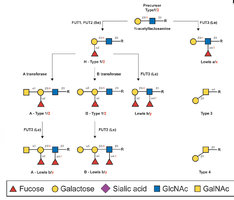
Blood Type Genetics and Co-Dominance
The inheritance of blood types in humans is a classic example of co-dominance and multiple alleles. The ABO blood group system is determined by the presence of different glycoproteins on the surface of red blood cells, encoded by the I gene. There are three main alleles: IA, IB, and i. The IA and IB alleles are co-dominant, meaning both can be expressed if present, while the i allele is recessive.
Co-dominance: Both IA and IB alleles are expressed in individuals with genotype IAIB, resulting in AB blood type.
Multiple alleles: More than two alleles exist for the blood type gene, leading to four possible phenotypes: A, B, AB, and O.
Immune response: Receiving the wrong blood type can trigger an immune reaction, causing destruction of infused blood cells and potential blockages.
Genetic selection: Certain blood types confer resistance or susceptibility to diseases (e.g., O type gives resistance to malaria but higher risk for cholera).
Example: A person with genotype IAIB will have AB blood type, expressing both A and B glycoproteins.
Incomplete Dominance: Curly Hair Trait
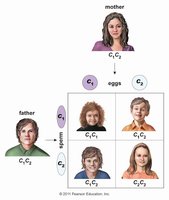
Incomplete dominance occurs when the phenotype of heterozygotes is intermediate between those of the two homozygotes. In humans, curly hair is an example of an incompletely dominant trait.
Genotype and phenotype: If C1 represents the allele for curly hair and C2 for straight hair, individuals with genotype C1C2 have wavy hair.
Punnett square: Used to predict offspring phenotypes from parental genotypes.
Mendelian Genetics and Gene Mapping
Gene Linkage and Independent Assortment
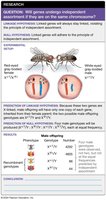
Genes located on the same chromosome may be inherited together, a phenomenon known as genetic linkage. However, crossing over during meiosis can separate linked genes, allowing for independent assortment.
Linked genes: Genes close together on a chromosome tend to be inherited as a group.
Crossing over: Exchange of genetic material between homologous chromosomes during meiosis I can break linkage.
Mapping genes: The frequency of crossing over is used to estimate the distance between genes on a chromosome.
Monohybrid and Dihybrid Crosses
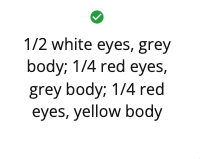
Monohybrid crosses involve a single gene, while dihybrid crosses involve two genes. The expected ratios of offspring phenotypes depend on whether the genes are linked or assort independently.
Monohybrid cross: Examines inheritance of one trait.
Dihybrid cross: Examines inheritance of two traits simultaneously.
Example: In fruit flies, crossing individuals with different eye and body color alleles can yield various phenotypic ratios.
DNA Fingerprinting and Biotechnology
Short Tandem Repeats (STRs) and DNA Fingerprinting
Short tandem repeats (STRs) are repetitive DNA sequences used in DNA fingerprinting to identify individuals and their relationships. STR analysis is a powerful tool in forensic science and genetic studies.
STRs: Short, repeated sequences of DNA found at specific loci in the genome.
DNA fingerprinting: Comparison of STR patterns between individuals to establish identity or kinship.
Polymerase Chain Reaction (PCR)
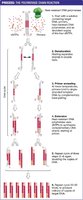
The polymerase chain reaction (PCR) is a technique used to amplify specific DNA sequences, making millions of copies from a small initial sample. PCR is essential for genetic analysis, cloning, and diagnostics.
Steps in PCR:
Denaturation: DNA strands are separated by heating.
Annealing: Primers bind to target sequences.
Extension: DNA polymerase synthesizes new DNA strands.
Applications: Used in DNA fingerprinting, disease diagnosis, and genetic research.
CRISPR-Cas9 Genome Editing and Gene Therapy
CRISPR-Cas9 Genome Editing
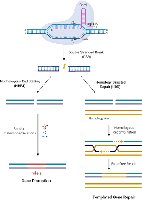
CRISPR-Cas9 is a revolutionary genome editing tool that allows for precise modifications of DNA. It can create insertions or deletions (indels), correct mutations, or introduce new genes.
Mechanism: Cas9 enzyme, guided by RNA, cuts DNA at specific sites. Repair mechanisms can introduce changes.
Applications: Used to study gene function, treat genetic diseases, and develop gene therapies.
Indels: Small insertions or deletions can disrupt gene function, often leading to loss-of-function mutations.
Gene Therapy in Humans
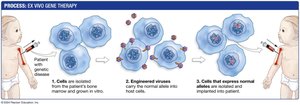
Gene therapy aims to treat genetic diseases by correcting defective genes. It is easier to fix diseases caused by loss-of-function alleles than those caused by gain-of-function mutations. Viruses are often used to deliver therapeutic genes to cells.
Ex vivo gene therapy: Cells are removed, genetically modified, and returned to the patient.
Challenges: Gain-of-function mutations (e.g., BCL2 translocation) are harder to correct.
CRISPR Gene Editing for Sickle Cell Disease
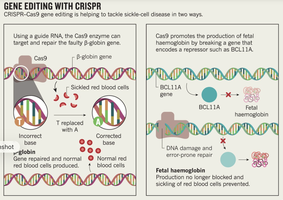
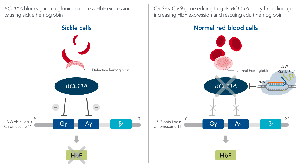
CRISPR-Cas9 is being used to treat sickle cell disease by editing the beta-globin gene. Two main strategies are employed: correcting the mutation or promoting fetal hemoglobin production by disrupting a repressor gene.
Correction: Cas9 replaces the incorrect base in the beta-globin gene, restoring normal hemoglobin.
Fetal hemoglobin: Editing the BCL11A gene increases fetal hemoglobin, reducing sickling of red blood cells.
Tandem Duplication of Beta-Globin Genes
Humans have tandem duplication of the beta-globin genes, which is relevant for understanding sickle cell disease and gene editing strategies.
Beta-globin gene cluster: Multiple copies of the gene exist, allowing for complex regulation and therapeutic targeting.
Summary Table: Key Concepts in Genetics and Biotechnology
Concept | Definition | Example/Application |
|---|---|---|
Co-dominance | Both alleles are fully expressed in heterozygotes | AB blood type |
Incomplete dominance | Heterozygote phenotype is intermediate | Wavy hair (C1C2 genotype) |
Gene linkage | Genes close together on a chromosome are inherited together | Eye and body color in fruit flies |
STRs | Short, repeated DNA sequences used for identification | DNA fingerprinting |
PCR | Amplifies DNA sequences | Genetic testing |
CRISPR-Cas9 | Genome editing tool | Gene therapy for sickle cell disease |
Gene therapy | Correction of defective genes | Ex vivo therapy for genetic diseases |
Additional info: Academic context was added to clarify the mechanisms of gene mapping, PCR, CRISPR, and gene therapy, as well as to provide definitions and examples for key genetic concepts.
