 Back
Genetics, Genes, and Chromosomes: Mendelian and Extended Patterns of Inheritance
Study Guide - Smart Notes
 Tailored notes based on your materials, expanded with key definitions, examples, and context.
Genetics, Genes & Chromosomes
Introduction to Genetics
Genetics is the study of heredity and the variation of inherited characteristics. The transmission of traits from one generation to the next is governed by genes, which are segments of DNA that specify traits. Offspring inherit genes from their parents, but are not identical, demonstrating variation due to the combination of alleles.
Heredity/Inheritance: The process by which traits are passed from parents to offspring.
Variation: Differences among individuals in a population.
Gene: A unit of heredity; a segment of DNA that codes for a specific trait.
Gregor Mendel and the Pea Plant Model
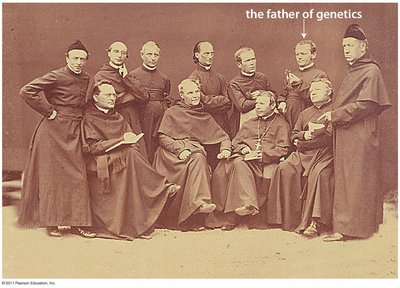
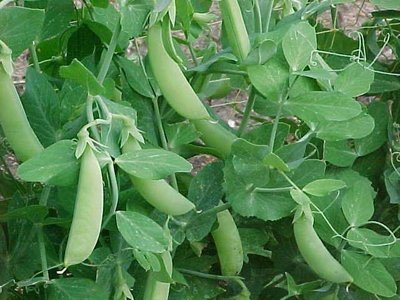
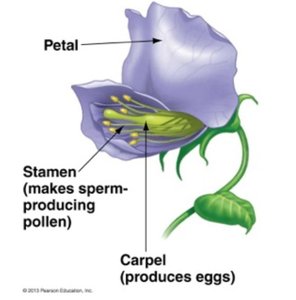
Gregor Mendel, often called the "father of genetics," conducted pioneering experiments in the 1800s using pea plants (Pisum sativum) to study inheritance. Pea plants were ideal for genetic studies because they self-fertilize, have a short generation time, produce many offspring, and exhibit clear variations in traits.
Model Organism: Pea plants were used due to their ease of breeding and observable traits.
Characteristic: A measurable or observable feature of an organism (e.g., flower color).
Trait: A variant of a characteristic (e.g., purple or white flowers).
Mendelian Experiments and Generations
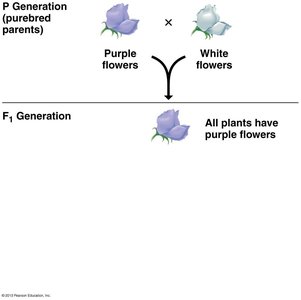
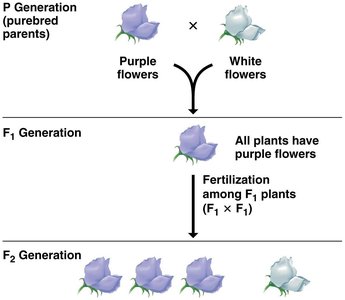
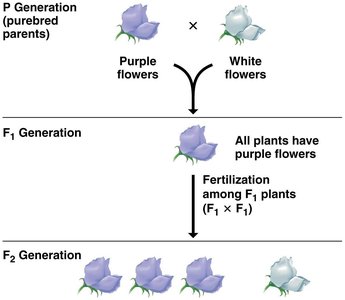
Mendel performed controlled crosses between pea plants to study inheritance patterns. He distinguished between parental (P), first filial (F1), and second filial (F2) generations.
P Generation: Purebred parents (e.g., purple x white flowers).
F1 Generation: Hybrid offspring, all showing the dominant trait.
F2 Generation: Offspring from self-fertilized F1 plants, showing a characteristic ratio of traits.
Traits and Characteristic Ratios
Mendel observed that traits in the F2 generation appeared in predictable ratios, most commonly 3:1 for dominant to recessive traits. This led to the formulation of Mendel's laws.
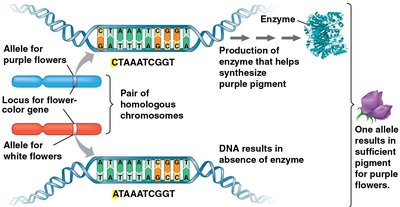
Dominant allele: Determines appearance (e.g., purple flowers).
Recessive allele: No impact on appearance when dominant allele is present (e.g., white flowers).
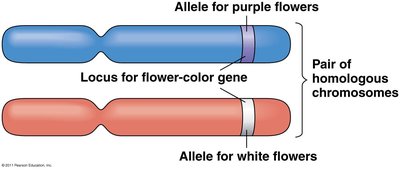
Allele: Different versions of a gene.
Mendel’s Laws of Inheritance
Law of Segregation
Each individual inherits two alleles for each gene, one from each parent. During gamete formation (meiosis), allele pairs segregate so that each gamete receives only one allele.
Phenotype: Observable trait (e.g., flower color).
Genotype: Genetic makeup (e.g., PP, Pp, pp).
Homozygous: Two identical alleles (e.g., PP or pp).
Heterozygous: Two different alleles (e.g., Pp).
Law of Independent Assortment
Genes for different traits assort independently during gamete formation, provided they are on different chromosomes or far apart on the same chromosome. This law explains the inheritance of multiple traits.
Dihybrid Cross: A cross involving two traits.
Independent Assortment: Genes are inherited independently of one another.
Probability in Genetics
Mendelian inheritance follows the laws of probability. The likelihood of inheriting a particular allele or genotype can be calculated using the law of multiplication and law of addition.
Law of Multiplication: Probability of two independent events occurring together is the product of their probabilities.
Law of Addition: Probability of either of two mutually exclusive events occurring is the sum of their probabilities.
Punnett Squares and Genetic Problem Solving
Punnett squares are used to predict the probability of offspring genotypes and phenotypes based on parental genotypes.
Symbols: Use one letter per characteristic; capital for dominant, lowercase for recessive.
Parental Genotypes: Record known genotypes and leave blanks for unknowns.
Punnett Square: Visual tool for calculating probabilities.
Complex Patterns of Inheritance
Incomplete Dominance
In incomplete dominance, the heterozygote phenotype is intermediate between the two homozygotes. For example, crossing red and white flowers may produce pink offspring.
Example: CRCR (red), CWCW (white), CRCW (pink).
Codominance
In codominance, both alleles are equally expressed in the phenotype. An example is blood type, where A and B alleles are codominant.
Multiple Alleles: More than two alleles exist for a gene (e.g., blood types: A, B, O).
Pleiotropy
Pleiotropy occurs when one gene affects multiple traits.
Polygenic Inheritance
Polygenic traits are controlled by multiple genes, resulting in continuous variation (e.g., height, skin color).
Epistasis
Epistasis is when the expression of one gene alters the expression of another gene at a different locus.
Human Disorders and Mendelian Patterns
Many human disorders follow Mendelian inheritance patterns, such as albinism (recessive) and achondroplasia (dominant).
Carrier: Heterozygote carrying a recessive allele without expressing the phenotype.
Chromosomal Basis of Inheritance
Mendelian inheritance has its physical basis in the behavior of chromosomes during meiosis. Thomas Hunt Morgan provided the first solid evidence associating specific genes with specific chromosomes using fruit flies.
Sex Chromosomes: Determine biological sex (X and Y in humans and fruit flies).
Autosomes: All other chromosomes.
Sex-Linked Genes
Genes located on sex chromosomes are called sex-linked genes. X-linked traits are more commonly expressed in males because they have only one X chromosome.
Examples: Color-blindness, Duchenne muscular dystrophy, hemophilia.
Linked Genes and Crossing Over
Genes located close together on the same chromosome tend to be inherited together (linked genes). Crossing over during meiosis can break linkage and create recombinant chromosomes, leading to new allele combinations.
Recombination Frequency: Used to create linkage maps and estimate distances between genes.
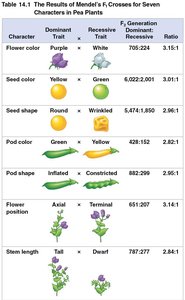
Summary Table: Mendel's F1 Crosses for Seven Characters
The table below summarizes Mendel's results for seven pea plant traits, showing dominant and recessive traits and their characteristic ratios.
Character | Dominant Trait | Recessive Trait | F1 Generation Ratio |
|---|---|---|---|
Flower color | Purple | White | 3.15:1 |
Seed color | Yellow | Green | 3.01:1 |
Seed shape | Round | Wrinkled | 2.96:1 |
Pod color | Green | Yellow | 2.82:1 |
Pod shape | Inflated | Constricted | 2.56:1 |
Flower position | Axial | Terminal | 3.14:1 |
Stem length | Tall | Dwarf | 2.84:1 |
Genetic Vocabulary
Allele: Variant form of a gene.
Genotype: Genetic constitution of an organism.
Phenotype: Observable characteristics.
Homozygous: Two identical alleles.
Heterozygous: Two different alleles.
Dominant: Allele that masks the effect of another.
Recessive: Allele whose effect is masked.
Key Equations
Law of Proportions: Probability of a gamete containing either allele:
Law of Multiplication: Probability of a zygote with a specific genotype:
Law of Addition: Probability of a phenotype (e.g., PP or Pp):
Applications and Practice Problems
Predicting offspring genotypes and phenotypes using Punnett squares.
Determining unknown genotypes with testcrosses.
Solving dihybrid cross problems and calculating expected ratios.
Analyzing inheritance patterns in humans and animals.
Additional info: These notes cover Mendelian genetics, extended inheritance patterns, and the chromosomal basis of inheritance, directly relevant to General Biology topics such as Mendelian Genetics, Gene Expression, Regulation of Expression, and Chromosomes.
