 Back
Genetics I: Principles of Heredity and Mendelian Genetics
Study Guide - Smart Notes
 Tailored notes based on your materials, expanded with key definitions, examples, and context.
Genetics: The Study of Heredity
Introduction to Genetics
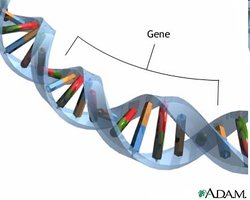
Genetics is the branch of biology concerned with the study of heredity and variation in organisms. The genes inherited from our parents determine the traits we exhibit, such as eye color, hair color, and certain inherited diseases.
Gene: A segment of DNA that carries instructions for making specific proteins, which influence traits.
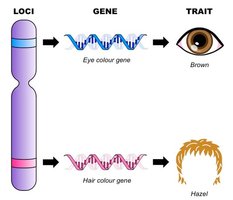
Trait: A characteristic determined by a gene, such as eye color or hair texture.
Heredity: The passing of traits from parents to offspring.
Genetics: The scientific study of heredity and variation.
Genes and Chromosomes
Gene Locus and Chromosome Structure
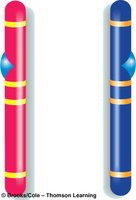
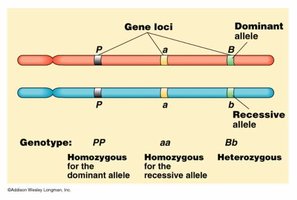
Each gene occupies a specific location, or locus, on a chromosome. The locus for a gene is consistent among individuals, meaning the gene for a particular trait (e.g., eye color) is found at the same position on the same chromosome in all humans.
Locus: The fixed position on a chromosome where a gene resides.
Chromosome: A DNA molecule with part or all of the genetic material of an organism.
Human Chromosomes: Autosomes and Sex Chromosomes
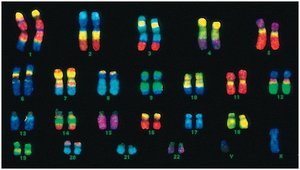
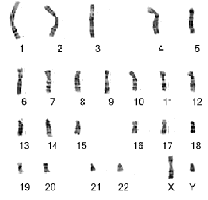
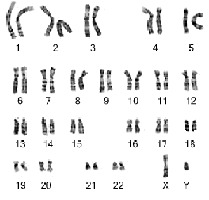
Humans have 23 unique chromosomes, organized into two sets (one from each parent). These include 22 pairs of autosomes and one pair of sex chromosomes (XX for females, XY for males).
Autosomes: Chromosomes not involved in determining sex (pairs 1-22).
Sex Chromosomes: Chromosomes that determine biological sex (X and Y).
Homologous Chromosomes: Chromosome pairs that carry the same genes but may have different alleles.
Diploid and Haploid Cells
Somatic cells are diploid (2n), containing two sets of chromosomes, while gametes (sperm and egg cells) are haploid (n), containing one set.
Diploid (2n): Cells with two sets of chromosomes (somatic cells).
Haploid (n): Cells with one set of chromosomes (gametes).
Alleles and Genetic Variation
Alleles and Homologous Chromosomes
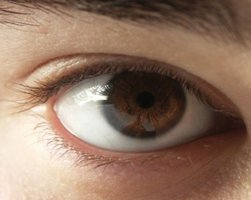
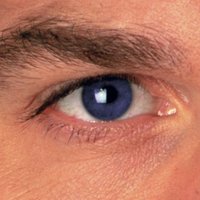
Homologous chromosomes carry the same genes, but the versions of those genes, called alleles, may differ. For example, the gene for eye color may have a brown or blue allele.
Allele: A variant form of a gene.
Genetic Variation: Differences in alleles among individuals, leading to different traits.
Dominance of Alleles
When two alleles for a gene are different, the dominant allele is expressed in the phenotype, while the recessive allele is masked unless both alleles are recessive.
Dominant Allele: Expressed when present; denoted by a capital letter (e.g., E for brown eyes).
Recessive Allele: Expressed only when both alleles are recessive; denoted by a lowercase letter (e.g., e for blue eyes).
Genotype and Phenotype
Definitions and Examples
The genotype is the combination of alleles an individual has for a particular gene, while the phenotype is the observable trait.
Genotype: EE, Ee, or ee for eye color.
Phenotype: Brown eyes (EE or Ee), Blue eyes (ee).
Homozygous: Two identical alleles (EE or ee).
Heterozygous: Two different alleles (Ee).
Genotype-Phenotype Table
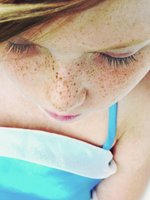
This table summarizes the relationship between genotype and phenotype for a trait such as freckles.
Genotype | Description | Phenotype (Example) |
|---|---|---|
FF | Homozygous dominant | Freckles |
Ff | Heterozygous | Freckles |
ff | Homozygous recessive | No freckles |
Mendelian Genetics
Gregor Mendel and Pea Plant Experiments
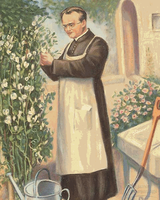
Gregor Mendel, the father of modern genetics, discovered how traits are passed from one generation to the next by experimenting with pea plants. He observed the inheritance of traits such as flower color and quantified the phenotypes of offspring.
Mendel's Model: Alternative versions of genes (alleles) account for variations in inherited characters.
Each organism inherits two copies of a gene, one from each parent.
If the two alleles differ, the dominant allele determines the phenotype.
Mendel's Laws of Heredity
Mendel formulated two fundamental laws:
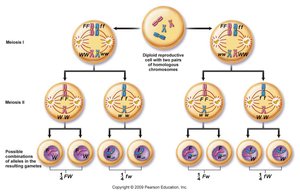
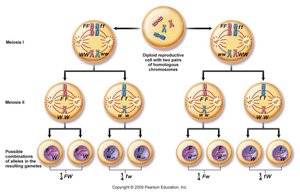
Law of Segregation: During gamete formation, the two alleles for a gene are separated, so each gamete receives only one allele.
Law of Independent Assortment: Alleles of genes for different traits segregate independently during gamete formation if they are on different chromosomes.
Predicting Inheritance: Punnett Squares and Probability
Punnett Squares
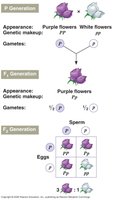
The Punnett square is a grid used to predict the probability of offspring genotypes and phenotypes based on parental alleles.
Rows represent possible gametes from one parent.
Columns represent possible gametes from the other parent.
Boxes show possible genotypes of offspring.
Monohybrid Crosses
A monohybrid cross involves two individuals heterozygous for a trait (e.g., Pp x Pp). The expected genotype ratio is 1:2:1 (PP:Pp:pp), and the phenotype ratio is 3:1 (dominant:recessive).
Genotype Ratio: 1 PP : 2 Pp : 1 pp
Phenotype Ratio: 3 dominant : 1 recessive
Genetic Disorders
Recessive Genetic Disorders
Recessive disorders are only expressed in individuals who are homozygous recessive for the faulty allele. Examples include albinism, cystic fibrosis, and sickle-cell disease.
Carrier: Heterozygous individuals who do not express the disorder but can pass the allele to offspring.
Albinism: Caused by a faulty allele (a) resulting in no melanin production.
Genotype | Phenotype |
|---|---|
AA | Normal pigmentation |
Aa | Normal pigmentation (carrier) |
aa | Albino |
Dominant Genetic Disorders
Dominant disorders are expressed if the individual has at least one dominant allele. Examples include achondroplasia (dwarfism), polydactyly (extra fingers/toes), and Huntington's disease.
Achondroplasia: Dwarfism caused by dominant allele (D).
Polydactyly: Extra fingers or toes.
Huntington's Disease: Degenerative brain disease manifesting later in life.
Genotype | Phenotype |
|---|---|
DD | Dwarf stature |
Dd | Dwarf stature |
dd | Normal stature |
Pedigrees and Inheritance Patterns
Pedigree Analysis
A pedigree is a chart that shows genetic relationships among family members and is used to analyze inheritance patterns, especially for recessive alleles masked in heterozygotes.
Dominant Trait Pedigree: Affected individuals have at least one affected parent; phenotype appears every generation.
Recessive Trait Pedigree: Unaffected parents can have affected offspring; phenotype may skip generations.
Pedigree Type | Pattern |
|---|---|
Dominant | Affected individuals have at least one affected parent; appears every generation |
Recessive | Unaffected parents can have affected offspring; may skip generations |
Solving Genetic Problems
Using Punnett Squares and Pedigrees
To solve genetic problems, determine the genotypes of the parents, set up a Punnett square, and analyze the probability of offspring genotypes and phenotypes. Pedigrees help track inheritance patterns across generations.
Identify parental genotypes based on phenotype and family history.
Use Punnett squares to predict offspring ratios.
Apply Mendel's laws to explain observed patterns.
Key Equations and Concepts
Probability in Genetics
The probability of inheriting a particular genotype or phenotype can be calculated using Mendelian ratios and Punnett squares.
Probability of genotype: for homozygous recessive in a monohybrid cross (Pp x Pp).
Probability of phenotype: dominant, recessive in a monohybrid cross.
Example Equation:
Additional info: These ratios are derived from Mendel's laws and the setup of Punnett squares.
