 Back
Genetics Problem Set #5 Study Guidance – Bacterial Genetics, Chromosomal Rearrangements, and DNA Repair
Study Guide - Smart Notes
 Tailored notes based on your materials, expanded with key definitions, examples, and context.
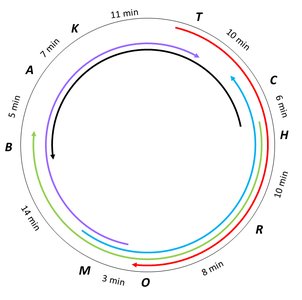
Q3. Draw a map of the bacterial chromosome based on the orders of gene entry and recombination from five different Hfr strains. Include: (a) the position of each gene, (b) the distance between each gene, (c) the position of the oriT for each Hfr strain, and (d) the direction of transfer for each Hfr strain.
Background
Topic: Bacterial Genetics – Chromosome Mapping by Conjugation
This question tests your understanding of how interrupted mating experiments with Hfr strains are used to map the order and relative distances of genes on the E. coli chromosome. It also asks you to interpret the direction and origin of transfer (oriT) for each strain, which helps reveal the circular nature of the bacterial chromosome.
Key Terms and Concepts:
Hfr strain: A bacterial cell with the F factor integrated into its chromosome, allowing transfer of chromosomal genes during conjugation.
oriT: Origin of transfer; the site where DNA transfer begins during conjugation.
Interrupted mating: Technique to stop conjugation at intervals, revealing the order and timing of gene transfer.
Gene mapping: Determining the order and relative distances of genes based on time of entry.
Direction of transfer: The path along the chromosome that DNA is transferred from donor to recipient.
Step-by-Step Guidance
Review the time-of-entry data for each Hfr strain. Each strain starts transfer at a different oriT and proceeds in a specific direction, transferring genes in a unique order.
For each strain, list the genes in the order they are transferred and note the time intervals between them. This will help you estimate the relative distances between genes.
Overlay the gene orders from all five strains to deduce the overall gene map. Look for overlapping regions and consistent gene orders to infer the circular chromosome structure.
Mark the oriT for each strain on your map and indicate the direction of transfer with arrows. Use color coding if helpful to distinguish each strain's path.
Calculate the approximate distances between genes based on the time intervals. Remember that the time reflects the physical distance along the chromosome.
Stop here and try to construct the map yourself using the data provided. Use the image below to visualize the circular chromosome and the paths of gene transfer.
Try solving on your own before revealing the answer!
Final Answer:
The map of the E. coli chromosome is circular, with genes positioned according to the time-of-entry data. Each Hfr strain has a unique oriT and direction of transfer, as shown in the image. The distances between genes are proportional to the time intervals. The overlapping paths confirm the chromosome's circular nature.
Refer to the image for the gene positions, oriT locations, and transfer directions. The color-coded arrows represent the five Hfr strains, and the minute marks indicate the relative distances between genes.
Q11. Draw the steps of the following repair mechanisms: (a) Synthesis-dependent strand annealing (SDSA), (b) Homologous recombination (HR) with a crossover resolution.
Background
Topic: DNA Repair – Double-Strand Break Repair Mechanisms
This question tests your understanding of two high-fidelity repair pathways for double-strand breaks in DNA: SDSA and HR with crossover. You are asked to illustrate the steps involved in each mechanism.
Key Terms and Concepts:
SDSA (Synthesis-Dependent Strand Annealing): A repair pathway where the invading strand is extended and then displaced to anneal with the complementary strand, resulting in non-crossover products.
Homologous recombination (HR): A repair pathway that can result in crossover or non-crossover products, involving strand invasion, DNA synthesis, and resolution of Holliday junctions.
Double-strand break (DSB): A type of DNA damage requiring repair by recombination.
Holliday junction: A cross-shaped structure formed during HR that can be resolved to produce crossover or non-crossover products.
Step-by-Step Guidance
For SDSA: Start with a double-strand break. The broken ends are processed to produce single-stranded DNA.
One strand invades a homologous template, forming a D-loop. DNA synthesis extends the invading strand.
The newly synthesized strand is displaced and anneals with the complementary strand on the other side of the break. Synthesis completes the repair.
For HR with crossover: After strand invasion and D-loop formation, both ends are engaged, and DNA synthesis occurs across the gap.
Holliday junctions are formed and resolved, resulting in crossover products. Try to follow the steps in the images below to visualize the process.
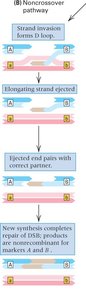
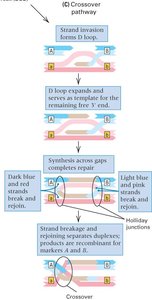
Try solving on your own before revealing the answer!
Final Answer:
(a) SDSA involves strand invasion, DNA synthesis, strand displacement, and annealing to the complementary strand, resulting in non-crossover repair. (b) HR with crossover involves strand invasion, D-loop expansion, synthesis across gaps, formation and resolution of Holliday junctions, and results in crossover products. The diagrams above illustrate each step.
