 Back
Genetics Review: Pedigree Analysis and Mendelian Genetics
Study Guide - Smart Notes
 Tailored notes based on your materials, expanded with key definitions, examples, and context.
Q16. The following pedigree tracks a recessive condition (r).
Background
Topic: Pedigree Analysis & Mendelian Genetics
This question tests your ability to interpret a pedigree chart to determine genotypes and predict the probability of inheriting a recessive genetic condition. Pedigrees are visual representations of family relationships and the inheritance of traits across generations.
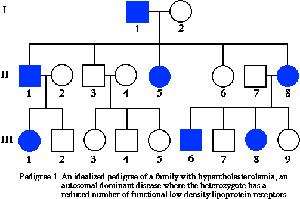
Key Terms and Concepts:
Pedigree: A diagram that shows the occurrence and appearance of phenotypes of a particular gene or organism and its ancestors.
Recessive allele (r): An allele that only expresses its phenotype when two copies are present (homozygous recessive).
Carrier: An individual who has one dominant and one recessive allele (heterozygous) and does not show the trait but can pass it on.
Genotype: The genetic makeup of an individual (e.g., RR, Rr, rr).
Phenotype: The observable trait (e.g., affected or unaffected).
Step-by-Step Guidance
Examine the pedigree chart and identify which individuals are affected by the recessive condition (usually shaded shapes).
Recall that affected individuals must have the genotype (homozygous recessive).
Unaffected individuals could be either (homozygous dominant) or (heterozygous carriers). If they have affected children, they must be carriers ($Rr$).
For part (a), use the information from the pedigree to deduce the genotypes of individuals I-1 and I-2 based on their offspring's phenotypes.
For part (b), set up a Punnett square to determine the probability that a child of III-8 (whose genotype you deduced) and a carrier will inherit the condition.
Try solving on your own before revealing the answer!
Final Answer:
For part (a): I-1 and I-2 are both likely carriers () because they have affected children.
For part (b): The probability that their child will have the condition is 25% () based on the Punnett square between III-8 (Rr) and a carrier (Rr).
This is because each parent can pass either the dominant or recessive allele, and only the combination results in the condition.
