 Back
BackGenome Size, Gene Number, and Gene Density in Prokaryotes and Eukaryotes
Study Guide - Smart Notes
 Tailored notes based on your materials, expanded with key definitions, examples, and context.
Genome Size and Gene Number
Overview of Genome Projects
Genome sequencing projects have cataloged the genetic material of thousands of organisms, ranging from bacteria to humans. As of 2023, tens of thousands of genomes have been sequenced, including both complete and draft genomes, as well as metagenomes (collections of genetic material from environmental samples).
Draft genomes are incomplete but provide valuable genetic information.
Metagenomes help study genetic diversity in complex environments.
Example: The Genomes Online Database (GOLD) tracks the progress of genome sequencing projects worldwide.
Genome Size in Prokaryotes and Eukaryotes
Genome size is typically measured in millions of base pairs (Mb). There is a wide range of genome sizes among different organisms:
Bacteria: Genome sizes usually range from 1 to 6 Mb. For example, Escherichia coli has a genome size of 4.6 Mb.
Archaea: Genome sizes are similar to bacteria, such as Archaeoglobus fulgidus with 2.2 Mb.
Eukaryotes: Genome sizes are much larger and more variable. For instance, the yeast Saccharomyces cerevisiae has a 12 Mb genome, while the human genome is about 3,200 Mb.
There is no simple correlation between genome size and organism complexity.
Gene Number and Gene Density
The number of genes in an organism's genome does not always correlate with its complexity. Prokaryotes typically have fewer genes than eukaryotes, but gene density (genes per Mb) is much higher in prokaryotes.
Prokaryotes: Usually have 1,500–7,500 genes. Gene density is high because most DNA codes for proteins or functional RNAs.
Eukaryotes: Gene numbers range from about 5,000 in unicellular eukaryotes to over 40,000 in some multicellular organisms. However, gene density is lower due to the presence of noncoding DNA.
Example: The human genome contains about 20,000 genes, but alternative splicing and regulatory sequences allow for the production of many more proteins.
Gene Density and Noncoding DNA
Gene Density
Gene density refers to the number of genes per million base pairs (Mb) of DNA. Prokaryotic genomes are gene-dense, while eukaryotic genomes contain large amounts of noncoding DNA.
In bacteria, most DNA codes for proteins, tRNAs, or rRNAs.
Noncoding regions in prokaryotes are mainly regulatory sequences (e.g., promoters).
In eukaryotes, a significant portion of DNA is noncoding, including introns and regulatory elements.
Noncoding DNA
Noncoding DNA includes sequences that do not code for proteins or functional RNAs. In eukaryotes, these regions can play important roles in gene regulation and genome structure.
Introns: Noncoding sequences within genes that are removed during RNA processing.
Regulatory elements: Control gene expression and can be located far from the genes they regulate.
Some noncoding DNA is transcribed into noncoding RNAs with regulatory or structural functions.
Genome Complexity and Alternative Splicing
Alternative Splicing
Alternative splicing allows a single gene to produce multiple different proteins by varying the combination of exons included in the final mRNA. This increases protein diversity without increasing gene number.
Vertebrate genomes use alternative splicing extensively.
This mechanism helps explain how humans can produce over 100,000 different polypeptides from about 20,000 genes.
Additional info: Alternative splicing is a key factor in the evolution of complex multicellular organisms, allowing for greater functional diversity from a limited set of genes.
Summary Table: Genome Size, Gene Number, and Gene Density
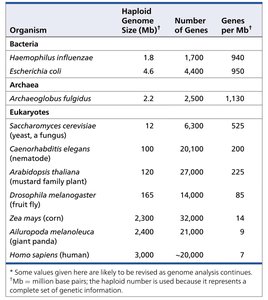
The following table compares the haploid genome size, number of genes, and gene density for selected organisms:
Organism | Haploid Genome Size (Mb) | Number of Genes | Genes per Mb |
|---|---|---|---|
Haemophilus influenzae | 1.8 | 1,700 | 940 |
Escherichia coli | 4.6 | 4,400 | 950 |
Archaeoglobus fulgidus | 2.2 | 2,500 | 1,130 |
Saccharomyces cerevisiae | 12 | 6,300 | 525 |
Caenorhabditis elegans | 100 | 20,100 | 200 |
Arabidopsis thaliana | 120 | 27,000 | 225 |
Drosophila melanogaster | 165 | 14,000 | 85 |
Zea mays | 2,300 | 32,000 | 14 |
Ailuropoda melanoleuca | 2,400 | 21,000 | 9 |
Homo sapiens | 3,200 | ~20,000 | 7 |
Additional info: The table illustrates that gene density decreases as genome size increases, especially in eukaryotes.
