 Back
BackGenomes and Their Evolution: Structure, Function, and Diversity
Study Guide - Smart Notes
 Tailored notes based on your materials, expanded with key definitions, examples, and context.
Genomics & Bioinformatics
Introduction to Genomics
Genomics is the study of the complete set of genes (genome) and their interactions within an organism. The development of high-throughput sequencing technologies has enabled the analysis of entire genomes, generating vast datasets.
Genomics: Investigates the structure, function, evolution, and mapping of genomes.
Bioinformatics: Utilizes computational tools, statistics, and machine learning to manage and interpret large biological datasets.
Applications of Genomics
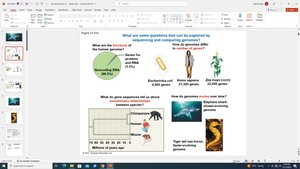
Genomic sequencing allows scientists to answer fundamental questions about gene function, evolutionary relationships, and genetic diversity among species.
Sequencing and Comparing Genomes: Reveals gene functions, evolutionary divergence, and genetic similarities.
Example: Comparison of human, mouse, and bacterial genomes highlights differences in gene number and organization.
A Historical Perspective on Sequencing
Advances in DNA Sequencing
DNA sequencing technology has evolved rapidly, increasing both speed and affordability.
1980s: Labs could sequence ~1000 base pairs (bp) per day.
2003 (Human Genome Project): ~1000 bp per second.
Current (NGS): ~35 million bp per second; individual human genomes can be sequenced in less than 48 hours for ~$1,000.
Shotgun Sequencing
Workflow of Shotgun Sequencing
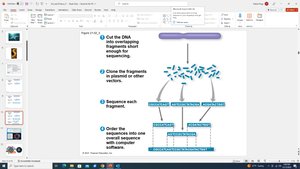
Shotgun sequencing is a method used to sequence entire genomes by randomly breaking DNA into small fragments, sequencing them, and assembling the sequences computationally.
DNA is cut into overlapping fragments.
Fragments are cloned into vectors (traditional method) or directly sequenced (NGS).
Sequences are assembled into a complete genome using software.
Biological Databases
Major Databases and Resources
Large-scale sequencing projects have generated vast amounts of biological data, stored in public databases.
NCBI: National Center for Biotechnology Information, hosts GenBank and other resources.
EMBL: European Molecular Biology Laboratory database.
DNA Databank of Japan, UCSC Genome Browser, Protein Data Bank, ENCODE: Additional key resources for genomics and proteomics.
Proteomics & Systems Biology
Proteome and Protein Interactions
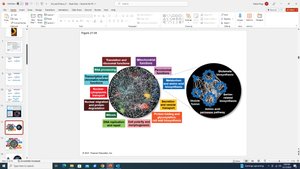
Proteomics studies the entire set of proteins (proteome) produced by an organism, focusing on their interactions and functions.
Proteins interact in complex networks, influencing cellular processes and systems biology.
Systems biology integrates genomics, proteomics, and other data to model biological systems.
Genome Size and Organization
Prokaryotic vs. Eukaryotic Genomes
Eukaryotes generally have much larger genomes than prokaryotes, with more genes and extensive noncoding DNA.
Prokaryotic genome: ~4 Mb, 1500–7500 genes.
Eukaryotic genome: ~3 Gb, 10,000–30,000 genes.
Eukaryotes have lower gene density, longer genes, and large amounts of noncoding DNA (repetitive elements, introns).
Genome Size Variation
Genome sizes vary widely among different groups of organisms.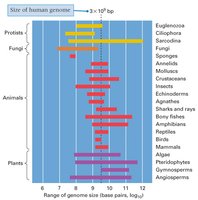
Kilobase (kb): nucleotides
Megabase (Mb): nucleotides
Gigabase (Gb): nucleotides
C-value: DNA content of the haploid genome
Examples of Genome Size
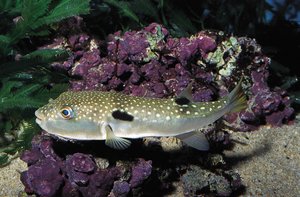
Takifugu rubripes (pufferfish): C = 400 Mb
Amphiuma means (amphiuma): C = 90,000 Mb

Content of a Typical Mammalian Genome
Human Genome Composition
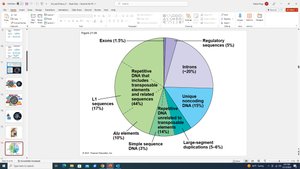
The human genome contains a large proportion of noncoding DNA, much of which has important but not fully understood functions.
Noncoding DNA includes regulatory sequences, introns, repetitive elements, and transposable elements.
Protein-coding sequences make up only about 1.5% of the genome.
Transposable Elements
Definition and Abundance
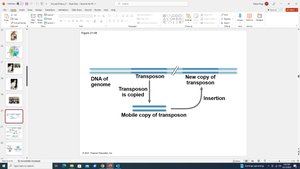
Transposable elements (TEs) are mobile DNA sequences found in all organisms, often comprising a significant portion of the genome.
Make up about 45% of the human genome.
Can insert at many locations, often causing mutations.
Types of Transposons
DNA transposons: Move as DNA, common in prokaryotes, less common in eukaryotes.
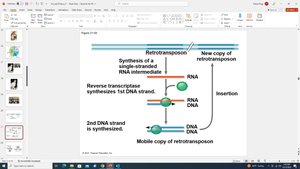
Retrotransposons: Move via an RNA intermediate, common in eukaryotes, require reverse transcriptase.
Transposable Elements and Mutation
Transposition is often mutagenic, frequently causing spontaneous mutations by inserting into or near protein-coding genes.
Cells have evolved mechanisms to regulate and limit transposition.
Repetitive Sequences & Satellite DNA
Satellite DNA
Satellite DNA consists of short, tandemly repeated sequences, often with unusual base composition, and varies widely among eukaryotes.
Can be repeated up to a million times in a haploid genome.
Protein Coding Loci
Gene Families and Duplication
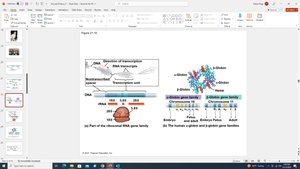
Protein-coding genes are often organized into multigene families, which arise through gene duplication.
Unique sequences and duplicated gene families contribute to genome complexity.
Including introns and regulatory sequences, protein-coding regions account for about 25% of the human genome.
Polyploidy
Definition and Types
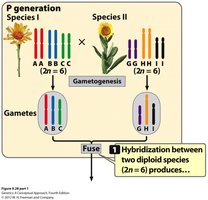
Polyploidy is the condition of having more than two complete sets of chromosomes.
Monoploid: Basic chromosome set.
Haploid: Chromosome set in gametes.
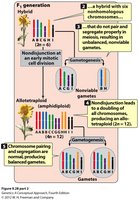
Autopolyploid: Chromosomes from a single species, often due to nondisjunction.
Allopolyploid: Chromosomes from two or more species, typically via hybridization and endoreduplication.
Polyploidy in Plants and Animals
Polyploidy is rare in vertebrates but common in plants due to their ability to self-pollinate and tolerate developmental perturbations.
Genome Evolution: Transposable Elements and Chromosomal Rearrangements
Role of Transposable Elements
Multiple copies of transposable elements can lead to ectopic recombination, causing chromosomal rearrangements.
Gene Duplication and Deletion
Unequal crossing over during meiosis can duplicate or delete genes, contributing to genome evolution.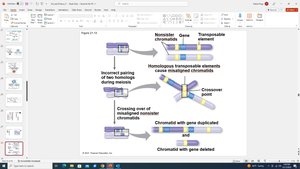
Homology: Orthology vs. Paralogy
Orthologs: Genes in different species that evolved from a common ancestral gene.
Paralogs: Genes within a species that arose by duplication and may acquire new functions.
Chromosome Variation & Evolution
Chromosome Fission and Fusion
Chromosome fission splits a chromosome into parts, while fusion joins two chromosomes. These events can be catastrophic but sometimes result in stably inherited chromosomes.
Variation in chromosome number among eukaryotes is evidence of the importance of these processes.
Human Chromosome 2 and Great Apes
Humans have 23 chromosomes, while other great apes have 24. Human chromosome 2 is a result of a fusion event between two ancestral ape chromosomes.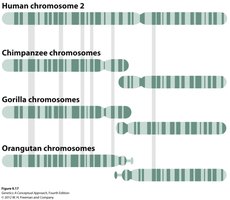
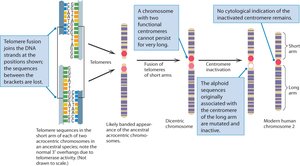
Translocations, Fusions, and Fissions
These chromosomal rearrangements have contributed to the diversity and evolution of eukaryotic genomes.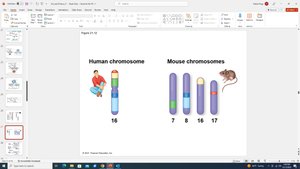
Summary Table: Genome Sizes and Gene Numbers
Comparison Across Organisms
Organism | Genome Size (Mb) | Estimated Number of Genes |
|---|---|---|
Bacteria | 0.6–10 | 500–5,000 |
Archaea | 0.5–5.8 | 1,500–3,000 |
Fungi | 10–60 | 6,000–12,000 |
Plants | 120–23,000 | 20,000–60,000 |
Animals | 130–3,000 | 15,000–30,000 |
Humans | 3,200 | ~20,000 |
Key Terms
Genome: The complete set of genetic material in an organism.
Gene: A segment of DNA that codes for a protein or functional RNA.
Transposon: A mobile genetic element that can change its position within the genome.
Polyploidy: The condition of having more than two sets of chromosomes.
Ortholog: Homologous gene in different species.
Paralog: Homologous gene within the same species, resulting from duplication.
