 Back
BackGenomics and DNA Sequencing: The Human Genome Project and Modern Techniques
Study Guide - Smart Notes
 Tailored notes based on your materials, expanded with key definitions, examples, and context.
Genomics and the Human Genome Project
Introduction to Genomics
Genomics is the comprehensive study of whole sets of genes and their interactions within and between species. The field has rapidly advanced due to the development of high-throughput DNA sequencing technologies, which generate vast amounts of genetic data. The management and analysis of this data have given rise to bioinformatics, which applies computational methods to biological questions.
Genomics: The study of entire genomes, including the complete set of DNA within a single cell of an organism.
Bioinformatics: The use of computer technology to collect, analyze, and interpret biological data, especially genetic sequences.
Applications: Understanding genetic diseases, evolutionary biology, and personalized medicine.
The Human Genome Project
Goals and Achievements
The Human Genome Project (HGP) was an international scientific effort launched in 1990 to sequence the entire human genome. The project was largely completed in 2003, with further refinements published in 2022. The HGP provided a reference genome, which is a representative DNA sequence for the human species.
Reference Genome: A consensus DNA sequence assembled from a small group of individuals, used as a standard for genetic studies.
Pangenome: A composite genome sequence that incorporates genetic diversity from multiple individuals, allowing for the identification of medically and evolutionarily significant variations.
Challenges: Sequencing repetitive DNA regions and representing global genetic diversity.
Approaches to DNA Sequencing
Whole-Genome Shotgun Sequencing
The whole-genome shotgun approach is a widely used method for sequencing entire genomes. It involves randomly breaking DNA into small fragments, sequencing each fragment, and then using computer algorithms to assemble the overlapping sequences into a continuous genome sequence.
Step 1: Cut the DNA from many copies of an entire chromosome into overlapping fragments short enough for sequencing.
Step 2: Clone the fragments in plasmids or other vectors.
Step 3: Sequence each fragment individually.
Step 4: Use computer software to order the sequences into one overall sequence by finding overlaps.
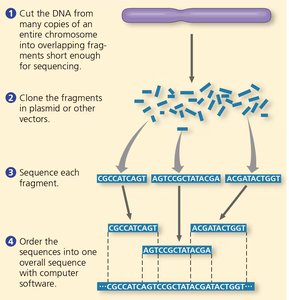
Key Point: The random fragmentation and subsequent computational assembly allow for efficient sequencing of large and complex genomes.
Sequencing by Synthesis and Technological Advances
Modern sequencing techniques, such as sequencing by synthesis, have dramatically increased the speed and reduced the cost of genome sequencing. These methods enable the parallel sequencing of millions of DNA fragments, further accelerating genomic research.
Sequencing by Synthesis: A method where DNA polymerase incorporates nucleotides into a growing DNA strand, and each incorporated nucleotide is detected in real time.
Impact: Enables rapid and cost-effective sequencing of entire genomes.
Metagenomics
Studying Communities of Organisms
Metagenomics is the analysis of genetic material recovered directly from environmental samples. This approach allows scientists to study the collective genomes (metagenomes) of microbial communities without the need to culture individual species in the laboratory.
Process: DNA is extracted from an environmental sample, sequenced, and then sorted and assembled using computational tools.
Advantages: Enables the study of complex microbial communities, such as those in soil, water, or the human gut, that are difficult or impossible to culture in the lab.
Applications: Discovery of new genes, understanding ecosystem functions, and identifying novel enzymes or metabolic pathways.
Data Analysis in Genomics
Bioinformatics and Genome Assembly
The vast amount of data generated by genome sequencing requires sophisticated computational tools for assembly, annotation, and interpretation. Bioinformatics is essential for transforming raw sequence data into meaningful biological insights.
Genome Assembly: The process of piecing together short DNA sequences into longer, continuous sequences representing chromosomes.
Annotation: Identifying genes, regulatory elements, and other functional regions within the genome.
Visualizing Shotgun Sequencing
Fragmentation and Assembly
The shotgun sequencing process involves generating many short DNA sequences, which are then computationally assembled into a complete genome. The following image illustrates the random nature of DNA fragmentation and the resulting sequence data.
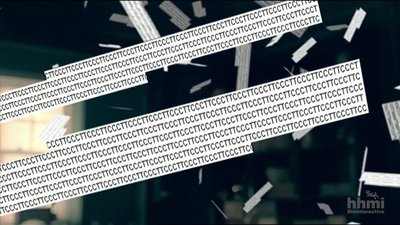
Key Point: The randomness of fragmentation is a defining feature of the shotgun approach, requiring powerful software to reconstruct the original sequence from overlapping fragments.
Summary Table: DNA Sequencing Approaches
Approach | Description | Advantages | Limitations |
|---|---|---|---|
Whole-Genome Shotgun | Randomly fragments DNA, sequences each piece, and assembles the genome computationally | Fast, scalable, suitable for large genomes | Requires advanced computational tools; repetitive regions can be challenging |
Sequencing by Synthesis | Parallel sequencing of millions of fragments using real-time detection | High throughput, cost-effective | Short read lengths may complicate assembly |
Metagenomics | Sequences DNA from entire communities in environmental samples | Studies unculturable organisms, reveals community structure | Complex data analysis, potential for incomplete assemblies |
Concept Check
Describe the whole-genome shotgun approach. The whole-genome shotgun approach involves randomly breaking the genome into small fragments, sequencing each fragment, and using computational methods to assemble the overlapping sequences into a complete genome.
What are some advantages of sequencing metagenomes? When is this approach more effective than sequencing single genomes? Metagenomics allows for the study of entire microbial communities without the need for culturing individual species. It is especially effective for analyzing environments with high microbial diversity or where many organisms cannot be cultured in the lab.
