 Back
BackGreen Algae and Land Plants: Evolution, Diversity, and Adaptations
Study Guide - Smart Notes
 Tailored notes based on your materials, expanded with key definitions, examples, and context.
Green Algae and Land Plants
Introduction to Viridiplantae
The Viridiplantae, or green plants, encompass both green algae and land plants. Green algae are crucial photosynthetic organisms in freshwater habitats, while land plants are the primary photosynthesizers in terrestrial environments. The evolutionary transition from aquatic green algae to terrestrial land plants marked a pivotal event in Earth's history, enabling the colonization of land by complex life forms.
Why Study Green Algae and Land Plants?
Ecological Importance: Green plants are foundational to terrestrial and aquatic ecosystems, providing oxygen, food, and habitat.
Human Dependence: Plants are essential for food, fuel, fibers, building materials, and pharmaceuticals.
Economic Impact: Agriculture, forestry, and horticulture are major industries based on plants.
Challenges: Some plants are problematic as weeds or invasive species, impacting crop productivity and natural habitats.
Evolution and Diversification of Land Plants
Analyzing Morphological Traits
Biologists study plant diversification by comparing morphological traits, analyzing the fossil record, and constructing phylogenetic trees. Green algae exhibit a range of forms (unicellular, multicellular, colonial) and inhabit diverse environments, while land plants are primarily terrestrial.
Similarities Between Green Algae and Land Plants
Similar chloroplast structure and thylakoid arrangement
Cell walls, sperm, and peroxisomes are structurally similar
Chloroplasts synthesize starch as a storage product
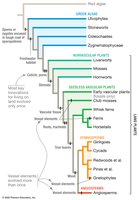
DNA sequence analysis identifies Zygnematophyceae, Coleochaetophyceae, and Charophyceae as closest relatives to land plants
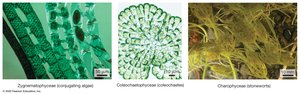
Major Morphological Differences Among Land Plants
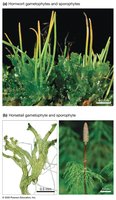
Nonvascular plants: Lack vascular tissue; reproduce via spores (e.g., mosses)
Seedless vascular plants: Have vascular tissue; reproduce via spores (e.g., ferns)
Seed plants: Have vascular tissue and produce seeds (e.g., gymnosperms and angiosperms)
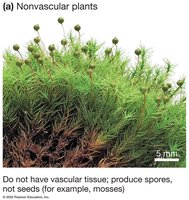
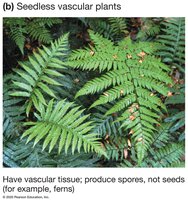
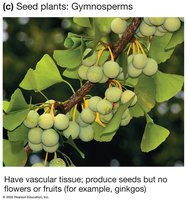
The Fossil Record and Major Evolutionary Events
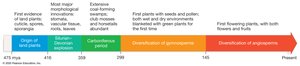
The fossil record reveals five major intervals in land plant evolution:
Origin of land plants (475 mya): Appearance of cuticle, spores, and sporangia
Silurian–Devonian explosion (416–359 mya): Diversification of major lineages and adaptations for terrestrial life
Carboniferous period (359–299 mya): Extensive coal-forming forests dominated by seedless vascular plants
Diversification of gymnosperms (299–145 mya): Adaptation to dry environments
Diversification of angiosperms (150 mya–present): Evolution of flowering plants
Phylogenetic Relationships
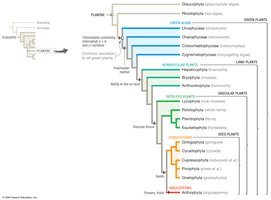
Green plants are monophyletic (descended from a single common ancestor)
Green algae are paraphyletic (do not include all descendants)
Land plants are monophyletic; nonvascular and seedless vascular plants are paraphyletic
Vascular tissue and seeds each evolved only once
Adaptations for Life on Land
Preventing Water Loss: Cuticle and Stomata
To survive on land, plants evolved adaptations to minimize water loss:
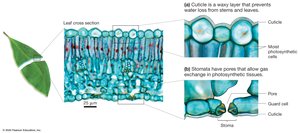
Cuticle: A waxy, watertight layer covering aboveground parts, preventing desiccation
Stomata: Pores surrounded by guard cells that regulate gas exchange and water loss
Protection from UV Radiation
Land plants developed UV-absorbing compounds to protect DNA from damage
Cuticle also provides some protection from UV light
Upright Growth and Vascular Tissue
Upright growth provides better access to sunlight but requires adaptations for water transport and structural support:
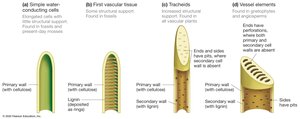
Vascular tissue: Specialized cells for water and nutrient transport
Tracheids: Long, thin water-conducting cells with lignin-reinforced walls
Vessel elements: Wider, shorter cells with open ends for efficient water movement
Key Evolutionary Innovations
Cuticle, stomata, and vascular tissue enabled colonization of land
These features evolved only once, but vessel elements evolved independently in several lineages (convergent evolution)
Reproduction in Dry Conditions
Desiccation-Resistant Spores
Spores: Encased in sporopollenin, allowing survival and dispersal in dry environments
Complex Reproductive Organs
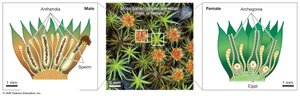
Gametangia: Multicellular organs that protect gametes from desiccation and damage
Antheridia: Sperm-producing structures
Archegonia: Egg-producing structures
Embryo Retention and Nourishment
Land plant embryos develop on and are nourished by the parent plant
This adaptation is a defining feature of the Embryophyta
Alternation of Generations
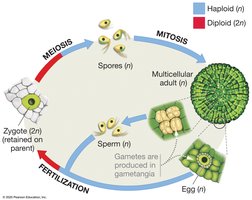
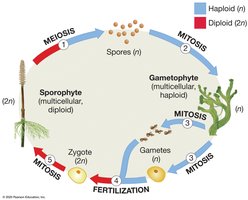
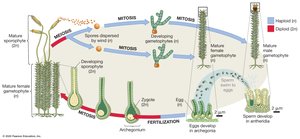
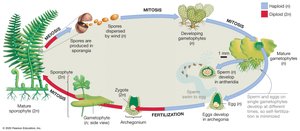
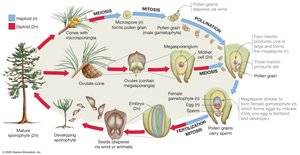
All land plants exhibit alternation of generations, with multicellular haploid (gametophyte) and diploid (sporophyte) phases:
Sporophyte (2n): Produces haploid spores by meiosis
Gametophyte (n): Produces gametes by mitosis
Fertilization produces a diploid zygote, which develops into a sporophyte
Life Cycle Dominance
Nonvascular plants: Gametophyte-dominant
Vascular plants: Sporophyte-dominant
Reduction of gametophyte size is a major evolutionary trend
Homosporous vs. Heterosporous Life Cycles
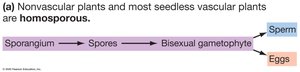
Homosporous: Single type of spore develops into a bisexual gametophyte (most nonvascular and seedless vascular plants)
Heterosporous: Two types of spores—microspores (male) and megaspores (female)—develop into separate gametophytes (all seed plants)

Pollen and Seeds
Pollen: Male gametophyte encased in sporopollenin, enabling fertilization without water
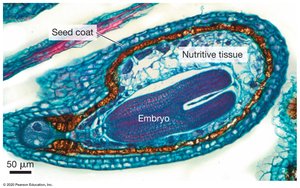
Seeds: Structures containing an embryo, nutritive tissue, and a protective coat, allowing for dispersal and survival in diverse environments
Flowers and Fruits
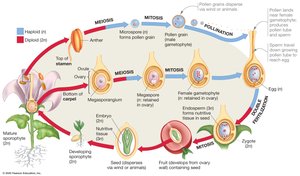
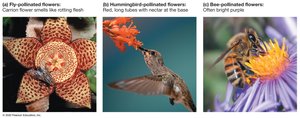
Flowers: Reproductive organs of angiosperms, containing stamens (male) and carpels (female)
Double fertilization: One sperm fertilizes the egg, another forms nutritive endosperm
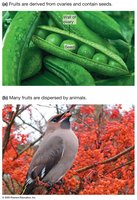
Fruits: Structures derived from the ovary, enclosing seeds and aiding in dispersal
Major Lineages and Diversity
Green Algae
Paraphyletic group with about 8,000 species
Primary producers in freshwater and some extreme environments
Form symbiotic relationships (e.g., lichens)
Nonvascular Plants
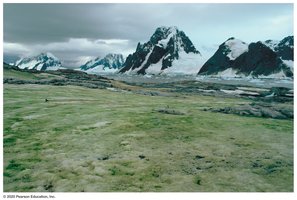
First land plant lineages; gametophyte-dominant
Lack lignin-reinforced vascular tissue
Flagellated sperm require water for fertilization
Seedless Vascular Plants
Paraphyletic group; sporophyte-dominant
Vascular tissue with lignin for support and transport
Gametophyte and sporophyte are independent
Seed Plants: Gymnosperms and Angiosperms
Monophyletic group defined by seeds and pollen
Gymnosperms: Seeds not enclosed in ovaries
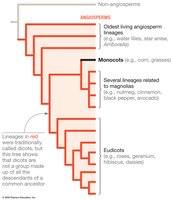
Angiosperms: Seeds enclosed in ovaries (fruits); most diverse group
Angiosperm Radiation
Adaptive radiation driven by water-conducting vessels, flowers, and fruits
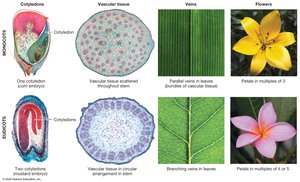
Traditionally divided into monocots (one cotyledon) and dicots (two cotyledons); eudicots are a true monophyletic group within dicots
Summary Table: Key Lineages of Green Algae and Land Plants
Group | Main Features | Examples |
|---|---|---|
Green Algae | Paraphyletic, aquatic, primary producers | Ulva, Chara, Spirogyra |
Nonvascular Plants | No vascular tissue, gametophyte-dominant | Mosses, liverworts, hornworts |
Seedless Vascular Plants | Vascular tissue, sporophyte-dominant, no seeds | Ferns, horsetails, club mosses |
Gymnosperms | Seeds, no flowers/fruits, pollen | Pines, ginkgo, cycads |
Angiosperms | Flowers, fruits, double fertilization | Grasses, roses, oaks |
Additional info: This summary integrates key concepts from the chapter, including evolutionary innovations, phylogenetic relationships, and the major adaptations that enabled the colonization of land by plants. The included images directly support the explanations of plant diversity, structure, and life cycles.
