 Back
Green Plants: Evolution, Diversity, and Adaptations
Study Guide - Smart Notes
 Tailored notes based on your materials, expanded with key definitions, examples, and context.
Green Plants: Evolution, Diversity, and Adaptations
Introduction to Green Plants
Green plants, or Viridiplantae, include both green algae and land plants. Green algae are primarily aquatic, while land plants dominate terrestrial ecosystems. The evolutionary transition from aquatic green algae to terrestrial land plants marked a significant transformation in Earth's biosphere, enabling the colonization of land and the development of complex terrestrial ecosystems.
Green algae are considered protists but are closely related to land plants.
Land plants were the first organisms to thrive fully exposed to air, fundamentally altering terrestrial environments.
Ecosystem Services Provided by Plants
Green algae and land plants provide essential ecosystem services:
Oxygen production through oxygenic photosynthesis.
Soil formation and retention by providing organic matter and preventing erosion.
Water retention in soils and moderation of local climates by shading and reducing wind impact.
Primary production: Land plants are dominant primary producers, converting sunlight into chemical energy and supporting terrestrial food webs.
Economic Importance of Plants
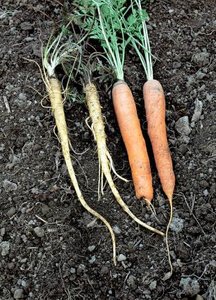
Food: Domestication and artificial selection of crop plants have shaped agriculture.
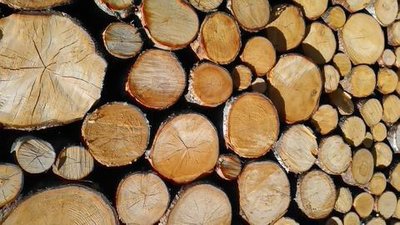
Fuel: Plants provide wood and fossil fuels (coal, petroleum, natural gas).
Fiber and building materials: Plants supply raw materials for clothing, paper, and construction.
Medicines: Many pharmaceuticals are derived from plant compounds, often evolved as defenses against herbivores.
Major Groups of Green Plants
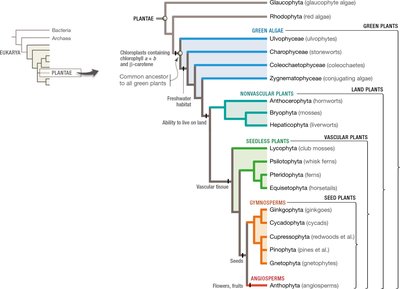
Green plants are classified into several major groups based on morphological and molecular traits:
Green Algae: Unicellular, colonial, or multicellular; mostly aquatic.
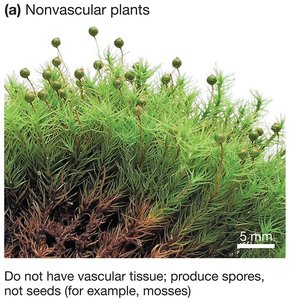
Nonvascular Plants: Lack vascular tissue; reproduce via spores (e.g., mosses).
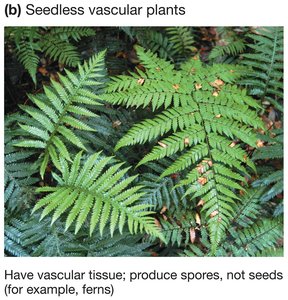
Seedless Vascular Plants: Have vascular tissue but reproduce via spores (e.g., ferns).
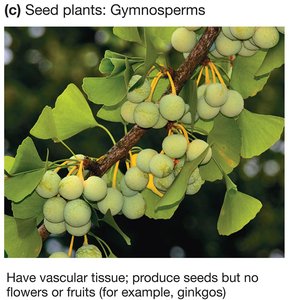
Seed Plants: Have vascular tissue and reproduce via seeds (e.g., gymnosperms and angiosperms).
Key Innovations in Plant Evolution
Several evolutionary innovations enabled plants to colonize land and diversify:
Cuticle and stomata: Prevent water loss and allow gas exchange.
Vascular tissue: Enables upright growth and efficient water/nutrient transport.
Seeds and pollen: Allow reproduction and dispersal in dry environments.
Flowers and fruits: Enhance reproductive success and seed dispersal (in angiosperms).
Comparative Morphology of Major Plant Groups
Group | Vascular Tissue | Reproductive Structure | Example |
|---|---|---|---|
Nonvascular Plants | No | Spores | Mosses |
Seedless Vascular Plants | Yes | Spores | Ferns |
Seed Plants: Gymnosperms | Yes | Seeds (no flowers/fruits) | Ginkgos |
Seed Plants: Angiosperms | Yes | Seeds (flowers/fruits) | Roses, grasses |
Phylogenetic Relationships and Diversity
Phylogenetic analyses show:
Green plants are monophyletic (descended from a single common ancestor).
Green algae are paraphyletic (do not include all descendants, i.e., land plants).
Land plants are monophyletic, with a single transition from water to land.
Adaptations to Terrestrial Life
Cuticle: Waxy layer that prevents water loss.
Stomata: Pores that regulate gas exchange.
Flavonoids: Protect against UV radiation.
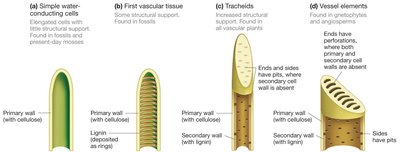
Tracheids and vessels: Specialized cells for water transport and support.
Reproductive Adaptations
Key innovations for reproduction on land include:
Desiccation-resistant spores: Protected by sporopollenin.
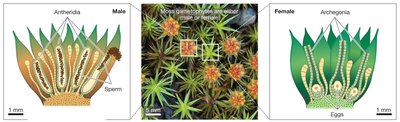
Complex gametangia: Structures that protect gametes (antheridia for sperm, archegonia for eggs).
Retention of embryos: Embryos develop on and are nourished by the parent plant (embryophytes).
Alternation of Generations
All land plants exhibit alternation of generations:
Gametophyte: Multicellular, haploid phase that produces gametes by mitosis.
Sporophyte: Multicellular, diploid phase that produces spores by meiosis.
In nonvascular plants, the gametophyte is dominant; in vascular plants, the sporophyte is dominant.
Trends in Plant Evolution
Reduction of the gametophyte and dominance of the sporophyte in vascular plants.
Evolution of heterospory (production of distinct male and female spores) in seed plants.
Development of pollen and seeds for reproduction in dry environments.
Diversity of Green Algae and Land Plants
Green algae and land plants are diverse, with major lineages including:
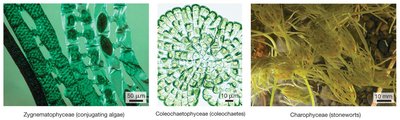
Ulvophyceae (sea lettuce), Charophyceae (stoneworts), Coleochaetophyceae (coleochaetes), Zygnematophyceae (conjugating algae).
Nonvascular plants: Liverworts, mosses, hornworts.
Seedless vascular plants: Lycophytes, whisk ferns, ferns, horsetails.
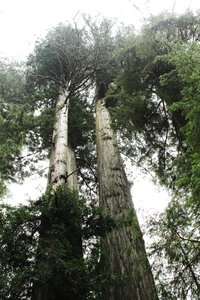
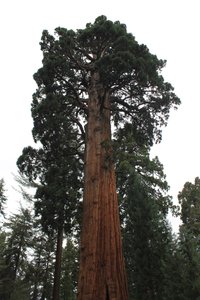
Seed plants: Gymnosperms (ginkgos, cycads, conifers, gnetophytes), angiosperms (flowering plants).
Examples and Applications
Mosses (nonvascular plants) are important in soil formation and water retention.
Ferns (seedless vascular plants) are common in moist habitats and have economic uses as ornamentals and food.
Ginkgos (gymnosperms) are used as ornamentals and in traditional medicine.
Angiosperms (flowering plants) include most crop species and dominate modern terrestrial ecosystems.
Representative Images
Summary Table: Evolutionary Innovations in Land Plants
Innovation | Function | Group(s) Where First Appeared |
|---|---|---|
Cuticle & Stomata | Water retention & gas exchange | Nonvascular plants |
Vascular Tissue | Transport & support | Seedless vascular plants |
Seeds & Pollen | Reproduction & dispersal in dry environments | Seed plants |
Flowers & Fruits | Efficient reproduction & seed dispersal | Angiosperms |
Additional info: This summary integrates key concepts from the evolution, diversity, and adaptations of green plants, emphasizing their ecological and economic importance, major evolutionary innovations, and representative lineages. Images included are directly relevant to the described concepts, such as plant morphology, phylogeny, and adaptations.
