 Back
Guided Study: Chromosome Number and Cell Type Changes During Meiosis
Study Guide - Smart Notes
 Tailored notes based on your materials, expanded with key definitions, examples, and context.
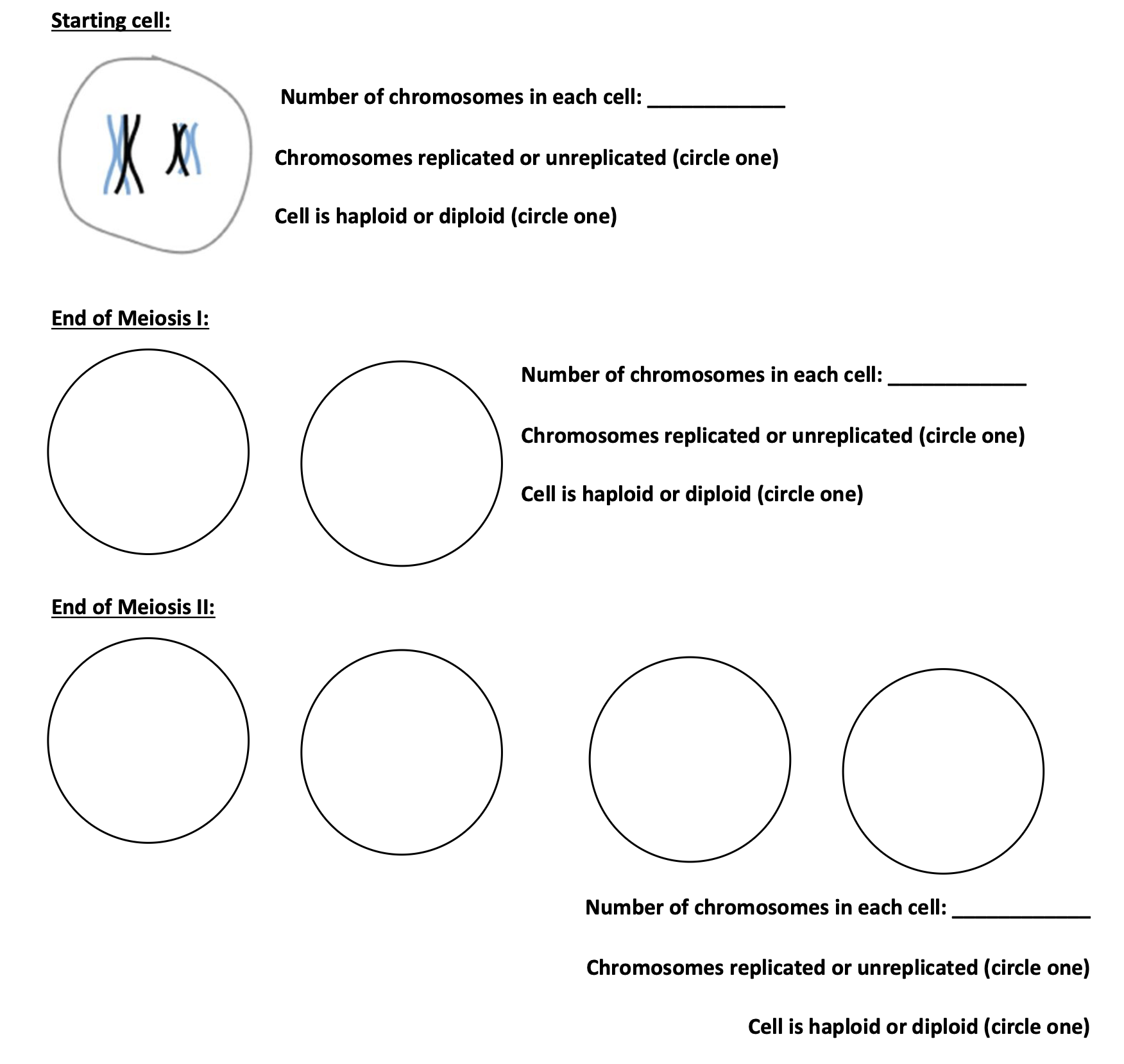
Q1. For each stage (starting cell, end of Meiosis I, end of Meiosis II), fill in:
Number of chromosomes in each cell
Whether chromosomes are replicated or unreplicated (circle one)
Whether the cell is haploid or diploid (circle one)
Background
Topic: Meiosis and Chromosome Number
This question tests your understanding of how chromosome number and cell ploidy change during the stages of meiosis. Meiosis is a type of cell division that reduces the chromosome number by half and produces four haploid cells from one diploid cell. It is essential for sexual reproduction.
Key Terms and Concepts:
Chromosome: A structure made of DNA and proteins that carries genetic information.
Replicated Chromosome: A chromosome that has been copied and consists of two sister chromatids joined at the centromere.
Unreplicated Chromosome: A chromosome consisting of a single chromatid.
Diploid (2n): A cell with two sets of chromosomes (one from each parent).
Haploid (n): A cell with one set of chromosomes.
Meiosis I: The first division in meiosis, separates homologous chromosomes.
Meiosis II: The second division in meiosis, separates sister chromatids.
Step-by-Step Guidance
Examine the starting cell. Count the number of chromosomes present. Are they paired (homologous chromosomes)? Are they replicated (two sister chromatids per chromosome)?
Determine if the starting cell is diploid or haploid. Diploid cells have pairs of homologous chromosomes; haploid cells have only one set.
At the end of Meiosis I, homologous chromosomes are separated into two cells. Each cell now has half the original chromosome number. Are the chromosomes still replicated?
At the end of Meiosis II, sister chromatids are separated, resulting in four cells. Each cell has chromosomes that are now unreplicated. What is the chromosome number in each cell, and are they haploid or diploid?
For each stage, use your understanding of chromosome behavior to fill in the worksheet: number of chromosomes, replicated/unreplicated, and haploid/diploid status.
Try solving on your own before revealing the answer!
Final Answer:
Starting cell: Number of chromosomes: 4 (as shown in the diagram). Chromosomes are replicated. Cell is diploid.
End of Meiosis I: Number of chromosomes in each cell: 2. Chromosomes are still replicated. Cells are haploid.
End of Meiosis II: Number of chromosomes in each cell: 2. Chromosomes are unreplicated. Cells are haploid.
Meiosis reduces the chromosome number by half in Meiosis I (diploid to haploid), and separates sister chromatids in Meiosis II, resulting in four haploid cells with unreplicated chromosomes.
