 Back
Guided Study: Energy Diagrams and Reaction Thermodynamics
Study Guide - Smart Notes
 Tailored notes based on your materials, expanded with key definitions, examples, and context.
Q1. Which of the following terms best describes the forward reaction in the figure above?
Background
Topic: Thermodynamics of Chemical Reactions
This question tests your understanding of how to classify reactions as exergonic or endergonic based on changes in free energy () as shown in an energy diagram.
Key Terms:
Exergonic Reaction: Releases energy; ; spontaneous.
Endergonic Reaction: Requires energy input; ; nonspontaneous.
Free Energy (): Energy available to do work in a system.
Key Formula:
Step-by-Step Guidance
Examine the energy diagram: Identify the free energy levels of reactants (A+B) and products (C+D).
Determine whether the products have lower or higher free energy than the reactants.
Recall that if the products have lower free energy, is negative (exergonic); if higher, $\Delta G$ is positive (endergonic).
Match the reaction type to the options given (exergonic/endergonic, values).
Try solving on your own before revealing the answer!
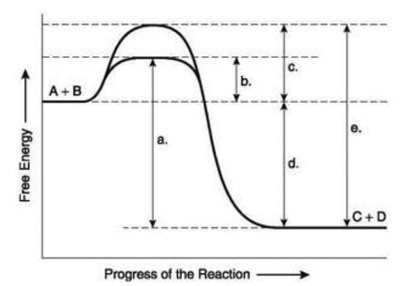
Q2. Which letter in the figure above represents the of the reaction?
Background
Topic: Energy Diagrams and Free Energy Change
This question asks you to identify the segment of the diagram that corresponds to the change in free energy () between reactants and products.
Key Terms:
: The difference in free energy between the products and reactants.
Key Formula:
Step-by-Step Guidance
Locate the energy level of the reactants (A+B) and the products (C+D) on the diagram.
Identify the vertical distance between these two points; this represents .
Look for the letter label on the diagram that marks this distance.
Try solving on your own before revealing the answer!
Q3. Which letter corresponds to the activation energy in the event an enzyme is NOT involved?
Background
Topic: Activation Energy and Enzyme Catalysis
This question tests your ability to identify the activation energy barrier for a reaction, which is the energy required to initiate the reaction without an enzyme.
Key Terms:
Activation Energy (): The energy required to reach the transition state from the reactants.
Transition State: The highest energy point along the reaction pathway.
Key Formula:
Step-by-Step Guidance
Find the peak of the curve (transition state) and the starting point (reactants) on the diagram.
Identify the vertical distance between these two points; this is the activation energy without an enzyme.
Look for the letter label that marks this distance.
Try solving on your own before revealing the answer!
Q4. Is this reaction spontaneous or nonspontaneous?
Background
Topic: Spontaneity of Chemical Reactions
This question asks you to determine whether the reaction will occur without external energy input, based on the sign of .
Key Terms:
Spontaneous Reaction: Occurs without external energy input; .
Nonspontaneous Reaction: Requires energy input; .
Key Formula:
Step-by-Step Guidance
Review the diagram to see if the products have lower or higher free energy than the reactants.
Recall that a negative indicates spontaneity, while a positive $\Delta G$ indicates nonspontaneity.
Use your understanding of the diagram to decide which applies to this reaction.
Try solving on your own before revealing the answer!
