 Back
Guided Study for Chapter 1: Biology – Exploring Life
Study Guide - Smart Notes
 Tailored notes based on your materials, expanded with key definitions, examples, and context.
Q1. A smart phone is not alive. List three characteristics of life that the phone does not exhibit.
Background
Topic: Characteristics of Life
This question tests your understanding of what defines living organisms, such as cellular organization, metabolism, response to stimuli, growth, reproduction, and adaptation.
Key Terms:
Cellular organization: Living things are made of cells.
Metabolism: Living things carry out chemical reactions.
Reproduction: Living things can reproduce.
Growth and development: Living things grow and develop.
Response to environment: Living things respond to stimuli.
Adaptation: Living things evolve over time.
Step-by-Step Guidance
Recall the main characteristics that define life (see key terms above).
Think about whether a smartphone can reproduce, grow, or respond to its environment in the same way as living organisms.
Consider if a smartphone is made of cells or has metabolism.
Identify three characteristics from the list that a smartphone does not possess.
Try solving on your own before revealing the answer!
Final Answer:
A smartphone does not exhibit cellular organization, metabolism, or reproduction. It is not made of cells, does not carry out chemical reactions, and cannot reproduce.
Q2. Does a motor vehicle fulfill any of the characteristics of life? If so, which one(s)?
Background
Topic: Characteristics of Life
This question asks you to compare non-living objects to living organisms and identify any similarities in characteristics.
Key Terms:
Metabolism (energy use)
Response to environment
Growth, reproduction, cellular organization
Step-by-Step Guidance
Review the list of life characteristics.
Think about how a motor vehicle uses energy (fuel) and responds to input (steering, acceleration).
Determine if these actions are similar to any characteristics of life.
Identify which, if any, characteristics a motor vehicle shares with living things.
Try solving on your own before revealing the answer!
Final Answer:
A motor vehicle uses energy (fuel), which is similar to metabolism, and responds to input, which is similar to response to environment. However, it does not grow, reproduce, or have cellular organization.
Q3. Which of the following is the highest level of taxonomic organization?
Background
Topic: Taxonomy and Classification
This question tests your knowledge of the hierarchy of biological classification.
Key Terms:
Domain: The broadest category in taxonomy.
Kingdom, Phylum, Species: Other levels in the hierarchy.
Step-by-Step Guidance
Recall the order of taxonomic ranks: Domain, Kingdom, Phylum, Class, Order, Family, Genus, Species.
Compare the options given to the hierarchy.
Identify which option is at the highest level.
Try solving on your own before revealing the answer!
Final Answer:
The highest level of taxonomic organization listed is Domain.
Q4. Complete the following table that compares the four kingdoms of the domain Eukarya: Plantae, Animalia, Fungi, Protista.
Background
Topic: Eukaryotic Kingdoms
This question tests your understanding of the characteristics that distinguish the four kingdoms within Eukarya.
Key Terms:
Plantae: Multicellular, photosynthetic, cell walls of cellulose.
Animalia: Multicellular, heterotrophic, no cell walls.
Fungi: Mostly multicellular, heterotrophic, cell walls of chitin.
Protista: Mostly unicellular, diverse modes of nutrition.
Step-by-Step Guidance
List the main characteristics for each kingdom (see key terms).
Compare their modes of nutrition, cell structure, and typical examples.
Fill in the table with these distinguishing features.
Try solving on your own before revealing the answer!
Final Answer:
Plantae: Multicellular, photosynthetic, cell walls of cellulose. Animalia: Multicellular, heterotrophic, no cell walls. Fungi: Mostly multicellular, heterotrophic, cell walls of chitin. Protista: Mostly unicellular, diverse nutrition.
Q5. What will all members of the domains Archaea and Bacteria have in common?
Background
Topic: Domains of Life
This question tests your understanding of the differences between prokaryotic and eukaryotic cells.
Key Terms:
Prokaryotic: Cells without a nucleus.
Eukaryotic: Cells with a nucleus.
Step-by-Step Guidance
Recall the main features of Archaea and Bacteria.
Compare these features to those of Eukarya.
Identify the common characteristic shared by Archaea and Bacteria.
Try solving on your own before revealing the answer!
Final Answer:
All members of Archaea and Bacteria are prokaryotic, meaning they lack a nucleus.
Q6. Which of the following would be considered a population?
Background
Topic: Levels of Biological Organization
This question tests your understanding of what constitutes a population in biology.
Key Terms:
Population: A group of individuals of the same species living in a specific area.
Community: All organisms in an area.
Step-by-Step Guidance
Review the definition of population.
Analyze each option to see if it fits the definition.
Identify which option describes a group of the same species in one area.
Try solving on your own before revealing the answer!
Final Answer:
A school of fish in a lake is considered a population.
Q7. The fact that new characteristics emerge as you go higher in biological levels is referred to as ________________.
Background
Topic: Emergent Properties
This question tests your understanding of how complexity increases at higher levels of biological organization.
Key Terms:
Emergent properties: New characteristics that arise at each level of organization.
Step-by-Step Guidance
Recall the term used to describe new properties that arise at higher levels.
Think about examples, such as tissues forming organs, or organ systems forming organisms.
Fill in the blank with the correct term.
Try solving on your own before revealing the answer!
Final Answer:
The term is "emergent properties." These are new characteristics that arise at higher levels of organization.
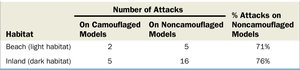
Q8. Were the observed number of attacks on noncamouflaged models greater than camouflaged models in the inland habitat? Use Table 1.5.
Background
Topic: Experimental Design and Data Interpretation
This question tests your ability to interpret experimental data related to animal behavior and adaptation.
Key Terms:
Camouflage: Adaptation that helps organisms blend in with their environment.
Experimental group: The group receiving the variable being tested.
Control group: The group not receiving the variable.
Step-by-Step Guidance
Examine the table for the inland (dark habitat) row.
Compare the number of attacks on camouflaged models versus noncamouflaged models.
Determine which group had more attacks.
Try solving on your own before revealing the answer!
Final Answer:
Yes, the observed number of attacks on noncamouflaged models (16) was greater than on camouflaged models (5) in the inland habitat.
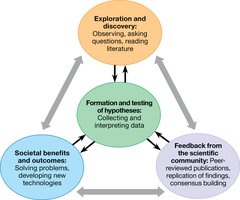
Q9. Does feedback from the scientific community influence the formation and testing of hypotheses? Use Figure 1.7.
Background
Topic: The Process of Science
This question tests your understanding of how peer review and community feedback shape scientific inquiry.
Key Terms:
Peer review: Evaluation of scientific work by others in the field.
Hypothesis: A testable explanation for an observation.
Step-by-Step Guidance
Review the diagram showing the process of science.
Identify the role of feedback from the scientific community in the diagram.
Explain how peer review, replication, and consensus building affect hypothesis formation and testing.
Try solving on your own before revealing the answer!
Final Answer:
Yes, feedback from the scientific community influences the formation and testing of hypotheses by providing peer review, replication of findings, and consensus building, which help refine and validate scientific ideas.
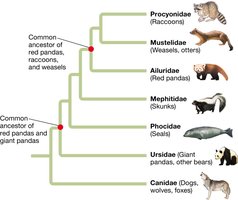
Q10. What do red pandas, weasels, and raccoons have in common? Use Figure 1.9C.
Background
Topic: Evolutionary Relationships
This question tests your understanding of phylogenetic trees and common ancestry.
Key Terms:
Phylogenetic tree: Diagram showing evolutionary relationships.
Common ancestor: The shared ancestor of different species.
Step-by-Step Guidance
Examine the phylogenetic tree in Figure 1.9C.
Identify the branches for red pandas, weasels, and raccoons.
Look for the point where their lineages converge, indicating a common ancestor.
Try solving on your own before revealing the answer!
Final Answer:
Red pandas, weasels, and raccoons share a common ancestor, as shown by their close branches on the phylogenetic tree.
