 Back
Guided Study: Phylogenetic Trees and Evolutionary Relationships
Study Guide - Smart Notes
 Tailored notes based on your materials, expanded with key definitions, examples, and context.
Q1. What is a phylogenetic tree, and how does it help us understand evolutionary relationships among species?
Background
Topic: Phylogenetic Trees and Common Descent
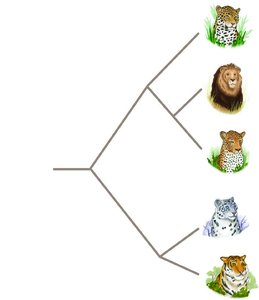
This question is testing your understanding of how phylogenetic trees are used to represent evolutionary relationships among organisms. Phylogenetic trees are diagrams that show how species are related through common ancestry, and help us visualize the branching patterns of evolution.
Key Terms and Concepts:
Phylogenetic tree: A diagram that represents evolutionary relationships among organisms based on common descent.
Node: Represents a common ancestor shared by the branches that diverge from it.
Branch: Represents a lineage evolving over time.
Relatedness: Determined by how recently two species share a common ancestor (node).
Step-by-Step Guidance
Examine the phylogenetic tree and identify the different species represented at the tips of the branches.
Notice where the branches split (nodes). Each node represents a common ancestor shared by the species that diverge from that point.
To determine which species are most closely related, look for the species that share the most recent common ancestor (the node closest to the tips).
Compare the placement of each species on the tree. The closer two species are to each other on the tree, the more closely related they are.
Try to identify which pairs of species share a node that is closer to the tips, and which share a node further back in the tree.
Try solving on your own before revealing the answer!
Final Answer:
A phylogenetic tree is a diagram that shows the evolutionary relationships among species based on common descent. It helps us understand which species are most closely related by showing how recently they share a common ancestor. In the provided tree, for example, the snow leopard and tiger share a more recent common ancestor with each other than with the lion or leopard, indicating they are more closely related.
By reading the tree, you can determine relatedness by following the branches and identifying the nodes that connect different species.
