 Back
Guided Study: Plant and Fungal Evolution, Adaptations, and Life Cycles
Study Guide - Smart Notes
 Tailored notes based on your materials, expanded with key definitions, examples, and context.
Q1. List three challenges that the first land-dwelling plants would have needed to overcome.
Background
Topic: Plant Evolution and Adaptation
This question explores the environmental and physiological obstacles faced by early plants as they transitioned from aquatic to terrestrial habitats.
Key Terms:
Desiccation: Loss of water to the environment.
Structural support: Ability to remain upright without buoyancy.
Reproduction: Ensuring successful reproduction outside water.
Step-by-Step Guidance
Consider the differences between aquatic and terrestrial environments, especially regarding water availability and physical support.
Think about how plants would need to prevent water loss, since air is much drier than water.
Reflect on the need for structural adaptations to support the plant body against gravity.
Consider how reproduction would be affected by the absence of water for gamete transport.
Try solving on your own before revealing the answer!
Final Answer:
The three main challenges were: preventing water loss (desiccation), providing structural support, and adapting reproductive strategies for land.
Early land plants evolved features like cuticles, vascular tissues, and new reproductive mechanisms to address these challenges.
Q2. Two adaptations that land plants have for minimizing water loss are __________ and __________.
Background
Topic: Plant Adaptations for Water Conservation
This question focuses on the structural and physiological features that help plants retain water in terrestrial environments.
Key Terms:
Cuticle: A waxy layer covering the surface of leaves and stems.
Stomata: Pores that regulate gas exchange and water loss.
Step-by-Step Guidance
Recall the main structures that help plants reduce water loss.
Think about how the cuticle acts as a barrier to evaporation.
Consider the role of stomata in controlling water loss and gas exchange.
Try solving on your own before revealing the answer!
Final Answer:
Cuticle and stomata are the two main adaptations for minimizing water loss.
The cuticle prevents evaporation, while stomata regulate water loss and gas exchange.
Q3. Complete the following table, which describes adaptations of land plants for terrestrial life.
Background
Topic: Plant Adaptations for Terrestrial Environments
This question asks you to match specific adaptations to the challenges of obtaining resources, supporting the plant body, and reproduction/dispersal.
Key Terms:
Roots: Absorb water and minerals from soil.
Vascular tissue: Xylem and phloem for transport and support.
Seeds and spores: Adaptations for reproduction and dispersal.
Step-by-Step Guidance
Identify which plant structures are responsible for obtaining resources from soil and air.
Think about how plants support themselves against gravity (e.g., lignin in cell walls, vascular tissue).
Consider adaptations for reproduction and dispersal, such as seeds, spores, and fruit.
Try solving on your own before revealing the answer!
Final Answer:
Obtaining resources: roots and leaves; Supporting the plant body: vascular tissue and lignin; Reproduction and dispersal: seeds, spores, and fruit.
Each adaptation addresses a specific challenge of terrestrial life.
Q4. The first group of land plants is called __________. List two adaptations that they lack.
Background
Topic: Early Land Plants (Bryophytes)
This question is about the characteristics and limitations of the earliest land plants.
Key Terms:
Bryophytes: Nonvascular plants like mosses and liverworts.
Vascular tissue: Specialized for transport and support.
Seeds: Adaptation for reproduction and dispersal.
Step-by-Step Guidance
Recall the name of the first land plant group (nonvascular plants).
Think about what features they lack compared to later plants (e.g., vascular tissue, seeds).
Consider how these limitations affect their habitat and reproduction.
Try solving on your own before revealing the answer!
Final Answer:
Bryophytes; they lack vascular tissue and seeds.
These limitations restrict them to moist environments and limit their size.
Q14. Figure 17.18B on page 364 of your textbook illustrates an elegant experiment that tests the hypothesis that a plant’s “sym” genes are necessary to form mycorrhizae with fungi. Clearly indicate the following: what hypothesis they were testing, how they tested their hypothesis, and identify their control and their results.
Background
Topic: Plant-Fungal Symbiosis and Genetic Control
This question examines an experiment investigating the genetic basis for mycorrhizal formation in plants.
Key Terms:
Mycorrhizae: Symbiotic association between plant roots and fungi.
"sym" gene: Gene required for symbiosis formation.
Transgenic plant: Plant genetically modified to carry a specific gene.
Control: Experimental group used for comparison.
Step-by-Step Guidance
Identify the hypothesis: The "sym" gene is necessary for mycorrhizal formation.
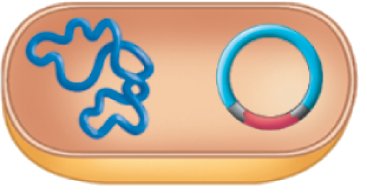
Describe the experimental setup: Mutant plants lacking the "sym" gene are transformed with a functional "sym" gene using Agrobacterium.
Explain how fungal spores are applied to both transgenic and control plants.
Discuss how the presence or absence of mycorrhizae is checked in both groups.
Try solving on your own before revealing the answer!
Final Answer:
Hypothesis: The "sym" gene is required for mycorrhizal formation. The experiment used mutant plants, introduced the "sym" gene, and compared mycorrhizal formation in transgenic versus control plants. Results showed mycorrhizae formed only in plants with the functional "sym" gene.
This demonstrates the genetic requirement for symbiosis.
