 Back
Heat and States of Matter: Structured Study Notes for General Biology
Study Guide - Smart Notes
 Tailored notes based on your materials, expanded with key definitions, examples, and context.
Heat and States of Matter
Temperature and Thermal Energy
The kinetic theory of matter explains that all matter is composed of constantly moving particles, including atoms, molecules, or ions. The temperature of a material is a measure of the average kinetic energy of its particles, while thermal energy is the total kinetic and potential energy of all particles in an object. Heat is defined as the transfer of thermal energy from a region of higher temperature to one of lower temperature. The specific heat of a substance is the amount of energy required to raise the temperature of 1 kg of that substance by 1°C.
Kinetic Theory of Matter: Particles in matter are always in random motion, moving at different speeds in all directions.
Temperature: Measures the average kinetic energy of particles. Common scales include Kelvin (K), Celsius (°C), and Fahrenheit (°F).
Thermal Energy: Sum of kinetic and potential energy due to particle interactions.
Heat: Energy transfer measured in Joules (J), always flows from warmer to cooler objects.
Specific Heat: Different substances require different amounts of energy to change temperature. Units: J/(kg·°C).
Thermal Energy Equation
The change in thermal energy can be calculated using the following equation:
Formula:
Q: Change in thermal energy (Joules)
m: Mass (kg)
T_f: Final temperature (°C)
T_i: Initial temperature (°C)
C: Specific heat (J/(kg·°C))
Measuring Specific Heat
Specific heat is measured using a calorimeter, which uses water and a thermometer to determine the energy absorbed or released by a substance.
Calorimeter: Device for measuring specific heat by monitoring temperature changes in water.
States of Matter
Four States of Matter
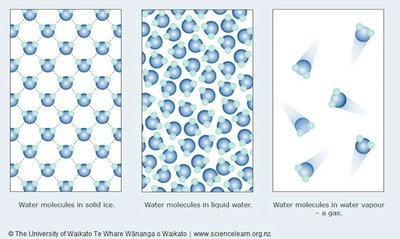
Matter exists in four primary states: solid, liquid, gas, and plasma. The kinetic theory of matter helps interpret changes between these states. Most matter expands when heated and contracts when cooled.
Solid: Particles are tightly packed and fixed in place, with definite shape and volume.
Liquid: Particles are close but not fixed, allowing flow. Definite volume, no definite shape.
Gas: Particles are far apart with weak attraction, no definite shape or volume.
Plasma: Most common state in the universe, particles move at high speeds and are ionized.
Changing States of Matter
Adding or removing thermal energy causes changes in the state of matter. These changes include melting, freezing, vaporization (evaporation and boiling), condensation, and thermal expansion.
Melting: Solid to liquid
Freezing: Liquid to solid
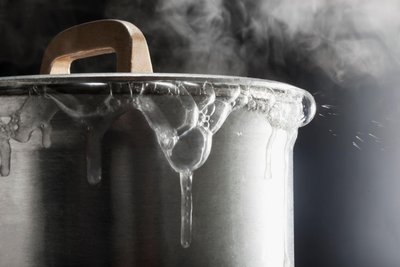
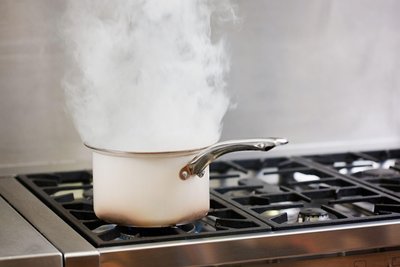
Vaporization: Liquid to gas (evaporation occurs at the surface, boiling occurs throughout the liquid at the boiling point)
Condensation: Gas to liquid
Thermal Expansion: Most matter expands when heated due to increased particle speed and decreased attractive forces.
Transferring Thermal Energy
Methods of Thermal Energy Transfer
Thermal energy can be transferred in three ways: conduction, convection, and radiation. The rate of energy flow depends on whether the material is a conductor or an insulator.
Conduction: Transfer of thermal energy through collisions between particles, without transferring matter. Metals are good conductors.
Convection: Transfer of thermal energy in fluids (liquids and gases) by movement of the fluid itself. Convection currents form due to differences in density.
Radiation: Transfer of energy by electromagnetic waves, can occur through empty space.
Insulators: Materials that slow the flow of thermal energy, often contain pockets of air.
Using Thermal Energy
Thermodynamics
The laws of thermodynamics govern the flow and conversion of thermal energy. The first law states that the increase in thermal energy of a system equals the work done and the energy added. The second law states that thermal energy cannot flow from a colder to a hotter object unless work is done. Entropy measures the dispersal of energy and always increases in natural processes.
First Law of Thermodynamics: (Increase in thermal energy equals work done plus energy added)
Second Law of Thermodynamics: Thermal energy flows from hot to cold unless work is done.
Entropy: Measure of energy dispersal; always increases in spontaneous processes.
Heating Systems
Heating systems transfer thermal energy to maintain desired temperatures. Common systems include forced air, radiator, and electric heating.
Forced Air Systems: Burn fuel to heat air, which is circulated through vents.
Radiator Systems: Heat water and circulate it through pipes; thermal energy is transferred to the air.
Electric Heating Systems: Convert electrical energy to thermal energy via resistors.

Converting Thermal Energy to Work
Heat engines convert thermal energy into work, but no device can convert all thermal energy into work due to the second law of thermodynamics. Internal combustion engines are common examples.
Heat Engines: Devices that convert thermal energy into mechanical work.
Internal Combustion Engines: Used in cars, convert fuel energy into work.
Moving Thermal Energy
Refrigerators use coolants that evaporate at low temperatures to absorb thermal energy and cool their interiors.
Coolant: Substance that absorbs thermal energy during evaporation.
Expansion Valve: Allows coolant to change from liquid to gas, cooling the refrigerator.
Entropy
Entropy increases as energy becomes more spread out and less concentrated. Complete conversion of thermal energy to work is impossible, so usable energy always decreases.
Entropy: Always increases in natural processes, leading to less usable energy.
