 Back
Chapter 15: Homeostasis and Endocrine Signaling: Regulation, Osmoregulation, and Excretion
Study Guide - Smart Notes
 Tailored notes based on your materials, expanded with key definitions, examples, and context.
Homeostasis and Endocrine Signaling
Homeostasis: Maintaining Internal Balance
Homeostasis is the process by which animals maintain a stable internal environment despite external fluctuations. This is essential for the proper functioning of cells and organs, especially in multicellular organisms where cellular specialization requires tightly regulated internal conditions.
Definition: Homeostasis refers to the maintenance of a "steady state" or internal balance, regardless of changes in the external environment.
Examples of regulated variables: Body temperature, blood pH, and glucose concentration.
Feedback control: Most homeostatic mechanisms rely on negative feedback, where a change in a variable triggers a response that counteracts the initial change.
Regulators vs. Conformers
Animals can be classified based on how they respond to environmental changes:
Regulators: Use internal mechanisms to control internal change despite external fluctuations (e.g., mammals regulate body temperature).
Conformers: Allow internal conditions to change in response to external changes (e.g., some fish conform to external temperature).
Major regulated conditions: Temperature, pH, water, and salt balance.
Endocrine System and Signaling
Overview of the Endocrine System
The endocrine system is a collection of glands that produce hormones, which regulate various physiological processes throughout the body.
Hormones: Chemical messengers that influence the activity of cells, tissues, and organs.
Glands: Specialized organs (e.g., pituitary, adrenal, thyroid) that secrete hormones into the bloodstream.
Endocrine vs. Exocrine: Endocrine glands secrete products internally (into blood or extracellular fluid), while exocrine glands secrete products externally (via ducts, e.g., sweat, saliva).
Endocrine Pathways
Simple endocrine pathways: Involve direct hormone release in response to internal stimuli (e.g., pH regulation in the digestive tract).
Neuroendocrine pathways: Involve integration of nervous and endocrine signals, often via the hypothalamus and pituitary gland. These can involve positive feedback mechanisms.
Multiple Effects and Evolution of Hormones
Pleiotropy: Many hormones have multiple effects depending on the target cell type and location (e.g., epinephrine increases blood glucose and muscle blood flow, but decreases digestive blood flow).
Evolution: Hormone functions can diverge between species (e.g., thyroid hormone regulates metabolism in mammals and metamorphosis in amphibians).
Osmoregulation and Excretion
Osmoregulation: Balancing Water and Solutes
Osmoregulation is the process by which animals control the concentration of solutes and water in their body fluids, maintaining osmotic balance with their environment.
Osmolarity: The solute concentration of a solution, measured in osmoles per liter.
Isotonic, hypertonic, hypotonic: Terms describing the relative solute concentrations between two solutions.
Freshwater vs. Marine Fish Osmoregulation
Fish have evolved different strategies to maintain osmotic balance depending on their environment.
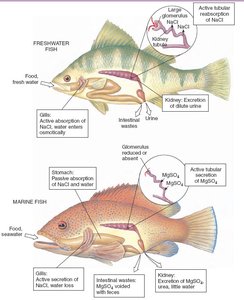
Freshwater fish: Live in a hypotonic environment (less solute outside than inside). They actively absorb salts through their gills and excrete large amounts of dilute urine to prevent water overload.
Marine fish: Live in a hypertonic environment (more solute outside than inside). They drink seawater, excrete excess salts through their gills, and produce small amounts of concentrated urine.
Nitrogenous Waste and Excretion
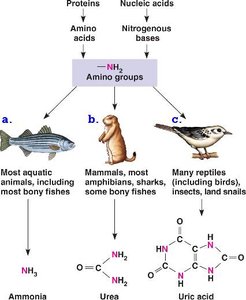
The breakdown of proteins and nucleic acids produces nitrogenous wastes, which must be excreted to prevent toxicity. The type of waste excreted affects water balance and is adapted to the animal's environment.
Ammonia (NH3): Highly toxic, requires large amounts of water for excretion. Common in aquatic animals.
Urea: Less toxic, requires less water. Excreted by mammals, most amphibians, and some fish.
Uric acid: Least toxic, excreted as a paste with minimal water loss. Found in birds, reptiles, and insects.
Excretory Systems in Animals
Invertebrate Excretory Systems
Protonephridia: Found in flatworms; networks of tubules with dead-end cells that filter body fluids.
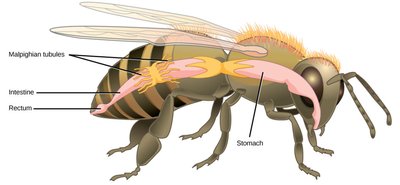
Malpighian tubules: Found in terrestrial arthropods (e.g., insects); remove wastes from hemolymph and excrete them into the digestive tract.
Vertebrate Excretory Systems
Kidneys: Main excretory organs in vertebrates, responsible for both osmoregulation and excretion of nitrogenous wastes.
Functions: Remove waste, regulate salt and water concentrations, and maintain blood pressure.
Steps of Excretory Process
Filtration: Physical filtering of body fluids to remove waste.
Reabsorption: Reclaiming valuable solutes from the filtrate.
Secretion: Adding nonessential solutes and wastes to the filtrate.
Excretion: Expelling the processed filtrate (urine) from the body.
Temperature Regulation
Thermoregulation in Animals
Temperature regulation is crucial for enzyme function and overall metabolic stability. Animals use various strategies to maintain optimal body temperature.
Ectothermy: Body temperature is determined by the environment. Most animals are ectotherms and use behavioral and metabolic adjustments to regulate temperature.
Endothermy: Generate heat internally to maintain a stable body temperature. Endotherms (e.g., mammals, birds) require more energy and food intake.
Ectothermic Strategies
Behavioral adjustments: Selecting microhabitats (e.g., basking, seeking shade) to regulate temperature.
Metabolic adjustments: Adjusting metabolic rates to compensate for temperature changes.
Endothermic Strategies
Heat generation: Shivering and increased metabolism to produce heat in cold environments.
Heat loss: Radiation, conduction, convection, and evaporation (e.g., sweating).
Energy requirements: Endotherms must consume more food to support higher metabolic rates.
