 Back
BackHomeostasis and Organization of the Animal Body
Study Guide - Smart Notes
 Tailored notes based on your materials, expanded with key definitions, examples, and context.
Homeostasis: Regulation of the Internal Environment
Introduction to Homeostasis
Homeostasis is the process by which animals maintain a stable internal environment, essential for optimal cellular function. The concept was first recognized by Claude Bernard and later termed by Walter Cannon. Despite the implication of "staying the same," homeostasis involves dynamic adjustments to both internal and external changes.
Definition: Homeostasis is the maintenance of internal conditions within narrow limits.
Importance: Enzymes, which catalyze nearly all cellular reactions, require stable conditions (temperature, pH, salt concentration) to maintain their structure and function.
Disruption: Extreme conditions (too hot, too acidic, etc.) can denature enzymes, halting essential biochemical reactions.
Example: Heat stroke in athletes demonstrates the dangers of failing to regulate body temperature.

Temperature Regulation in Animals
Animals employ various strategies to regulate body temperature, which is crucial for enzyme activity and overall metabolism. The terms "warm-blooded" and "cold-blooded" are commonly used but can be misleading.
Endotherms: Generate most of their heat through metabolic reactions (e.g., mammals, birds).
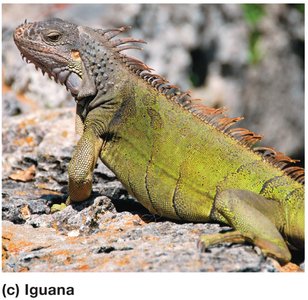
Ectotherms: Rely primarily on environmental heat sources (e.g., reptiles, amphibians, most fish, invertebrates).
Variation: Body temperatures can fluctuate widely in some species, depending on behavior and habitat.
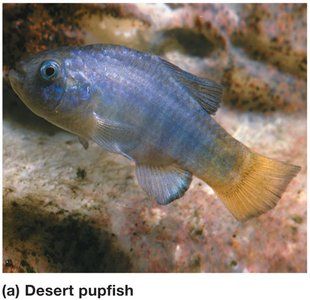
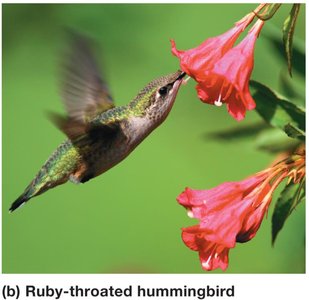
Examples: Desert pupfish can tolerate extreme water temperatures; hummingbirds maintain high body temperatures during the day but cool down at night.
Feedback Systems in Homeostasis
Homeostasis is maintained by feedback systems, which sense changes and initiate responses to restore balance. There are two main types: negative and positive feedback.
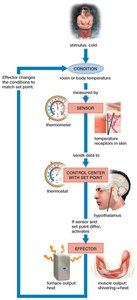
Negative Feedback: Counteracts changes, returning the system to its set point. This is the primary mechanism for maintaining homeostasis (e.g., temperature, glucose, hormone levels).
Positive Feedback: Amplifies changes, often leading to a specific outcome (e.g., childbirth).
Components of Negative Feedback:
Sensor: Detects the current condition (e.g., thermometer, nerve endings).
Control Center: Compares the condition to the set point (e.g., thermostat, hypothalamus).
Effector: Produces output to restore the desired condition (e.g., heater, shivering muscles).
Example: The hypothalamus in vertebrates regulates body temperature by coordinating nervous signals, hormone release, and behaviors.
Positive Feedback in Biological Systems
Positive feedback is less common but plays a role in processes that require rapid completion, such as childbirth.
Example: During labor, stretching of the cervix triggers the release of oxytocin, which intensifies contractions until birth occurs.
Termination: The cycle ends when the stimulus (pressure on the cervix) is removed.
Organization of the Animal Body
Structural Hierarchy
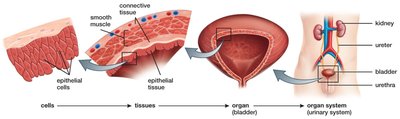
Animals maintain homeostasis through a hierarchical organization of structures, from cells to organ systems.
Cells: Fundamental units of life.
Tissues: Groups of similar cells performing specific functions.
Organs: Composed of multiple tissue types, performing complex functions.
Organ Systems: Groups of organs working together (e.g., urinary system: kidneys, ureters, bladder, urethra).
Major Categories of Animal Tissues
Animal tissues are classified into four major types, each with distinct functions and characteristics.
Epithelial Tissue: Covers body surfaces, lines cavities, and forms glands.
Connective Tissue: Provides support and structure (e.g., bone, cartilage, blood).
Muscle Tissue: Enables movement.
Nerve Tissue: Transmits electrical signals for communication and control.
Epithelial Tissue: Structure and Function
Epithelial tissue forms membranes and glands, providing protection, facilitating exchange, and regulating movement of substances.
Characteristics:
Free surface facing a cavity or external environment.
Anchored to a basement membrane (fibrous proteins).
Thin, lacking blood vessels; relies on diffusion for nutrient and waste exchange.
Cells are tightly connected, often forming barriers (e.g., urinary bladder).
High regenerative capacity due to exposure to harsh conditions.
Classification of Epithelial Membranes
Epithelial membranes are classified by cell layer number and cell shape.
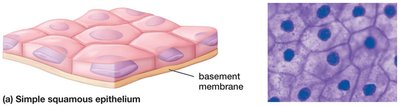
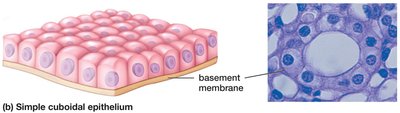
Simple Epithelium: One cell layer thick.
Stratified Epithelium: Multiple cell layers, providing durability.
Cell Shapes:
Squamous: Flat and thin.
Cuboidal: Cube-shaped.
Columnar: Tall and column-shaped; may be ciliated.
Functions and Locations of Epithelial Types
Simple Squamous Epithelium: Lines lung air sacs, allowing rapid gas diffusion.
Simple Cuboidal Epithelium: Lines kidney tubules, aiding in urine formation; protects gland ducts.
Simple Columnar Ciliated Epithelium: Lines the trachea, with cilia and mucus-secreting cells to trap and remove debris.
Stratified Epithelium: Found in areas subject to wear, such as skin, esophagus, mouth, and anus.
Glands: Exocrine and Endocrine
Glands are specialized clusters of epithelial cells for secretion.
Exocrine Glands: Secrete substances into body cavities or onto surfaces via ducts (e.g., sweat, mammary, salivary glands).
Endocrine Glands: Release hormones directly into interstitial fluid and bloodstream (e.g., ovaries, testes, thyroid, pituitary).
Hormones: Chemical messengers that regulate activities of other cells throughout the body.
----------------------------------------
