 Back
BackHomeostatic Processes for Thermoregulation: Form, Function, and Behavior
Study Guide - Smart Notes
 Tailored notes based on your materials, expanded with key definitions, examples, and context.
Thermoregulation and Homeostasis
Introduction to Thermoregulation
Thermoregulation is the process by which animals maintain their body temperature within a certain range, ensuring optimal conditions for enzymatic reactions and cellular processes. This regulation is essential for survival, as deviations from the set point can disrupt metabolism and cellular function.
Homeostasis: The maintenance of a stable internal environment despite external fluctuations.
Set Point: The target value or range for physiological parameters, such as body temperature.
Heat: In this context, refers to thermal energy, which can be transferred between organisms and their environment.
Sources of Heat: Endothermy vs. Ectothermy
Endotherms and Ectotherms
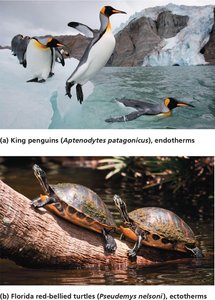
Animals regulate body temperature using heat derived from internal metabolism or external sources. The distinction between endotherms and ectotherms is fundamental to understanding thermoregulatory strategies.
Endotherms: Animals (e.g., mammals, birds) that primarily use metabolic heat to maintain body temperature. They can remain active in a wide range of environmental temperatures.
Ectotherms: Animals (e.g., amphibians, reptiles, most fishes, invertebrates) that rely mainly on external heat sources. They often use behavioral adaptations to regulate temperature.
Endothermy and ectothermy are not mutually exclusive; some animals use both strategies depending on environmental conditions.
Variation in Body Temperature
Poikilotherms and Homeotherms
Animals can also be classified based on the variability of their body temperature:
Poikilotherms: Animals whose body temperature varies with the environment (e.g., largemouth bass).
Homeotherms: Animals that maintain a relatively constant body temperature (e.g., river otter).
There is no strict correlation between being an endotherm/ectotherm and being a homeotherm/poikilotherm.
The terms "cold-blooded" and "warm-blooded" are misleading and not used in scientific contexts.
Mechanisms of Heat Exchange
Modes of Heat Transfer
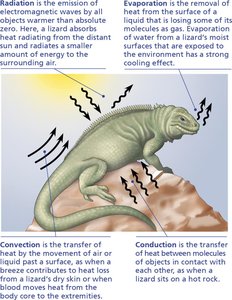
Animals exchange heat with their environment through four main processes:
Radiation: Emission of electromagnetic waves (e.g., heat from the sun).
Evaporation: Loss of heat as liquid water becomes vapor (e.g., sweating, panting).
Convection: Transfer of heat by movement of air or liquid past a surface (e.g., wind chill).
Conduction: Direct transfer of heat between objects in contact (e.g., lizard on a hot rock).
Balancing Heat Loss and Gain
Insulation
Insulation reduces heat flow between an animal and its environment, playing a critical role in thermoregulation for both endotherms and some ectotherms.
Forms of insulation include hair, feathers, and layers of fat (e.g., blubber in marine mammals).
Animals can adjust insulation (e.g., raising fur or feathers) to regulate heat loss.
Marine mammals rely on blubber to maintain core temperatures in cold water.
Circulatory Adaptations
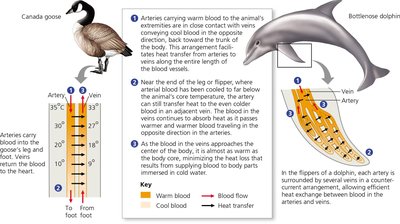
Circulatory systems regulate heat flow between the body core and surface. Key mechanisms include:
Vasodilation: Widening of blood vessels near the surface increases heat loss.
Vasoconstriction: Narrowing of blood vessels reduces heat loss.
Countercurrent Exchange: Arteries and veins are arranged to maximize heat transfer and minimize heat loss, especially in extremities.
Evaporative Cooling
When environmental temperatures exceed body temperature, evaporative cooling is essential for preventing overheating.
Mechanisms include sweating, panting, and specialized structures (e.g., mouth pouches in birds).
Evaporation removes heat as water vapor leaves the body surface.
Behavioral Responses
Both ectotherms and endotherms use behavior to regulate body temperature.
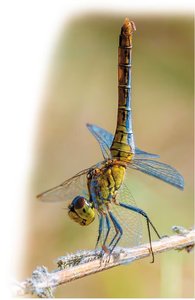
Seeking shade or sun, changing body orientation, bathing, or huddling are common strategies.
Some insects, like dragonflies, adopt specific postures to minimize heat absorption.
Adjusting Metabolic Heat Production
Endotherms can increase heat production (thermogenesis) to counteract heat loss.
Shivering Thermogenesis: Rapid muscle contractions generate heat (e.g., in birds and mammals).
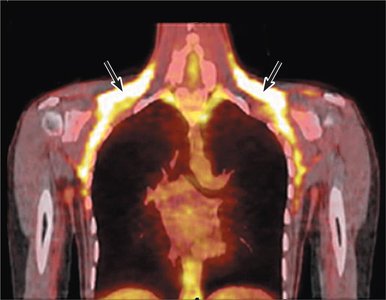
Nonshivering Thermogenesis: Hormonal signals increase metabolic activity, especially in brown fat tissue.
Brown fat is specialized for rapid heat production and is found in infants and some adult mammals.
Thermogenesis in Nonavian Reptiles
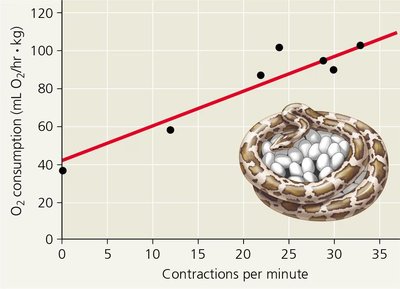
Some reptiles, such as the Burmese python, can increase body temperature through shivering, especially during egg incubation.
Muscle contractions increase oxygen consumption and heat production.
This adaptation is rare among reptiles but demonstrates the diversity of thermoregulatory mechanisms.
Acclimatization in Thermoregulation
Seasonal and Cellular Adjustments
Animals can acclimatize to changing temperatures through physiological and biochemical changes.
Birds and mammals may grow thicker fur or increase fat stores in winter.
Ectotherms may alter enzyme variants or membrane lipid composition to maintain function at different temperatures.
Some ectotherms produce antifreeze proteins to survive subzero temperatures.
Physiological Thermostats and Fever
The Hypothalamus as a Thermostat
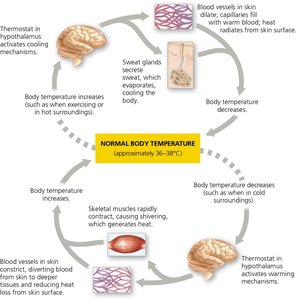
The hypothalamus in the brain acts as the body's thermostat, detecting deviations from the set point and initiating responses to restore normal temperature.
When body temperature rises, mechanisms such as vasodilation and sweating are activated to promote heat loss.
When body temperature falls, vasoconstriction and shivering are triggered to conserve and generate heat.
Fever and Behavioral Fever
Fever is an adaptive response to infection, involving an increase in the set point for body temperature. Both endotherms and ectotherms can exhibit fever, with ectotherms often seeking warmer environments to elevate body temperature during infection.
Summary Table: Thermoregulatory Mechanisms
Mechanism | Description | Example |
|---|---|---|
Insulation | Reduces heat flow between body and environment | Blubber in whales, fur in mammals |
Circulatory Adaptations | Regulates blood flow to control heat exchange | Countercurrent exchange in dolphin flippers |
Evaporative Cooling | Removes heat via evaporation of water | Sweating in humans, panting in dogs |
Behavioral Responses | Actions to seek or avoid heat | Basking in sun, seeking shade |
Metabolic Heat Production | Increases internal heat via metabolism | Shivering, brown fat activity |
Key Equations
Heat transfer (general): Where Q = heat energy, m = mass, c = specific heat, \Delta T = temperature change
Concept Check
What mode of heat exchange is involved in "wind chill"? Convection—moving air increases heat loss from the body.
Why might flower color matter to a hummingbird on a cool morning? Darker flowers absorb more sunlight, providing a warmer microenvironment for the bird.
Why is shivering likely during the onset of a fever? The set point for body temperature increases, so the body generates heat through shivering to reach the new set point.
