 Back
BackHormonal Regulation in Plants and Animals: Form and Function
Study Guide - Smart Notes
 Tailored notes based on your materials, expanded with key definitions, examples, and context.
Hormonal Regulation in Plants and Animals
Physiological Challenge: Regulation and Coordination
Organisms face the challenge of regulating growth and physiological functions while adapting to environmental conditions. This regulation is achieved through the coordination of internal and external stimuli, primarily via hormones and signaling systems.
Homeostasis: The maintenance of stable internal conditions despite external changes.
Growth and Development: Hormones coordinate cellular activities to ensure proper development and response to environmental cues.
Central Nervous System Communication: The nervous system interacts with peripheral organs to regulate physiological functions.
Plant Hormones and Growth Regulators
Plant hormones, also known as growth regulators, are chemical messengers that influence plant growth, development, and responses to stimuli.
Historical Experiments: Early studies by Darwin & Darwin and Frits Went revealed the role of auxin in phototropism and plant growth.
Auxin Mechanisms: Auxin promotes cell elongation and is central to the acid growth hypothesis.
Seed Germination: Hormones regulate the initiation and progression of seed germination.
Five Major Types of Plant Hormones
Auxin (IAA): Produced in shoot tips; regulates cell elongation, phototropism, and gravitropism.
Cytokinins: Synthesized in roots; promote cell division and delay senescence.
Gibberellins (GA): Produced in seeds and young leaves; stimulate stem elongation, seed germination, and flowering.
Abscisic Acid (ABA): Found in leaves and seeds; induces dormancy and closes stomata during stress.
Ethylene: Produced in all plant parts; regulates fruit ripening and response to stress.
Practical Uses of Plant Hormones
Auxin: Used in rooting powders to promote root formation in cuttings.
Ethylene: Applied to accelerate fruit ripening in agriculture.
Animal Hormones: Integration of Nervous and Endocrine Systems
Animal hormones are chemical messengers produced by endocrine glands, regulating physiological functions and maintaining homeostasis.
Local and Long-Distance Signaling: Hormones can act locally (paracrine/autocrine) or travel through the bloodstream to distant targets (endocrine).
Nervous-Endocrine Integration: The nervous system (fast, electrical) and endocrine system (slow, chemical) work together to regulate body functions.
Major Endocrine Glands and Hormones
Anterior Pituitary: Produces growth hormone, ACTH, TSH, etc.
Posterior Pituitary: Releases oxytocin and vasopressin.
Adrenal Glands: Produce cortisol, adrenaline.
Pancreas: Secretes insulin and glucagon.
Endocrine vs Exocrine Glands
Endocrine Glands: Release hormones directly into the bloodstream.
Exocrine Glands: Secrete substances into ducts (e.g., sweat, digestive enzymes).
Receptor-Mediated Hormone Action
Hormones exert their effects by binding to specific receptors on target cells, initiating a signal transduction pathway.
Receptor Specificity: Only cells with the appropriate receptor respond to a hormone.
Signal Transduction Steps:
Hormone binds to receptor.
Receptor activates intracellular signaling cascade.
Cellular response is produced.
Hormone Solubility and Signal Transduction
Fat-Soluble Steroid Hormones: Pass through cell membranes and bind to intracellular receptors.
Water-Soluble Peptide Hormones: Bind to membrane receptors and activate second messenger systems.
Regulation of Hormone Function: Feedback Loops
Hormone levels are regulated by feedback mechanisms to maintain homeostasis.
Negative Feedback: Hormone secretion is inhibited when the desired effect is achieved.
Positive Feedback: Hormone secretion is amplified in response to a stimulus.
Disturbances: Inability to produce a hormone disrupts feedback loops, leading to physiological imbalances.
Key Terms and Definitions
Hormone: Chemical messenger produced by glands, affecting target cells.
Posterior/Anterior Pituitary: Lobes of the pituitary gland with distinct hormone functions.
Peptide Hormone: Hormone composed of amino acids; water-soluble.
Steroid Hormone: Hormone derived from cholesterol; fat-soluble.
Local Regulator: Chemical that acts locally on nearby cells.
Neurosecretory Cell: Neuron that releases hormones into the blood.
Receptor: Protein that binds a hormone and initiates a response.
Tropism: Directional growth response in plants.
Plant Growth Regulator: Substance that influences plant growth and development.
Positive/Negative Feedback: Mechanisms regulating hormone levels.
Example: Growth Regulation in Humans
Growth hormone produced by the anterior pituitary regulates bone and tissue growth. Deficiency or excess can lead to abnormal growth patterns.
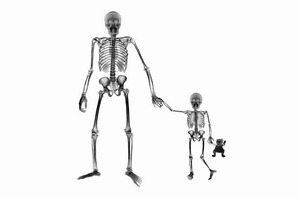
Example: The image above illustrates the difference in skeletal size between an adult and a child, highlighting the role of hormones in growth and development.
Additional info: Academic context was added to expand brief points into full explanations and to ensure completeness for exam preparation.
