 Back
BIO 102 Chapter 44_StudyGuide D
Study Guide - Smart Notes
 Tailored notes based on your materials, expanded with key definitions, examples, and context.
Overview of Hormonal Regulation
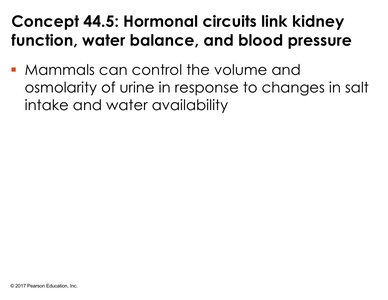
Mammals possess sophisticated hormonal circuits that regulate the volume and osmolarity of urine, enabling adaptation to changes in salt intake and water availability. These mechanisms are crucial for maintaining homeostasis, particularly blood pressure and fluid balance.
Key Hormones: Antidiuretic hormone (ADH), Renin-Angiotensin-Aldosterone System (RAAS), and Atrial Natriuretic Peptide (ANP).
Regulatory Focus: Hormones modulate kidney function to control water reabsorption and urine output, directly impacting blood volume and pressure.
Antidiuretic Hormone (ADH) and Renal Function
Mechanism of ADH Action
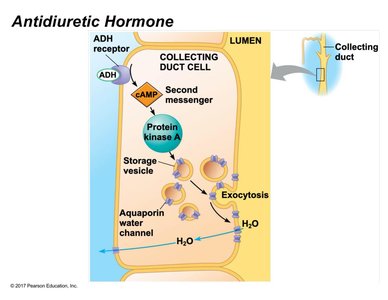
Antidiuretic hormone (ADH), also known as vasopressin, is a peptide hormone that regulates water reabsorption in the kidneys. ADH binds to receptors on the membrane of collecting duct cells, initiating a signal transduction cascade that increases water permeability.
ADH Binding: ADH binds to its receptor on the collecting duct cell membrane, acting as a primary messenger.
Signal Cascade: The binding triggers production of cyclic AMP (cAMP), a secondary messenger, which activates protein kinase A.
Aquaporin Insertion: Protein kinase A phosphorylates proteins, leading to exocytosis of aquaporin water channels from storage vesicles to the cell membrane facing the lumen.
Water Reabsorption: Aquaporins facilitate passive movement of water from the filtrate (urine) into the interstitial fluid, promoting water reabsorption.
Regulation of Fluid Retention and Blood Osmolarity
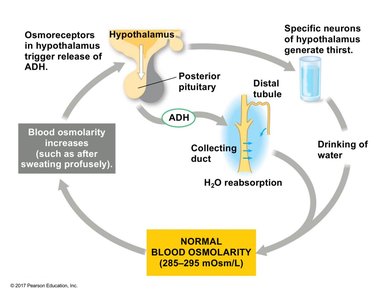
ADH is released in response to increased blood osmolarity, such as during dehydration or high salt intake. Osmoreceptors in the hypothalamus detect this change and trigger ADH release from the posterior pituitary, as well as stimulate thirst.
Blood Osmolarity: Osmolarity is the concentration of solutes in blood, measured in moles per liter.
Homeostatic Response: Increased osmolarity leads to ADH release and thirst, both promoting water retention and intake to restore normal osmolarity.
ADH Effects: ADH increases water permeability in the distal tubule and collecting duct, enhancing water reabsorption.
Diuretics and Antidiuretics: Effects on Urine Volume
Definitions and Examples
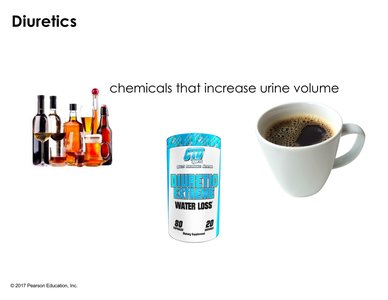
The terms antidiuretic and diuretic refer to substances that decrease or increase urine production, respectively. ADH is an antidiuretic, while diuretics are chemicals that promote urine formation and water loss.
Antidiuretic: Inhibits urine formation, increases water retention (e.g., ADH).
Diuretic: Increases urine volume, promotes water loss (e.g., caffeine, alcohol, blood pressure medications).
Caffeine: Increases glomerular filtration rate, leading to more urine output.
Alcohol: Inhibits ADH, reducing water reabsorption and increasing urine volume.
Clinical Application: Diuretics are used to treat hypertension by reducing blood volume.
Diabetes and Urine Output
Diabetes can result in excessive urine production (polyuria). Diabetes insipidus is caused by ADH hyposecretion, leading to reduced water reabsorption. Type 1 and type 2 diabetes involve excess glucose in the tubule, causing water to follow and increasing urine output.
Diabetes Insipidus: Low ADH, high urine volume, unrelated to glucose.
Type 1/2 Diabetes: Excess glucose in tubule, water follows glucose, increased urine output.
The Renin-Angiotensin-Aldosterone System (RAAS)
Mechanism and Components
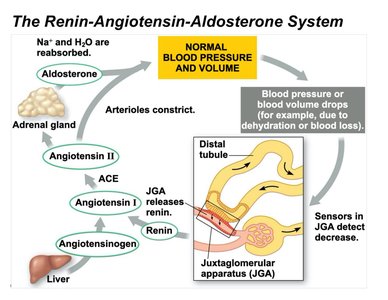
The RAAS is a hormonal system that responds to decreased blood pressure or volume, such as from blood loss or dehydration. It involves multiple organs and hormones to restore blood pressure and volume.
Juxtaglomerular Apparatus (JGA): Sensors in the nephron detect decreased blood pressure and release renin.
Renin: Enzyme that converts angiotensinogen (from the liver) to angiotensin I.
ACE (Angiotensin Converting Enzyme): Converts angiotensin I to angiotensin II (found in lungs and kidneys).
Angiotensin II: Acts on adrenal gland to release aldosterone, which increases sodium and water reabsorption.
Result: Increased blood volume and pressure, restoration of homeostasis.
Impact of Angiotensin II
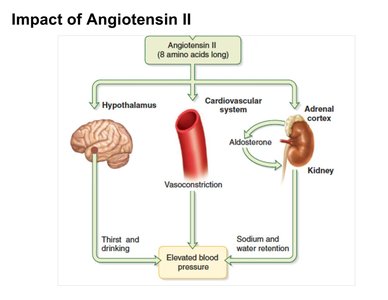
Angiotensin II has multiple effects beyond stimulating aldosterone release. It acts as a potent vasoconstrictor, stimulates thirst via the hypothalamus, and increases sodium and water retention in the kidneys.
Vasoconstriction: Narrows blood vessels, increasing arterial blood pressure.
Thirst Stimulation: Promotes fluid intake, increasing blood volume.
Aldosterone Release: Enhances sodium and water reabsorption.
Coordinated Regulation of Salt and Water Balance
Hormonal Interactions and Homeostasis
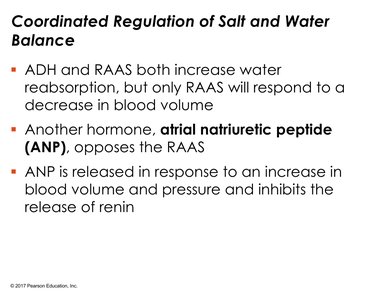
ADH and RAAS both increase water reabsorption, but only RAAS responds to decreased blood volume. Atrial natriuretic peptide (ANP) is released in response to increased blood volume and pressure, and opposes the actions of RAAS.
ANP: Released by cardiac muscle in the atria when blood pressure rises.
Effects: Inhibits renin, aldosterone, and ADH release; increases sodium excretion and urine output; modifies arterioles to increase glomerular filtration rate.
Checks and Balances: ANP provides negative feedback to prevent excessive blood volume and pressure.
Summary Table: Hormonal Regulation of Kidney Function
Hormone | Stimulus | Main Effect | Impact on Blood Pressure/Volume |
|---|---|---|---|
ADH | Increased blood osmolarity | Increases water reabsorption | Raises blood volume, lowers osmolarity |
RAAS (Aldosterone) | Decreased blood pressure/volume | Increases sodium and water reabsorption | Raises blood volume and pressure |
ANP | Increased blood pressure/volume | Increases sodium excretion, inhibits renin/aldosterone/ADH | Lowers blood volume and pressure |
Key Equations
Osmolarity:
