 Back
Hormones and the Endocrine System: Regulation and Signaling Pathways
Study Guide - Smart Notes
 Tailored notes based on your materials, expanded with key definitions, examples, and context.
Hormones and the Endocrine System
Overview of Hormonal Signaling
The endocrine system uses hormones—chemical messengers secreted into the bloodstream—to regulate physiological processes throughout the body. Hormones act on specific target cells that possess the appropriate receptors, ensuring precise control of growth, metabolism, development, and homeostasis. The endocrine and nervous systems often interact to coordinate complex responses.
Types of Intercellular Signaling
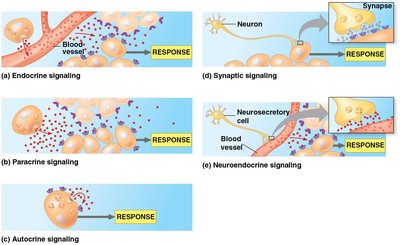
Endocrine signaling: Hormones are released into the bloodstream and affect distant target cells.
Paracrine signaling: Local regulators diffuse to nearby cells within the same tissue.
Autocrine signaling: The secreting cell is also the target cell; the signal acts on itself.
Synaptic signaling: Neurons release neurotransmitters at synapses to communicate with adjacent cells.
Neuroendocrine signaling: Neurosecretory cells release neurohormones into the blood, affecting distant targets.
Local Regulators
Prostaglandins: Mediate inflammation, blood clotting, and other local responses.
Nitric oxide (NO): A gaseous regulator that causes vasodilation by relaxing smooth muscle in blood vessels.
Local regulators are crucial for processes such as blood pressure regulation, nervous system function, and reproduction.
Chemical Classes of Hormones
Major Hormone Classes
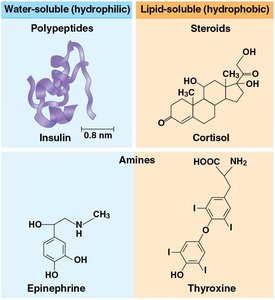
Polypeptides: Chains of amino acids (e.g., insulin); water-soluble.
Steroids: Derived from cholesterol (e.g., cortisol); lipid-soluble.
Amines: Derived from amino acids (e.g., epinephrine, thyroxine); can be water- or lipid-soluble.
Hormone Response Pathways
Water-Soluble vs. Lipid-Soluble Hormones
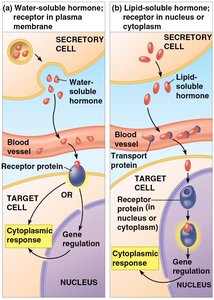
Water-soluble hormones: Secreted by exocytosis, travel freely in blood, bind to cell-surface receptors, and trigger cytoplasmic responses or gene regulation via signal transduction pathways.
Lipid-soluble hormones: Diffuse across cell membranes, travel in blood bound to transport proteins, and bind to intracellular receptors in the cytoplasm or nucleus, directly affecting gene expression.
Multiple Responses to a Single Hormone
The same hormone can elicit different responses in different target cells, depending on the receptor type or signal transduction pathway present. For example, epinephrine triggers various effects in different tissues during the "fight-or-flight" response.
Endocrine Tissues and Organs
Endocrine vs. Exocrine Glands
Endocrine glands: Ductless organs (e.g., thyroid, parathyroid, testes, ovaries) that secrete hormones directly into the bloodstream.
Exocrine glands: Have ducts that carry secretions to body surfaces or cavities (e.g., salivary glands).
Hormone Pathways and Feedback Regulation
Simple Endocrine Pathways
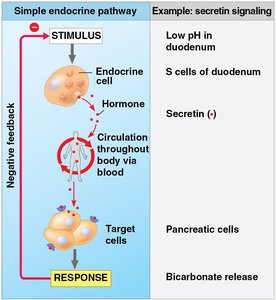
Endocrine cells respond directly to stimuli by secreting hormones, which travel through the blood to target cells. Signal transduction in target cells produces a physiological response. Negative feedback often regulates these pathways, maintaining homeostasis.
Example: Low pH in the duodenum stimulates S cells to release secretin, which prompts the pancreas to secrete bicarbonate, raising the pH and inhibiting further secretin release.
Simple Neuroendocrine Pathways
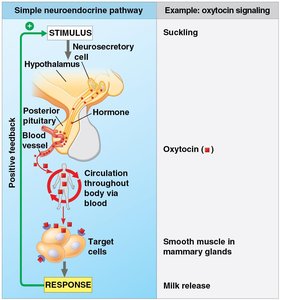
In these pathways, a sensory neuron detects a stimulus and activates a neurosecretory cell, which releases a neurohormone into the bloodstream. Positive feedback can amplify the response.
Example: Suckling stimulates the hypothalamus, leading to oxytocin release from the posterior pituitary, which causes milk release and further suckling.
Feedback Mechanisms
Negative feedback: The response reduces the initial stimulus, stabilizing physiological conditions (e.g., secretin pathway).
Positive feedback: The response amplifies the stimulus, leading to an even greater response (e.g., oxytocin pathway).
Coordination of Endocrine and Nervous Systems
The Hypothalamus and Pituitary Gland
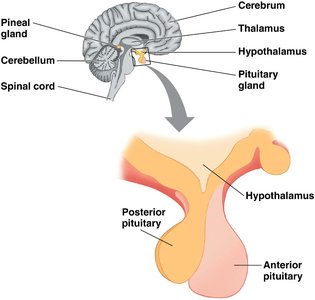
The hypothalamus integrates nervous and endocrine functions. It receives neural input and initiates neuroendocrine signals that regulate the pituitary gland. The pituitary consists of:
Posterior pituitary: Stores and releases hormones made in the hypothalamus (e.g., oxytocin, antidiuretic hormone).
Anterior pituitary: Synthesizes and secretes its own hormones under hypothalamic regulation.
Summary Table: Types of Signaling and Their Features
Type of Signaling | Secreting Cell | Signal Molecule | Target | Distance |
|---|---|---|---|---|
Endocrine | Endocrine cell | Hormone | Distant cells (via blood) | Long |
Paracrine | Local cell | Local regulator | Nearby cells | Short |
Autocrine | Local cell | Local regulator | Same cell | Very short |
Synaptic | Neuron | Neurotransmitter | Postsynaptic cell | Very short |
Neuroendocrine | Neurosecretory cell | Neurohormone | Distant cells (via blood) | Long |
Key Equations and Concepts
Hormone-Receptor Binding: Specificity of response is determined by the presence of receptors on target cells.
Signal Transduction: Water-soluble hormones use cell-surface receptors and second messengers; lipid-soluble hormones use intracellular receptors to directly regulate gene expression.
Practice Questions
What type of signaling involves a hormone acting on a nearby cell? Paracrine signaling
Which class of hormones is lipid-soluble? Steroids and some amines
Where are the receptors for lipid-soluble hormones located? In the cytoplasm or nucleus of the target cell
What is the main function of negative feedback in hormone pathways? To maintain homeostasis by reducing the initial stimulus
Which gland stores and releases hormones made in the hypothalamus? Posterior pituitary
