 Back
Hormones and the Endocrine System: Regulation, Signaling, and Homeostasis
Study Guide - Smart Notes
 Tailored notes based on your materials, expanded with key definitions, examples, and context.
Hormones and the Endocrine System
The Body’s Long-Distance Regulators
Animal hormones are chemical signals secreted into the circulatory system, communicating regulatory messages throughout the body. Although hormones reach all parts of the body, only target cells with specific receptors respond. The endocrine system is responsible for chemical signaling by hormones.

Types of Cell Signaling
Communication between animal cells via secreted signals is classified by the type of secreting cell and the route taken by the signal:
Endocrine signaling: Hormones secreted by endocrine cells travel via the bloodstream to distant target cells.
Paracrine signaling: Local regulators act over short distances, affecting nearby target cells.
Autocrine signaling: The secreting cell is also the target cell.
Synaptic signaling: Neurons release neurotransmitters at synapses, affecting adjacent cells.
Neuroendocrine signaling: Neurosecretory cells release neurohormones into the bloodstream.
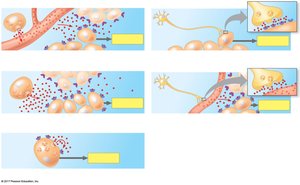
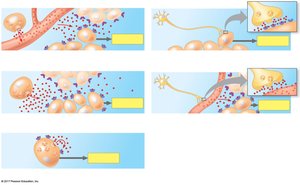
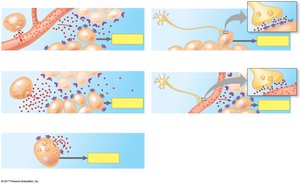
Classes of Local Regulators
Local regulators include modified fatty acids (e.g., prostaglandins), polypeptides, and gases. Nitric oxide (NO) acts as both a local regulator and neurotransmitter, promoting vasodilation when blood oxygen levels fall.
Classes of Hormones
Hormones are classified by their solubility:
Water-soluble (hydrophilic): Polypeptides (e.g., insulin), amines (e.g., epinephrine, thyroxine)
Lipid-soluble (hydrophobic): Steroids (e.g., cortisol)
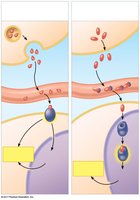
Cellular Hormone Response Pathways
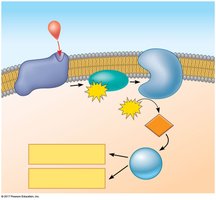
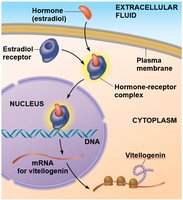
Water-soluble hormones are secreted by exocytosis, travel freely in the bloodstream, and bind to cell-surface receptors. Lipid-soluble hormones diffuse across cell membranes, travel bound to transport proteins, and bind to receptors in the cytoplasm or nucleus.
Water-soluble hormone pathway: Binding to receptor initiates a signal transduction pathway, leading to cytoskeletal changes, enzyme activation, or altered gene expression.
Lipid-soluble hormone pathway: Hormone-receptor complex acts as a transcriptional regulator in the nucleus, changing gene expression.
Multiple Responses to a Single Hormone
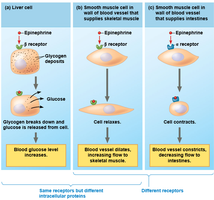
The same hormone can have different effects depending on the target cell’s receptor type or signal transduction pathway. For example, epinephrine triggers the "fight-or-flight" response, affecting various organs differently.
Endocrine Tissues and Organs
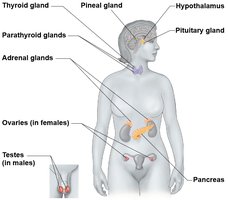
Endocrine cells are grouped in endocrine glands (e.g., thyroid, parathyroid, testes, ovaries), which are ductless. Exocrine glands (e.g., salivary glands) have ducts to carry secretions to body surfaces or cavities.
Feedback Regulation and Coordination with the Nervous System
Feedback Regulation
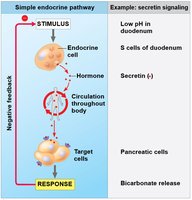
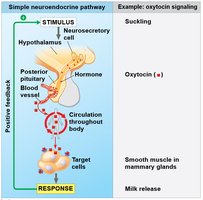
Hormone pathways are regulated by feedback mechanisms:
Negative feedback: Inhibits a response by reducing the initial stimulus, preventing excessive activity.
Positive feedback: Reinforces a stimulus, driving a process to completion.
Coordination of Endocrine and Nervous Systems
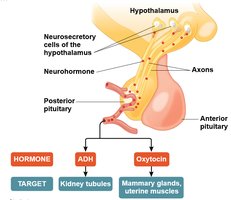
The hypothalamus coordinates endocrine signaling in vertebrates, receiving nervous input and initiating neuroendocrine signals. The pituitary gland (posterior and anterior) is regulated by the hypothalamus.
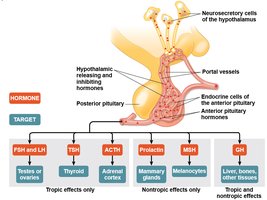
Hormone Cascade Pathways
Sets of hormones from the hypothalamus, anterior pituitary, and target endocrine glands are organized into hormone cascades. Anterior pituitary hormones in these pathways are called tropic hormones.
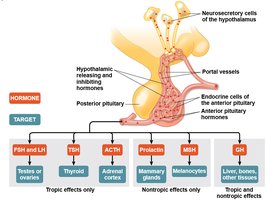
Thyroid Regulation
Thyroid hormone regulates many functions. If levels drop, the hypothalamus releases TRH, stimulating the anterior pituitary to release TSH, which then stimulates the thyroid gland to release thyroid hormone. Negative feedback prevents overproduction.
Hormonal Regulation of Growth
Growth hormone (GH) from the anterior pituitary has tropic and nontropic effects. The liver responds by releasing insulin-like growth factors (IGFs), stimulating bone and cartilage growth.
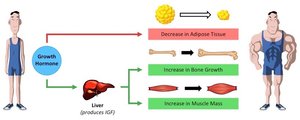
Endocrine Glands: Regulation of Homeostasis, Development, and Behavior
Adrenal Hormones: Response to Stress
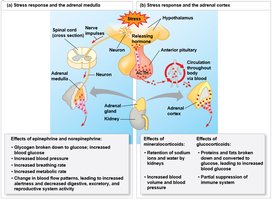
The adrenal glands (atop the kidneys) consist of the adrenal medulla (producing amines like epinephrine and norepinephrine) and adrenal cortex (producing steroids like aldosterone and cortisol). These hormones mediate the body’s response to stress.
Epinephrine’s Multiple Effects
Epinephrine can cause different responses in different cell types:
Liver cells: Glycogen breakdown and glucose release.
Skeletal muscle blood vessels: Dilation and increased blood flow.
Intestinal blood vessels: Constriction and decreased blood flow.
Sex Hormones
The gonads (testes and ovaries) produce androgens, estrogens, and progesterone. All are present in both sexes but in different proportions. Synthesis is controlled by gonadotropins (FSH and LH) from the anterior pituitary, which are regulated by gonadotropin-releasing hormone from the hypothalamus.
Testes: Synthesize androgens (mainly testosterone), promoting male reproductive structures and secondary sex characteristics.
Ovaries: Synthesize estrogens (mainly estradiol), maintaining the female reproductive system and secondary sex characteristics.
Progesterone: Prepares and maintains the uterus in mammals.
Additional info:
Hormone signaling is essential for maintaining homeostasis, regulating development, and coordinating complex behaviors.
Hormone pathways often involve multiple levels of regulation and feedback to ensure precise control.
