 Back
Hormones and the Endocrine System: Structure, Function, and Regulation
Study Guide - Smart Notes
 Tailored notes based on your materials, expanded with key definitions, examples, and context.
Hormones and the Endocrine System
Overview of Internal Communication Systems
The endocrine system and nervous system are the two primary internal communication systems in animals. They differ in speed, mechanism, and the nature of their signals.
Nervous system: Transmits high-speed electrical signals (seconds or less) through specified pathways (axons and nerves) directly to target cells.
Endocrine system: Releases chemical messengers called hormones into the bloodstream, which act more slowly (hours to days) and can affect distant target cells.
Analogy: The nervous system is like a telephone network (direct, wired), while the endocrine system is like radio signals (broadcasted, received only by cells with the appropriate receptor).

Endocrine System Structure and Function
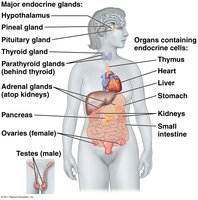
The endocrine system consists of organs and cells that produce and secrete hormones directly into the bloodstream. These hormones regulate homeostasis, growth, development, and responses to stimuli.
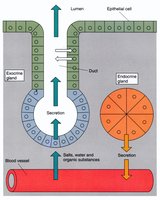
Endocrine glands: Ductless organs that secrete hormones into body fluids.
Exocrine glands: Have ducts and secrete substances onto body surfaces or into cavities (e.g., sweat, mucus, digestive enzymes).
Target cells: Only cells with specific receptors for a hormone will respond to its signal.
Chemical Signal Categories
Six Major Categories of Animal Chemical Signals
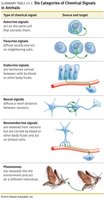
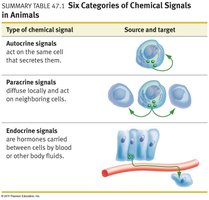
Animal cells communicate using six major types of chemical signals, classified by their mode of action rather than their molecular structure.
Autocrine: Act on the same cell that secretes them.
Paracrine: Diffuse locally and affect neighboring cells.
Endocrine: Hormones carried by blood or other fluids to distant cells.
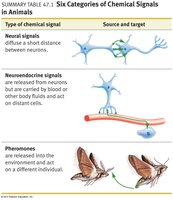
Neural: Neurotransmitters diffuse short distances between neurons.
Neuroendocrine: Released from neurons but carried by blood to distant cells.
Pheromones: Released into the environment and act on a different individual.
Type of Signal | Source and Target |
|---|---|
Autocrine | Acts on the same cell that secretes them |
Paracrine | Diffuses locally and acts on neighboring cells |
Endocrine | Hormones carried between cells by blood or other body fluids |
Neural | Diffuses a short distance between neurons |
Neuroendocrine | Released from neurons, carried by blood, acts on distant cells |
Pheromones | Released into the environment, acts on a different individual |
Hormone Pathways and Feedback
Three Pathways of Endocrine Function
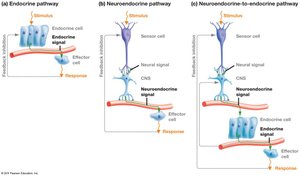
Hormones act through three main negative feedback pathways to regulate physiological processes.
Endocrine pathway: Hormones are released directly from endocrine cells to effector cells.
Neuroendocrine pathway: Neuroendocrine signals are released from neurons and act directly on effector cells.
Neuroendocrine-to-endocrine pathway: Neural signals stimulate endocrine cells to release hormones that act on effector cells.
Nervous-Endocrine Integration
The nervous and endocrine systems are tightly integrated. Electrical signals from the nervous system often trigger hormone release, and hormones can modulate nervous system activity. Negative feedback inhibition is a key regulatory mechanism.
Target cell specificity: Only cells with the appropriate receptor respond to a hormone.
Negative feedback: Reduces hormone production/secretion when the desired effect is achieved.
Hormone Chemical Families
Three Types of Hormones
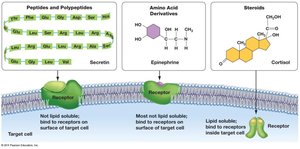
Animal hormones are classified into three chemical families, each with distinct properties and mechanisms of action.
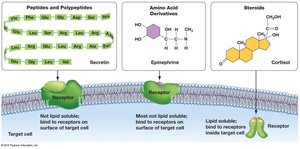
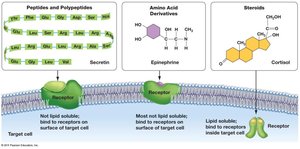
Polypeptides: Chains of amino acids linked by peptide bonds (e.g., insulin).
Amino acid derivatives: Modified amino acids (e.g., epinephrine, thyroxine).
Steroids: Lipid molecules with a four-ring structure (e.g., cortisol, ecdysone).
Solubility and Mechanism of Action
The solubility of hormones determines how they are transported and how they interact with target cells.
Steroids: Lipid soluble, diffuse through plasma membrane, bind to intracellular receptors, often alter gene expression.
Polypeptides and most amino acid derivatives: Not lipid soluble, released by exocytosis, bind to cell surface receptors, trigger signal transduction cascades.
Thyroxine: An amino acid derivative that is lipid soluble and acts similarly to steroids.
Hormone Action on Target Cells
Steroid Hormone Action
Steroid hormones enter target cells, bind to intracellular receptors, and regulate gene expression by interacting with hormone-response elements in DNA.
Zinc finger: DNA-binding region of steroid hormone receptors.
Hormone-response elements: Specific DNA sequences upstream of target genes.
Transcriptional amplification: Hormone-receptor complex stimulates production of many mRNAs, each translated multiple times.
Non-steroid Hormone Action
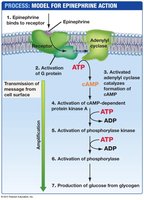
Non-steroid hormones (polypeptides and most amino acid derivatives) cannot enter target cells. They bind to cell surface receptors and initiate signal transduction cascades that amplify the signal and elicit cellular responses.
Signal transduction: Conversion of extracellular signal to intracellular response.
Second messengers: Molecules like cAMP amplify the signal inside the cell.
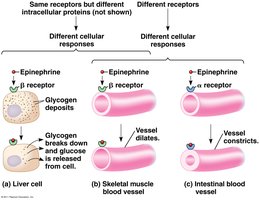
Example: Epinephrine activates phosphorylase, catalyzing glucose formation from glycogen.
Hormone Regulation and Effects
Thyroid Regulation: Hormone Cascade Pathway
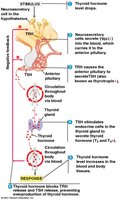
Thyroid hormone levels are regulated by a hormone cascade involving the hypothalamus, anterior pituitary, and thyroid gland. This pathway maintains metabolic homeostasis.
TRH (Thyrotropin-releasing hormone): Released by hypothalamus when thyroid hormone levels drop.
TSH (Thyroid-stimulating hormone): Released by anterior pituitary in response to TRH.
Thyroid hormone: Released by thyroid gland, regulates metabolism.
Diversity of Hormone Effects
The same hormone can trigger different responses in different target cells, depending on receptor type, second messengers, and cellular context. This explains the complexity and versatility of hormonal regulation.
Example: Epinephrine causes glycogen breakdown in liver cells, vessel dilation in skeletal muscle, and vessel constriction in intestinal blood vessels.
Hormonal Control of Metamorphosis
Amphibian Metamorphosis
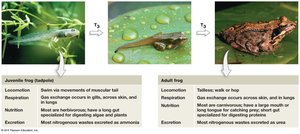
Amphibian metamorphosis is controlled by thyroid hormone (T3), which triggers growth, apoptosis, and changes in cell structure and function as tadpoles transform into adult frogs.
Growth: Formation of new structures (e.g., legs).
Apoptosis: Programmed cell death (e.g., tail cells).
Functional change: Intestinal cells adapt from plant digestion to animal prey digestion.
Insect Metamorphosis
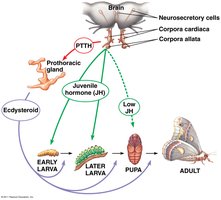
Insect metamorphosis is regulated by a combination of hormones, including PTTH (prothoracicotropic hormone), ecdysone, and juvenile hormone (JH). The interplay of these hormones determines molting, pupation, and adult development.
PTTH: Stimulates ecdysone release from prothoracic glands.
Ecdysone: Promotes molting and development.
Juvenile hormone: Maintains larval characteristics; its decline triggers metamorphosis.
High JH: Ecdysone induces juvenile growth.
Low JH: Ecdysone triggers pupation and adult development.

Additional info: The notes expand on brief points with academic context, definitions, and examples to ensure completeness and clarity for exam preparation.
