Back
Hormones and the Endocrine System: Structure, Function, and Regulation
Study Guide - Smart Notes
 Tailored notes based on your materials, expanded with key definitions, examples, and context.
Hormones and the Endocrine System
Overview of Internal Communication Systems
The body uses two major internal communication systems: the nervous system and the endocrine system. These systems differ in speed, mechanism, and specificity of signal transmission.
Nervous system: Transmits high-speed electrical signals (in seconds or less) through specific pathways (axons and nerves) to targeted cells.
Endocrine system: Relies on chemical messengers called hormones that are secreted into the bloodstream and act on distant target cells, often with slower and longer-lasting effects.
Target cells must have specific receptors to respond to hormones; otherwise, the signal has no effect.


Endocrine System Structure and Function
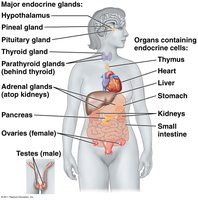
The endocrine system is composed of organs and cells that produce and secrete hormones directly into the bloodstream. These hormones regulate a wide range of physiological processes, including homeostasis, growth, development, and responses to stimuli.
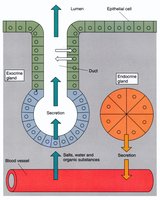
Endocrine glands: Ductless organs that secrete hormones into surrounding fluids for distribution throughout the body.
Exocrine glands: Have ducts and secrete substances (e.g., sweat, digestive enzymes) onto body surfaces or into cavities; not part of the endocrine system.
Chemical Signals in Animals
Categories of Chemical Signals
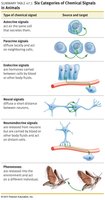
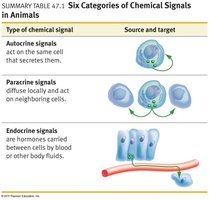
Animals use six major categories of chemical signals, classified by their mode of action and target:
Autocrine signals: Act on the same cell that secretes them.
Paracrine signals: Diffuse locally and affect neighboring cells.
Endocrine signals (hormones): Carried by blood or other body fluids to distant target cells.
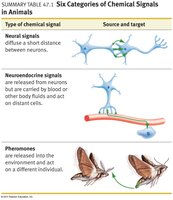
Neural signals (neurotransmitters): Diffuse short distances between neurons.
Neuroendocrine signals: Released from neurons but travel in blood to distant cells.
Pheromones: Released into the environment and act on other individuals of the same species.
Autocrine, Paracrine, and Endocrine Signaling
These three types of signaling differ in the distance over which the signal acts and the identity of the target cell.
Autocrine: Cytokines are a well-studied example, amplifying the cell's own response to stimuli.
Paracrine: Includes some cytokines and cell-cell signals like insulin and glucagon, which can also act as hormones.
Endocrine: Hormones produced by specialized cells or glands, acting on distant targets via the bloodstream.
Neural, Neuroendocrine, and Pheromonal Signaling
Neural and neuroendocrine signals are crucial for rapid and coordinated responses, while pheromones mediate communication between individuals.
Neural signals: Neurotransmitters like norepinephrine can also function as hormones.
Neuroendocrine signals: Hormones such as antidiuretic hormone (ADH) are released by neurons and act on distant targets.
Pheromones: Coordinate reproductive behaviors and mate attraction.
Hormone Pathways and Feedback
Three Pathways of Hormone Action
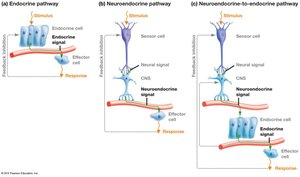
Hormones can act through three main negative feedback pathways:
Endocrine pathway: Endocrine cells release hormones directly to effector cells.
Neuroendocrine pathway: Neuroendocrine signals act directly on effector cells (e.g., hypothalamus to posterior pituitary to release ADH).
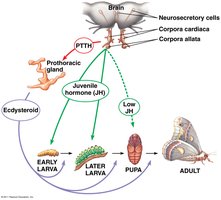
Neuroendocrine-to-endocrine pathway: Neural signals stimulate endocrine cells, which then release hormones to act on effector cells (e.g., PTTH to ecdysone in insects).
Nervous and Endocrine System Integration
The nervous and endocrine systems are tightly integrated. Electrical signals from the nervous system often trigger hormone release, and hormones can modulate nervous system activity. Negative feedback inhibition is a key regulatory mechanism, reducing hormone production or secretion when appropriate.
Hormone Chemical Families and Mechanisms
Three Major Hormone Families
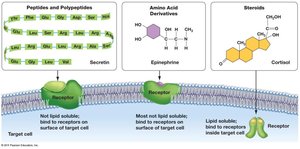
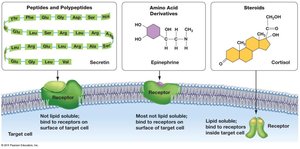
Animal hormones fall into three chemical families, each with distinct properties and mechanisms of action:
Polypeptides: Chains of amino acids linked by peptide bonds (e.g., insulin).
Amino acid derivatives: Modified amino acids (e.g., epinephrine, thyroxine).
Steroids: Lipid molecules with a characteristic four-ring structure (e.g., cortisol, estrogen).
Hormone Solubility and Target Cell Entry
The solubility of a hormone determines how it interacts with target cells:
Steroid hormones: Lipid-soluble, diffuse through plasma membranes, bind to intracellular receptors, and often alter gene expression.
Polypeptides and most amino acid derivatives: Not lipid-soluble, released by exocytosis, bind to cell surface receptors, and trigger intracellular signal transduction cascades.
Thyroxine: An amino acid derivative that is lipid-soluble and acts similarly to steroids.
Steroid Hormone Action
Steroid hormones regulate gene expression by binding to intracellular receptors that interact with specific DNA sequences called hormone-response elements.
The hormone-receptor complex binds DNA and stimulates transcription of target genes.
This leads to the production of many mRNA molecules, which are translated into proteins that mediate the hormone's effects.
Non-Steroid Hormone Action and Signal Transduction
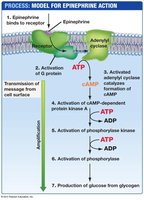
Non-steroid hormones (polypeptides and most amino acid derivatives) cannot cross the plasma membrane. They bind to cell surface receptors, initiating a signal transduction cascade that amplifies the signal and leads to a cellular response.
Second messengers such as cyclic AMP (cAMP) play a key role in amplifying the signal inside the cell.
Example: Epinephrine activates phosphorylase, leading to the breakdown of glycogen into glucose.
Hormone Regulation and Effects
Hormone Cascade Pathways
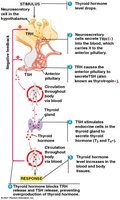
Some hormones are regulated through cascade pathways, where one hormone stimulates the release of another. For example, thyroid hormone regulation involves the hypothalamus, anterior pituitary, and thyroid gland.
If thyroid hormone levels drop, the hypothalamus releases TRH, stimulating the anterior pituitary to release TSH, which in turn stimulates the thyroid gland to release thyroid hormone.
Diversity of Hormone Effects
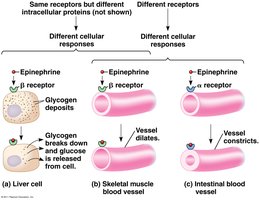
The same hormone can have different effects in different target cells, depending on the receptors, second messengers, and intracellular proteins present. This explains why a single hormone can trigger diverse responses in different tissues or at different developmental stages.
Hormonal Control of Metamorphosis
Amphibian Metamorphosis
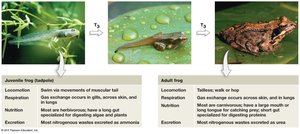
Amphibian metamorphosis is controlled by thyroid hormones, especially triiodothyronine (T3). Increased T3 levels trigger changes such as limb growth, tail resorption, and gut remodeling, allowing the transition from aquatic tadpole to terrestrial adult.
Insect Metamorphosis
Insect development is regulated by a combination of hormones, including prothoracicotropic hormone (PTTH), ecdysone, and juvenile hormone (JH). The balance of these hormones determines whether the insect molts to a larger larva, enters the pupal stage, or becomes an adult.
High JH: Ecdysone induces larval molting.
Low JH: Ecdysone triggers metamorphosis to the pupal stage.
No JH: Ecdysone promotes transition to adulthood and sexual maturity.