 Back
How Cells Harvest Chemical Energy: Aerobic Cellular Respiration and Fermentation
Study Guide - Smart Notes
 Tailored notes based on your materials, expanded with key definitions, examples, and context.
How Cells Harvest Chemical Energy
Introduction to Aerobic Cellular Respiration
Aerobic cellular respiration is the process by which cells break down glucose in the presence of oxygen to produce ATP, the main energy currency of the cell. This process occurs in multiple stages, primarily within the mitochondria of eukaryotic cells.
Aerobic: Requires oxygen (O2).
ATP: Adenosine triphosphate, the energy molecule produced.
Location: Most stages occur inside the mitochondria.
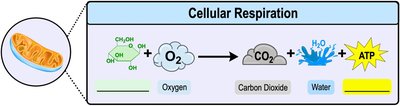
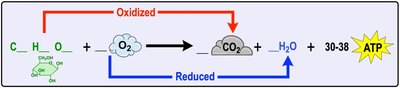
Overall Chemical Equation:
Glucose is oxidized to carbon dioxide.
Oxygen is reduced to water.
Stages of Aerobic Cellular Respiration
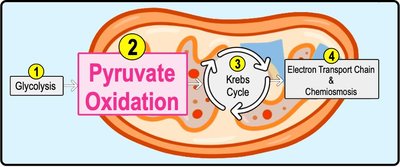
The process of aerobic cellular respiration is divided into four main stages:
Glycolysis
Pyruvate Oxidation
Krebs Cycle (Citric Acid Cycle)
Electron Transport Chain & Chemiosmosis
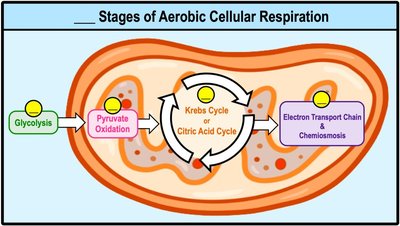
Mnemonic for Stages
To remember the order: Glycolysis, Pyruvate Oxidation, Krebs Cycle, Electron Transport Chain & Chemiosmosis.
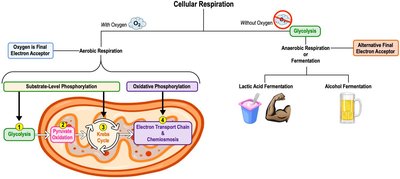
Map of Cellular Respiration Pathways
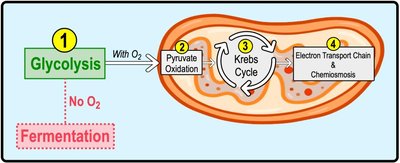
Cellular respiration can proceed with or without oxygen. In the absence of oxygen, cells use fermentation or anaerobic respiration.
With Oxygen: Glycolysis → Pyruvate Oxidation → Krebs Cycle → Electron Transport Chain & Chemiosmosis
Without Oxygen: Glycolysis → Fermentation (Lactic Acid or Alcohol)
Redox Reactions in Cellular Respiration
Oxidation-Reduction (Redox) Reactions
Redox reactions involve the transfer of electrons between molecules. Oxidation is the loss of electrons, while reduction is the gain of electrons. These reactions always occur together.
Oxidation: Loss of electrons
Reduction: Gain of electrons
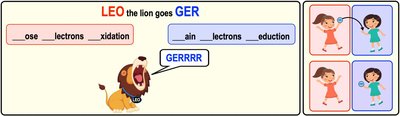
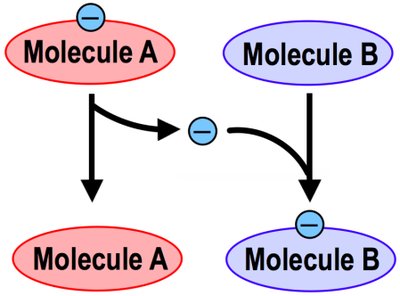
Example: When glucose donates electrons to NAD+ (forming NADH), glucose is oxidized and NAD+ is reduced.
Electron Carriers: NADH & FADH2
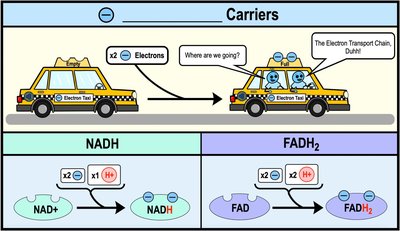
Electron carriers such as NADH and FADH2 transport high-energy electrons to the electron transport chain.
NAD+ and FAD: Oxidized forms
NADH and FADH2: Reduced forms, carry electrons
Act as "electron taxis" shuttling electrons to the ETC
Glycolysis
Overview of Glycolysis
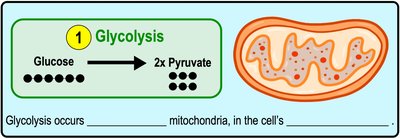
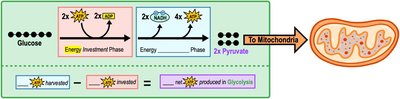
Glycolysis is the first step of cellular respiration, breaking down one glucose molecule (6 carbons) into two pyruvate molecules (3 carbons each). It occurs in the cytoplasm and does not require oxygen.
"Glyco" = sugar, "lysis" = splitting
Only step that occurs outside mitochondria
Phases of Glycolysis
Energy Investment Phase: Uses 2 ATP to start the process
Energy Harvest Phase: Produces 4 ATP and 2 NADH
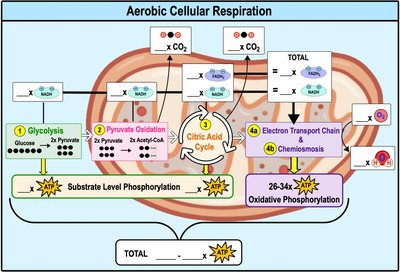
Net Products (per glucose): 2 pyruvate, 2 NADH, 2 ATP
Pyruvate Oxidation
Conversion of Pyruvate to Acetyl-CoA
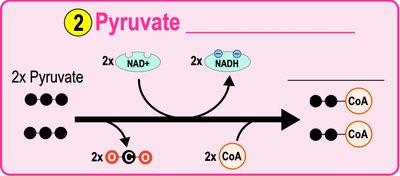
Each pyruvate from glycolysis is transported into the mitochondrial matrix and converted into acetyl-CoA, producing NADH and releasing CO2.
Occurs in the mitochondrial matrix
Products (per glucose): 2 acetyl-CoA, 2 NADH, 2 CO2
Krebs Cycle (Citric Acid Cycle)
Overview and Phases
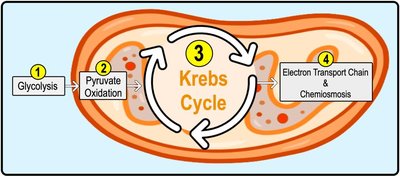
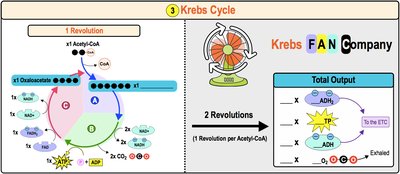
The Krebs Cycle completes the breakdown of glucose by oxidizing acetyl-CoA to CO2 and transferring electrons to NADH and FADH2. It occurs in the mitochondrial matrix.
Three main phases: Acetyl-CoA entry, citrate oxidation, oxaloacetate regeneration
Each turn produces: 1 ATP, 3 NADH, 1 FADH2, 2 CO2 (per acetyl-CoA)
Two turns per glucose molecule
Electron Transport Chain & Chemiosmosis
Electron Transport Chain (ETC)
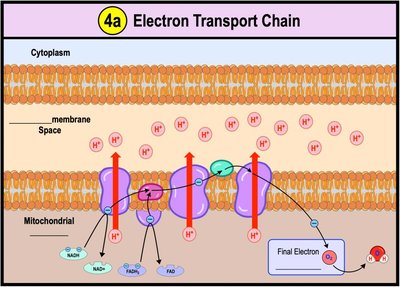
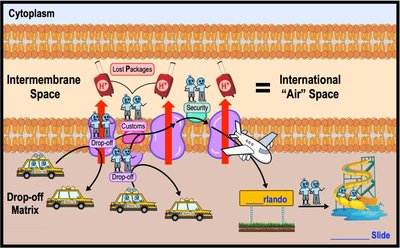
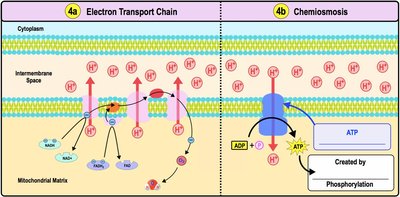
The ETC is a series of proteins in the inner mitochondrial membrane that transfer electrons from NADH and FADH2 to oxygen, the final electron acceptor. This process pumps H+ ions into the intermembrane space, creating a proton gradient.
Final electron acceptor: Oxygen (O2)
Water is formed when O2 accepts electrons and H+
Chemiosmosis and ATP Synthase
The H+ gradient created by the ETC drives chemiosmosis, where H+ flows back into the matrix through ATP synthase, generating ATP from ADP and inorganic phosphate.
Oxidative phosphorylation: ETC + chemiosmosis
Produces the majority of ATP in cellular respiration (26-34 ATP per glucose)
Review of Aerobic Cellular Respiration
Summary Table of Products
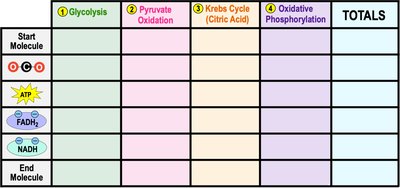
The following table summarizes the total products generated from one molecule of glucose during each stage of aerobic cellular respiration:
Stage | ATP | NADH | FADH2 | CO2 | H2O |
|---|---|---|---|---|---|
Glycolysis | 2 | 2 | 0 | 0 | 0 |
Pyruvate Oxidation | 0 | 2 | 0 | 2 | 0 |
Krebs Cycle | 2 | 6 | 2 | 4 | 0 |
Oxidative Phosphorylation | 26-34 | 0 | 0 | 0 | 6 |
Total | 30-38 | 10 | 2 | 6 | 6 |
Fermentation & Anaerobic Respiration
Fermentation
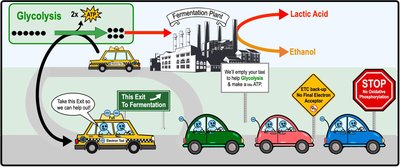
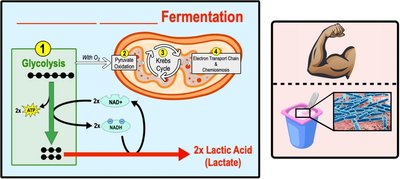
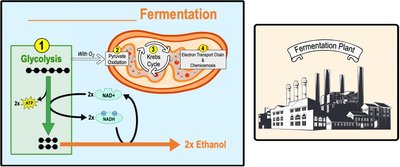
When oxygen is not available, cells can perform fermentation to regenerate NAD+ and allow glycolysis to continue. Fermentation produces much less ATP than aerobic respiration.
Lactic Acid Fermentation: Pyruvate is reduced to lactic acid (lactate), regenerating NAD+. Occurs in muscle cells and some bacteria.
Alcohol Fermentation: Pyruvate is reduced to ethanol and CO2, regenerating NAD+. Occurs in yeast and some plants.
Anaerobic Respiration
Some unicellular organisms can use molecules other than oxygen as the final electron acceptor in the electron transport chain (e.g., nitrate, sulfate, CO2). Anaerobic respiration produces more ATP than fermentation but less than aerobic respiration.
Alternative electron acceptors: Nitrate (NO3–), sulfate (SO42–), CO2
Key Terms:
Substrate-level phosphorylation: Direct formation of ATP in glycolysis and Krebs cycle.
Oxidative phosphorylation: ATP formation via ETC and chemiosmosis.
Summary: Aerobic cellular respiration is a highly efficient process for harvesting energy from glucose, producing up to 38 ATP per glucose molecule. In the absence of oxygen, cells rely on fermentation or anaerobic respiration, which yield much less ATP.
