 Back
BackHow Cells Harvest Chemical Energy: Cellular Respiration (Part I)
Study Guide - Smart Notes
 Tailored notes based on your materials, expanded with key definitions, examples, and context.
How Cells Harvest Chemical Energy
Overview of Cellular Respiration
Cellular respiration is the process by which cells extract energy from organic molecules, primarily glucose, to produce ATP, the energy currency of the cell. This process involves a series of metabolic pathways that convert biochemical energy from nutrients into ATP, releasing waste products such as carbon dioxide and water.
Cellular Respiration (CR): An exergonic process that breaks down glucose and other organic molecules in the presence of oxygen to release energy.
Big Picture: Food is digested and broken down into smaller molecules, which are then used in cellular respiration to generate ATP.
Key Stages: Glycolysis, Pyruvate Oxidation, Citric Acid (Krebs) Cycle, Electron Transport Chain (ETC), and Chemiosmosis.
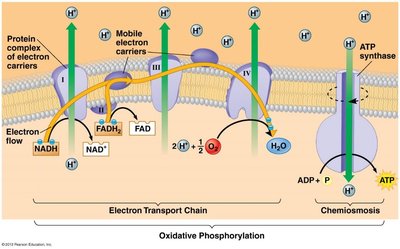
ATP Production: Most ATP is produced during oxidative phosphorylation (ETC + chemiosmosis).
Integration with Digestion, Respiration, and Excretion
The process of cellular respiration is closely linked to the digestive, respiratory, and excretory systems. The journey of food from ingestion to ATP production involves several steps:
Food is ingested and digested into smaller molecules (e.g., glucose, amino acids, fatty acids).
Enzymes in the digestive tract break down polysaccharides into monosaccharides, proteins into amino acids, and fats into fatty acids and glycerol.
Monosaccharides like glucose are absorbed into the bloodstream and transported to cells.
Glucose enters cells via transporter proteins, often regulated by insulin.
Inside the cell, glucose undergoes glycolysis, producing pyruvate, which enters the mitochondria.
Most energy is harvested in the mitochondria via the electron transport chain and chemiosmosis, requiring oxygen.
Waste products (CO2 and H2O) are expelled via the respiratory and excretory systems.
Key Terms and Concepts
Phosphorylation: The addition of a phosphate group (P) to a molecule, making it more reactive and less stable. This occurs during glycolysis and other metabolic steps.
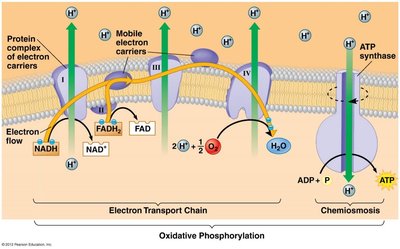
Oxidative Phosphorylation: The final stage of cellular respiration where most ATP is produced, involving the electron transport chain and chemiosmosis.
Chemiosmosis: The diffusion of H+ ions down their concentration gradient through ATP synthase, driving the synthesis of ATP from ADP and P.
Cellular Respiration: The Big Picture
Redox Reactions in Cellular Respiration
Cellular respiration is fundamentally a series of redox (reduction-oxidation) reactions. Glucose is oxidized, losing electrons (and hydrogen atoms), while oxygen is reduced, gaining electrons to form water.
Oxidation: Loss of electrons (e.g., glucose is oxidized to CO2).
Reduction: Gain of electrons (e.g., oxygen is reduced to H2O).
Electron Carriers: NAD+ and FAD are reduced to NADH and FADH2 during glycolysis and the Krebs cycle, carrying electrons to the ETC.
Overall Equation for Cellular Respiration
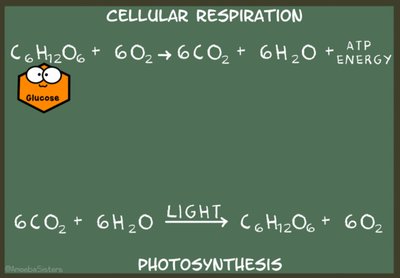
The overall chemical equation for cellular respiration is:
Reactants: Glucose (C6H12O6) and Oxygen (O2).
Products: Carbon dioxide (CO2), Water (H2O), and ATP (energy).
Energy Transformation and ATP Production
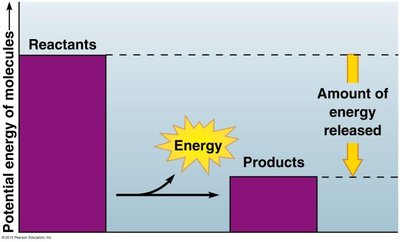
During cellular respiration, the potential energy stored in glucose is released and used to synthesize ATP. The process is exergonic, meaning it releases energy. The energy released is less than the energy stored in the reactants, as some is lost as heat.
Exergonic Reaction: Energy is released as glucose is broken down.
ATP: The main energy currency produced, used for cellular work.
Summary Table: Oxidation and Reduction in Cellular Respiration
Process | Substance | Electron Movement | Result |
|---|---|---|---|
Oxidation | Glucose (C6H12O6) | Loses electrons (H atoms) | CO2 produced |
Reduction | Oxygen (O2) | Gains electrons (H atoms) | H2O produced |
Self-Test Questions
What are the reactants and products of cellular respiration?
Which molecules are oxidized and which are reduced?
How is energy from food transformed into ATP?
Additional Info:
Pyruvate oxidation occurs prior to the citric acid cycle.
NADH is produced in glycolysis; both NADH and FADH2 are produced in the Krebs cycle.
Exact ATP yield per glucose is an estimate due to variability in the process.
