 Back
How Cells Harvest Chemical Energy: Fermentation and Cellular Respiration
Study Guide - Smart Notes
 Tailored notes based on your materials, expanded with key definitions, examples, and context.
Fermentation: An Alternative Pathway for Energy Extraction
Overview of Fermentation
Fermentation is a metabolic process that allows cells to extract energy from food molecules in the absence of oxygen. It is an anaerobic pathway that is essential for certain organisms and cell types when oxygen is not available.
Purpose: To extract stored energy from food without using oxygen.
Who performs fermentation? Prokaryotes in anaerobic environments (e.g., gut bacteria), yeast, skeletal muscle cells during intense exercise, and red blood cells.
Location: Cytoplasm of the cell.
Stages:
Glycolysis
Production of alcohol or acid
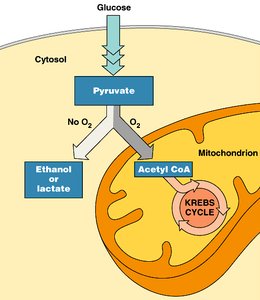
Summary Table: Cellular Respiration vs. Fermentation
Process | Stages | Inputs | Outputs/Goal | Cell Location |
|---|---|---|---|---|
Cellular Respiration | I. Glycolysis II. Pyruvate Oxidation III. Citric Acid Cycle IV. Oxidative Phosphorylation | 6C molecule (e.g., glucose) | ATP, NADH, FADH2, CO2, H2O | Cytoplasm (glycolysis), Mitochondria (other stages) |
Fermentation | I. Glycolysis II. Production of alcohol or acid | 6C molecule (e.g., glucose) | ATP, NADH, Ethanol or Lactic Acid, CO2 (alcohol fermentation), NAD+ | Cytoplasm |
Alcohol Fermentation
Steps of Alcohol Fermentation
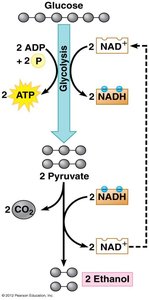
Alcohol fermentation is a two-step process that occurs in yeast and some bacteria. It is used in winemaking, brewing, and baking.
Step I: Glycolysis – Glucose is oxidized to pyruvate, producing ATP and NADH.
Step II: Production of Alcohol
CO2 is released from pyruvate.
Pyruvate is converted to ethanol, regenerating NAD+ for glycolysis.
Organisms: Yeast (fungi), some bacteria.
Lactic Acid Fermentation
Steps of Lactic Acid Fermentation
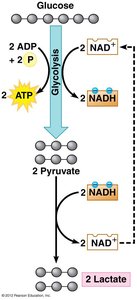
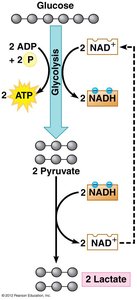
Lactic acid fermentation is performed by certain bacteria and animal cells (e.g., muscle cells during strenuous exercise). It is important in the production of dairy products and other fermented foods.
Step I: Glycolysis – Glucose is oxidized to pyruvate, producing ATP and NADH.
Step II: Production of Lactic Acid
No CO2 is released.
Pyruvate is converted to lactic acid, regenerating NAD+.
Applications: Cheese, yogurt, kefir, sour cream, soy sauce, sauerkraut.
Other cells/organisms: Muscle cells at the start of strenuous exercise, red blood cells, gut bacteria.
Fermentation in Food Production
Cheese production: Milk (lactose = glucose + galactose) is curdled by bacteria and rennet, producing lactic acid and forming curds. Whey is removed.
Swiss cheese holes: Formed by CO2 produced by certain bacteria during fermentation.
Comparison: Cellular Respiration vs. Fermentation
Key Differences
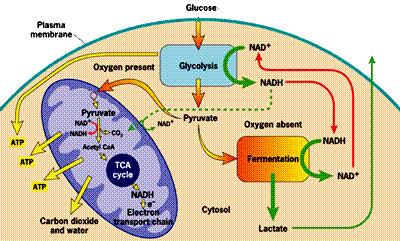
Both processes begin with glycolysis, which oxidizes glucose to pyruvate.
Fermentation does not require oxygen or mitochondria.
Cellular respiration continues in the mitochondria if oxygen is present, producing much more ATP.
Summary Table: Inputs and Outputs
Process | Stages | Inputs | Outputs/Goal | Cell Location |
|---|---|---|---|---|
Cellular Respiration | I. Glycolysis II. Pyruvate Oxidation III. Citric Acid Cycle IV. Oxidative Phosphorylation | Glucose, O2 | CO2, H2O, ATP (lots) | Cytoplasm, Mitochondria |
Fermentation | I. Glycolysis II. Alcohol or Acid Production | Glucose | Ethanol or Lactic Acid, ATP (2 per glucose) | Cytoplasm |
Glycolysis: The Common First Step
Key Reactions in Glycolysis
Oxidation: 3-carbon sugar phosphate (3C-P) loses hydrogen (and electrons).
Reduction: NAD+ is reduced to NADH.
Phosphorylation: Energy released from oxidation is used to add phosphate to ADP, forming ATP.
The net equation for glycolysis is:
Self-Test and Review Questions
What happens to pyruvate if there is no oxygen?
Which organisms use fermentation?
What are the main differences between fermentation and cellular respiration?
Can you draw and label the steps of cellular respiration and fermentation?
Summary of Energy Harvesting Pathways
Glycolysis: Occurs in the cytoplasm, produces 2 ATP and 2 NADH per glucose.
Fermentation: Converts pyruvate to ethanol or lactic acid, regenerates NAD+, yields 2 ATP per glucose.
Cellular Respiration: If oxygen is present, pyruvate enters mitochondria, is converted to acetyl CoA, enters the citric acid cycle, and proceeds to oxidative phosphorylation, yielding much more ATP.
Key Terms and Definitions
Fermentation: Anaerobic process that allows ATP production without oxygen by regenerating NAD+.
Glycolysis: The breakdown of glucose into pyruvate, yielding ATP and NADH.
Pyruvate: The end product of glycolysis; can be further metabolized by fermentation or cellular respiration.
NAD+/NADH: Electron carrier molecules involved in redox reactions.
Citric Acid Cycle (Krebs Cycle): Series of reactions in mitochondria that generate electron carriers for oxidative phosphorylation.
Oxidative Phosphorylation: Process in mitochondria that uses electron transport and chemiosmosis to produce ATP.
Additional info: The diagrams and tables above summarize the main differences between fermentation and cellular respiration, highlighting the importance of oxygen, the location of each process, and the energy yield. Fermentation is crucial for cells and organisms that experience low-oxygen conditions, allowing continued ATP production and survival.
