 Back
How Cells Obtain Energy: Metabolism, Cellular Respiration, and Fermentation
Study Guide - Smart Notes
 Tailored notes based on your materials, expanded with key definitions, examples, and context.
Energy and Metabolism
Bioenergetics and Energy Flow in Ecosystems
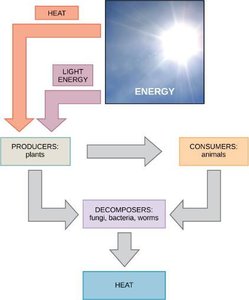
Bioenergetics is the study of how energy flows through living systems, such as cells and ecosystems. Energy enters most ecosystems as sunlight, is converted by producers (plants) into chemical energy, and then transferred to consumers (animals) and decomposers (fungi, bacteria, worms). At each stage, some energy is lost as heat.
Producers (plants) capture light energy and convert it into chemical energy via photosynthesis.
Consumers (animals) obtain energy by eating producers or other consumers.
Decomposers (fungi, bacteria, worms) break down dead organisms, recycling nutrients and releasing energy as heat.
Metabolism: An Overview
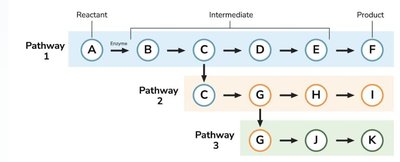
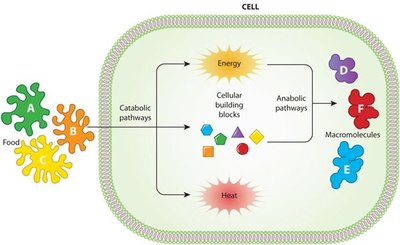
Metabolism encompasses all chemical reactions within a cell, including those that consume or generate energy. These reactions are organized into metabolic pathways, which are sequences of chemical reactions that transform a starting molecule into a final product through a series of intermediates.
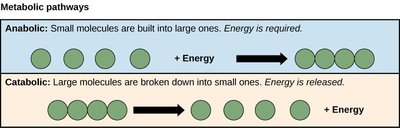
Anabolic pathways: Build complex molecules from simpler ones (e.g., photosynthesis, DNA replication).
Catabolic pathways: Break down complex molecules into simpler ones (e.g., cellular respiration, fermentation).
Energy: Forms and Definitions
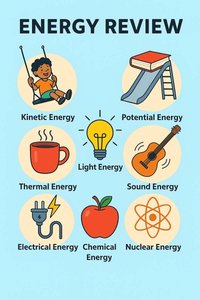
Energy is defined as the ability to do work or cause change. It exists in various forms, including kinetic, potential, thermal, light, chemical, electrical, sound, and nuclear energy.
Kinetic energy: Energy of motion (e.g., a moving object).
Potential energy: Stored energy due to position or structure (e.g., a stretched rubber band).
Chemical energy: Stored in chemical bonds (e.g., glucose, ATP).
Thermal energy: Energy associated with temperature (heat).
Light energy: Energy carried by photons (e.g., sunlight).
Thermodynamics in Biology
Thermodynamics is the study of energy and its transformations. Two fundamental laws govern energy in biological systems:
First Law of Thermodynamics: The total amount of energy in the universe is constant; energy can be transformed but not created or destroyed.
Second Law of Thermodynamics: Every energy transfer or transformation increases the entropy (disorder) of the universe; some energy is always lost as heat.
Heat energy is the energy transferred from one system to another that is not used for work.
Enzymes and Catalysis
Enzyme Structure and Function
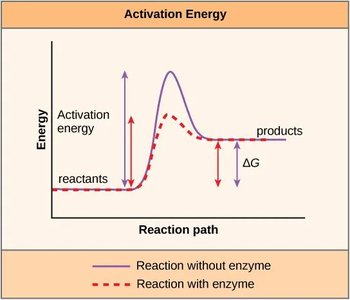
Enzymes are globular proteins that act as biological catalysts, speeding up chemical reactions by lowering the activation energy required. They are essential for metabolic pathways.
Substrate: The reactant molecule(s) that enzymes act upon.
Active site: The region on the enzyme where the substrate binds and the reaction occurs.
Enzyme activity can be affected by environmental factors such as pH, temperature, salinity, and the presence of cofactors or coenzymes.
Cellular Respiration
Overview and Equation
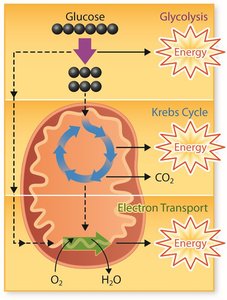
Cellular respiration is a catabolic process that releases energy from food molecules (such as glucose) in the presence of oxygen. The overall chemical equation is:
Glycolysis: Breaks down glucose into pyruvate in the cytoplasm.
Krebs Cycle (Citric Acid Cycle): Converts pyruvate into CO2 and captures high-energy electrons in the mitochondria.
Electron Transport Chain (ETC): Uses electrons to create an electrochemical gradient, producing ATP and water.
ATP: The Energy Currency of the Cell
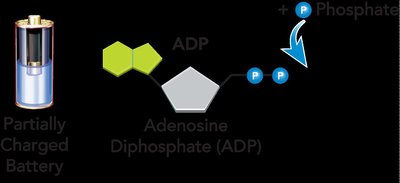
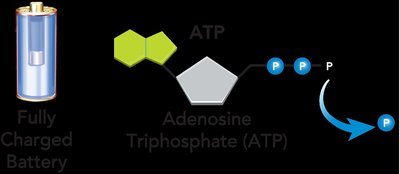
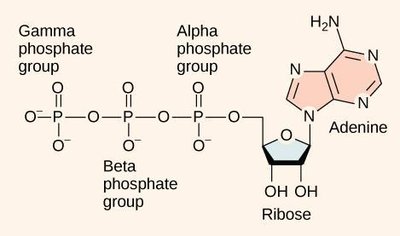
Adenosine triphosphate (ATP) is the primary energy carrier in cells. Energy is stored in the bonds between phosphate groups and released when ATP is hydrolyzed to ADP (adenosine diphosphate).
ATP → ADP + Pi + energy (used for cellular work)
ADP + Pi + energy → ATP (recharging ATP when energy is available)
Electron Carriers
Electron carriers such as NAD+ and FAD shuttle high-energy electrons during metabolic processes. These carriers are reduced (gain electrons) and oxidized (lose electrons) repeatedly.
NAD+ + 2e- + H+ → NADH
FAD + 2e- + 2H+ → FADH2
Glycolysis
Glycolysis is the first step in cellular respiration, occurring in the cytoplasm. It breaks one glucose molecule into two pyruvate molecules, producing a net gain of 2 ATP and 2 NADH per glucose.
Costs 2 ATP to split glucose into 2 G3P (glyceraldehyde-3-phosphate).
Each G3P is converted to pyruvate, generating 2 ATP and 1 NADH per G3P.
The Citric Acid Cycle (Krebs Cycle)
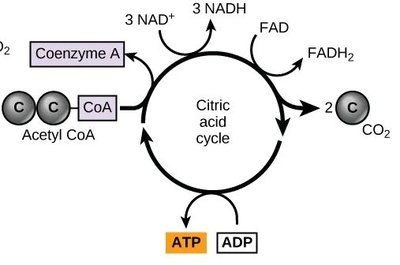
The citric acid cycle occurs in the mitochondrial matrix. Pyruvate is converted to acetyl-CoA, which enters the cycle. Each turn of the cycle releases CO2, produces ATP, and captures electrons in NADH and FADH2.
Acetyl-CoA combines with a 4-carbon molecule to form citric acid (6C).
Two CO2 are released, ATP is produced, and electron carriers are reduced.
The original 4C molecule is regenerated for another cycle.
Oxidative Phosphorylation and the Electron Transport Chain
Oxidative phosphorylation occurs in the inner mitochondrial membrane. Electrons from NADH and FADH2 are passed through the electron transport chain to oxygen, the final electron acceptor. This process creates a proton gradient used by ATP synthase to generate ATP.
Only 2 ATP are produced in glycolysis and 2 in the Krebs cycle.
Most ATP (25-30 per glucose) is produced during oxidative phosphorylation.
ATP synthase uses the flow of H+ ions (chemiosmosis) to convert ADP to ATP.
Fermentation (Anaerobic Pathways)
Fermentation Overview
Fermentation is an anaerobic process that allows cells to regenerate NAD+ when oxygen is not available, enabling glycolysis to continue and produce a small amount of ATP.
Lactic acid fermentation: Converts pyruvate to lactic acid (lactate), regenerating NAD+. Occurs in animal cells under low oxygen conditions (e.g., muscle fatigue).
Alcohol fermentation: Occurs in yeasts and some bacteria, converting pyruvate to ethanol and CO2 while regenerating NAD+.
Summary Table: Cellular Respiration and Fermentation
Process | Location | Oxygen Required? | Main Products |
|---|---|---|---|
Glycolysis | Cytoplasm | No | 2 ATP, 2 NADH, 2 Pyruvate |
Krebs Cycle | Mitochondrial Matrix | Yes | 2 ATP, 6 NADH, 2 FADH2, 4 CO2 |
Electron Transport Chain | Inner Mitochondrial Membrane | Yes | 25-30 ATP, 6 H2O |
Lactic Acid Fermentation | Cytoplasm | No | 2 ATP, Lactic Acid |
Alcohol Fermentation | Cytoplasm | No | 2 ATP, Ethanol, CO2 |
