 Back
16 How Genes Work: From DNA to Protein and the Impact of Mutations
Study Guide - Smart Notes
 Tailored notes based on your materials, expanded with key definitions, examples, and context.
Chapter 16: How Genes Work
Introduction
This chapter explores the molecular mechanisms by which genetic information encoded in DNA is expressed as functional molecules, primarily proteins. It also examines how mutations can alter gene function and lead to changes in phenotype.
16.1 What Do Genes Do?
The One-Gene, One-Enzyme Hypothesis
Gene Function: Early geneticists sought to understand how genes control cellular functions. Beadle and Tatum's experiments with Neurospora crassa (bread mold) demonstrated that genes act by coding for enzymes.
Null or Loss-of-Function Alleles: These are mutant alleles that do not produce a functional product, allowing researchers to link specific genes to specific biochemical pathways.
Experimental Approach: By irradiating mold and screening for mutants unable to synthesize certain compounds, they found that each mutant was defective in a single enzyme in the arginine biosynthesis pathway.
One-Gene, One-Polypeptide Hypothesis: The original hypothesis was refined to recognize that genes code for polypeptides, which may function as enzymes or structural proteins.
Example: Srb and Horowitz isolated mutants, each lacking a different enzyme in the arginine pathway, confirming the one-gene, one-enzyme hypothesis.
16.2 The Central Dogma of Molecular Biology
Flow of Genetic Information
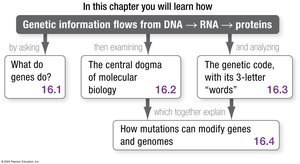
Central Dogma: The central dogma summarizes the flow of genetic information: DNA → RNA → Protein.
Transcription: The process by which a DNA template is used to synthesize a complementary RNA molecule.
Translation: The process by which the information in messenger RNA (mRNA) is used to assemble amino acids into a polypeptide (protein).
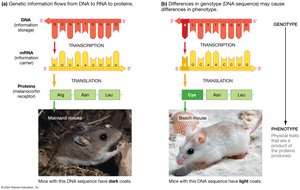
Genotype and Phenotype: An organism's genotype is determined by its DNA sequence, while its phenotype is the result of the proteins produced.
Equation:
RNA as the Intermediary
Messenger RNA (mRNA): Carries genetic information from DNA in the nucleus to the site of protein synthesis in the cytoplasm.
RNA Polymerase: The enzyme that synthesizes RNA from a DNA template.
Modifications to the Central Dogma
Some genes code for functional RNAs (e.g., rRNA, tRNA) that are not translated into proteins.
Reverse transcription (RNA → DNA) occurs in some viruses via the enzyme reverse transcriptase.
16.3 The Genetic Code
Structure and Properties of the Genetic Code
Codon: A sequence of three nucleotides in mRNA that specifies a particular amino acid.
Triplet Code: The genetic code is read in groups of three bases (codons), each coding for one amino acid.
Start Codon: AUG (methionine) signals the start of translation.
Stop Codons: UGA, UAA, and UAG signal the end of translation.
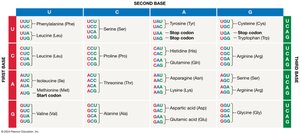
Key Features of the Genetic Code
Redundant: Most amino acids are specified by more than one codon.
Unambiguous: Each codon codes for only one amino acid.
Non-overlapping: Codons are read one at a time, without overlap.
Nearly Universal: The code is conserved across almost all organisms.
Conservative: Codons for the same amino acid often share the first two bases.
Applications
Knowing the genetic code allows prediction of amino acid sequences from DNA or mRNA sequences and vice versa.
16.4 What Are the Types and Consequences of Mutation?
Definition and Types of Mutation
Mutation: Any permanent change in an organism’s DNA sequence, creating new alleles.
Point Mutations: Changes affecting one or a few nucleotides.
Chromosome-Level Mutations: Large-scale changes affecting chromosome structure or number.
Types of Point Mutations
Missense Mutation: Alters the amino acid sequence of a protein.
Silent Mutation: Does not change the amino acid sequence due to redundancy in the code.
Frameshift Mutation: Addition or deletion of nucleotides shifts the reading frame, altering all downstream codons.
Nonsense Mutation: Changes a codon to a stop codon, truncating the protein.
Effects of Mutations on Fitness
Beneficial: Increase an organism’s fitness.
Neutral: No effect on fitness.
Deleterious: Decrease fitness; most mutations are neutral or deleterious.
Chromosome Mutations
Inversion: Segment of a chromosome breaks off, flips, and rejoins.
Translocation: Segment breaks off and attaches to another chromosome.
Deletion: Segment is lost.
Duplication: Segment is present in multiple copies.
Chromosome mutations can be visualized in a karyotype and are common in cancer cells.
Linking Genotype to Phenotype
The central dogma explains how genetic variation (genotype) leads to observable traits (phenotype) through the production of proteins. Differences in DNA sequence can result in different proteins, which in turn affect an organism’s traits.
Summary Table: Types and Consequences of Point Mutations
Type of Mutation | Effect on Protein | Potential Impact |
|---|---|---|
Missense | Changes one amino acid | Variable (beneficial, neutral, or deleterious) |
Silent | No change in amino acid | Usually neutral |
Frameshift | Alters reading frame, changes many amino acids | Usually deleterious |
Nonsense | Introduces premature stop codon | Usually deleterious |
Additional info: Chromosome-level mutations such as aneuploidy (abnormal number of chromosomes) and polyploidy (extra sets of chromosomes) can have significant evolutionary and medical consequences.
