 Back
How Genes Work: From DNA to Protein and the Impact of Mutations
Study Guide - Smart Notes
 Tailored notes based on your materials, expanded with key definitions, examples, and context.
How Genes Work
Introduction
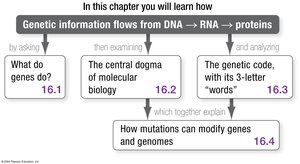
Understanding how genes function at the molecular level is central to modern biology. This chapter explores the mechanisms by which genetic information is expressed, the flow of information from DNA to proteins, and how mutations can alter gene function and phenotype.
What Do Genes Do?
The One-Gene, One-Enzyme Hypothesis
Early experiments by Beadle and Tatum established that genes direct the synthesis of specific enzymes. By inducing mutations in the bread mold Neurospora crassa, they demonstrated that each gene encodes a single enzyme, leading to the "one-gene, one-enzyme" hypothesis. This was later refined to the "one-gene, one-polypeptide" hypothesis, as not all proteins are enzymes and some proteins are composed of multiple polypeptides.
Null or loss-of-function alleles: Mutated genes that do not produce functional products.
Genetic screens: Used to identify mutants unable to synthesize specific compounds, revealing the role of individual genes in metabolic pathways.
Example: Mutants unable to synthesize arginine were found to lack one of the enzymes in the arginine biosynthetic pathway.
The Central Dogma of Molecular Biology
Flow of Genetic Information
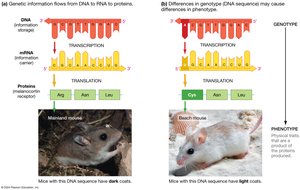
The central dogma summarizes the directional flow of genetic information in cells: DNA → RNA → Protein. Genes are stretches of DNA that code for proteins, and the sequence of nucleotides in DNA determines the sequence of amino acids in proteins.
Transcription: The process of synthesizing RNA from a DNA template.
Translation: The process of synthesizing proteins using the information encoded in messenger RNA (mRNA).
Messenger RNA (mRNA): Carries genetic information from DNA in the nucleus to the ribosomes in the cytoplasm, where proteins are synthesized.
RNA polymerase: The enzyme responsible for synthesizing RNA from a DNA template.
Linking Genotype to Phenotype
An organism's genotype is determined by its DNA sequence, while its phenotype is the result of the proteins produced. Different alleles of a gene can lead to variations in protein structure and function, resulting in different phenotypes.
Modifications to the Central Dogma
Some genes code for functional RNAs that are not translated into proteins (e.g., rRNA, tRNA).
Reverse transcription: In some viruses, information flows from RNA back to DNA via the enzyme reverse transcriptase.
The Genetic Code
Structure and Properties
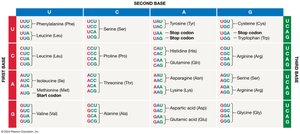
The genetic code defines how sequences of nucleotides (codons) in mRNA are translated into amino acids. Each codon consists of three nucleotides, forming a triplet code that specifies one amino acid.
Codon: A sequence of three RNA bases that codes for a specific amino acid.
Start codon (AUG): Signals the beginning of protein synthesis and codes for methionine.
Stop codons (UAA, UAG, UGA): Signal the end of protein synthesis.
Redundancy: Most amino acids are encoded by more than one codon.
Unambiguous: Each codon specifies only one amino acid.
Non-overlapping: Codons are read one at a time.
Nearly universal: The genetic code is conserved across almost all organisms.
Conservative: Codons for the same amino acid often share the first two bases.
Cracking the Code
Researchers such as Nirenberg and Matthaei synthesized artificial RNAs to determine which codons specified which amino acids. This work led to the complete deciphering of the genetic code.
Applications of the Genetic Code
Predicting amino acid sequences from DNA or mRNA sequences.
Determining possible DNA or mRNA sequences for a given amino acid sequence (noting redundancy).
Types and Consequences of Mutation
Definition and Types of Mutation
A mutation is any permanent change in an organism's DNA sequence. Mutations can alter genotype and potentially phenotype by creating new alleles.
Point mutations: Changes affecting one or a few nucleotides.
Chromosome-level mutations: Large-scale changes affecting chromosome structure or number.
Point Mutations
Missense mutation: Changes one amino acid in a protein.
Silent mutation: Does not change the amino acid sequence due to code redundancy.
Frameshift mutation: Insertion or deletion shifts the reading frame, altering all downstream codons.
Nonsense mutation: Changes a codon to a stop codon, truncating the protein.
Mutations can be:
Beneficial: Increase fitness.
Neutral: No effect on fitness.
Deleterious: Decrease fitness.
Chromosome Mutations
Inversion: Segment of chromosome breaks off, flips, and rejoins.
Translocation: Segment attaches to a different chromosome.
Deletion: Segment is lost.
Duplication: Segment is present in multiple copies.
Chromosome mutations can also be beneficial, neutral, or deleterious. Many cancers are associated with chromosome-level mutations, which can be visualized using karyotypes.
Summary Table: Types of Point Mutations and Their Consequences
Type of Mutation | Effect on Protein | Potential Impact |
|---|---|---|
Missense | Changes one amino acid | Variable (can be beneficial, neutral, or deleterious) |
Silent | No change in amino acid | Usually neutral |
Frameshift | Alters reading frame, changes many amino acids | Usually deleterious |
Nonsense | Introduces premature stop codon | Usually deleterious |
Key Equations
Central Dogma:
Number of possible codons:
(Four possible nucleotides, three positions per codon)
Additional info: The images of Dr. Hopi Hoekstra in the field (image_4, image_5, image_6) are not directly relevant to the molecular mechanisms of gene expression and are therefore not included. The cover and publisher images (image_1, image_2) are not included as they do not reinforce the scientific content.
