 Back
How Genes Work: From DNA to Protein and the Impact of Mutations
Study Guide - Smart Notes
 Tailored notes based on your materials, expanded with key definitions, examples, and context.
How Do Genes Work?
The Flow of Genetic Information
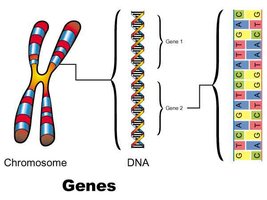
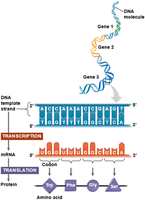
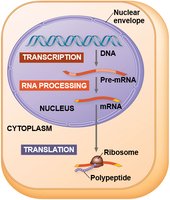
Genetic information is stored in the sequence of nucleotides within DNA. The process by which this information is used to produce proteins, which determine phenotype, is called gene expression. Gene expression consists of two main stages: transcription and translation. Proteins are the direct link between genotype (genetic makeup) and phenotype (observable traits).
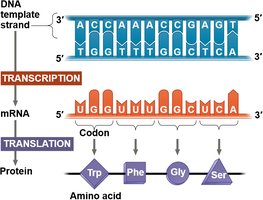
Transcription: DNA is used as a template to synthesize a complementary RNA molecule.
Translation: The RNA molecule is used to direct the synthesis of a polypeptide (protein).
Gene: A sequence of DNA that encodes for a protein or regulates how much protein is made.

Genes and Proteins: Historical Discovery
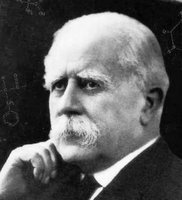
The relationship between genes and proteins was first suggested by Archibald Garrod in 1902. He proposed that genes dictate phenotypes through enzymes, which catalyze specific chemical reactions. His study of metabolic defects, such as Alkaptonuria, provided evidence that symptoms of inherited diseases reflect the inability to synthesize certain enzymes, correlating one gene to one enzyme.
Alkaptonuria: A disease where the urine turns black due to the absence of a specific enzyme.
One gene-one enzyme hypothesis: Each gene encodes a specific enzyme (later expanded to proteins).

Complexity of Gene-Protein Relationships
The one gene-one protein model is an oversimplification. Some genes do not encode proteins, and some proteins are composed of subunits from different genes. Traits can be influenced by multiple genes (polygenic), and environmental factors can interact with genes (multifactorial traits).
Polygenic traits: Traits influenced by multiple genes (e.g., height, skin color).
Multifactorial traits: Traits influenced by both genes and environment (e.g., diabetes, cancer).
Gene Expression: Transcription and Translation
Transcription
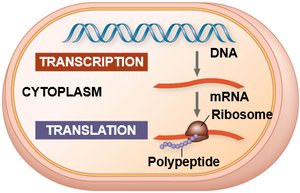
Transcription is the process by which information from a DNA sequence is copied to a complementary RNA sequence. The main product is messenger RNA (mRNA), which carries the genetic code from the nucleus to the cytoplasm.
RNA: Acts as a bridge between DNA and proteins.
mRNA: Messenger RNA, the transcript that is translated into protein.

Translation
Translation is the process by which the sequence of mRNA is converted into an amino acid sequence, forming a polypeptide. Ribosomes are the cellular structures where translation occurs.
Ribosome: Site of protein synthesis.
Polypeptide: Chain of amino acids that folds into a functional protein.
Transcription and Translation in Prokaryotes vs. Eukaryotes
In prokaryotes, translation can begin before transcription is finished because there is no nuclear envelope. In eukaryotes, transcription occurs in the nucleus, and translation occurs in the cytoplasm, separated by the nuclear envelope.
Prokaryotes: No nucleus; transcription and translation are coupled.
Eukaryotes: Transcription in nucleus; translation in cytoplasm.
The Genetic Code
Codons: Triplets of Nucleotides
The genetic code is based on a triplet code, where each set of three nucleotides (codon) in mRNA specifies an amino acid. There are 64 possible codons but only 20 amino acids, making the code redundant but not ambiguous.
Codon: Three-nucleotide sequence in mRNA that specifies an amino acid.
Redundancy: Multiple codons can code for the same amino acid.
Reading frame: The correct grouping of nucleotides to ensure proper translation.
The Codon Table for mRNA
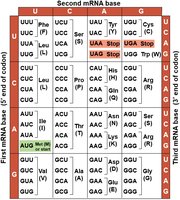
The codon table shows which mRNA codons correspond to which amino acids. Start and stop codons are also indicated, which signal the beginning and end of translation.
Mutations and Their Effects
Types of Mutations
Mutations are changes in the genetic information of a cell. They can affect protein structure and function and are a source of genetic variation. Mutations are random with respect to an individual's fitness.
Point mutations: Changes in a single nucleotide pair.
Substitutions: Replacement of one nucleotide with another.
Insertions and deletions: Addition or loss of nucleotide pairs, often causing frameshift mutations.
Substitution Mutations
Substitution mutations can be silent, missense, or nonsense:
Silent mutation: No effect on the amino acid due to redundancy.
Missense mutation: Codes for a different amino acid.
Nonsense mutation: Changes a codon to a stop codon, usually resulting in a nonfunctional protein.
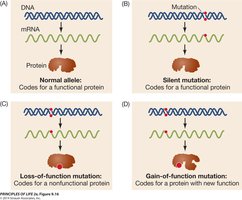
Insertions and Deletions
Insertions and deletions can alter the reading frame, producing a frameshift mutation. Frameshift mutations often have a more severe impact on protein function than substitutions.
Frameshift mutation: Alters the grouping of codons, changing the entire amino acid sequence downstream.
The Molecular Basis of Sickle-cell Disease: A Point Mutation
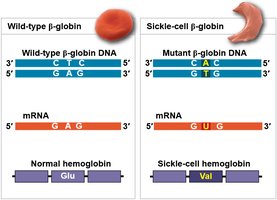
Sickle-cell disease is caused by a single nucleotide substitution in the gene encoding β-globin, resulting in a missense mutation. This changes the amino acid from glutamic acid to valine, altering the protein's structure and function.
Ranking Mutation Impact
Mutations can be ranked by their impact on gene structure and function:
Frameshift: Greatest impact; alters reading frame and protein sequence.
Nonsense: High impact; produces truncated, usually nonfunctional protein.
Missense: Moderate impact; changes one amino acid, may affect function.
Silent: Least impact; no change in protein product.
Mutation as the Source of Genetic Variation
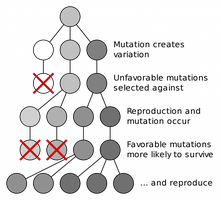
Mutation is the ultimate source of genetic variation, providing new alleles for evolution. Mutations occur randomly and are not directed by an organism's needs or fitness.
Genetic variation: Essential for evolution and adaptation.
Randomness: Mutations are not influenced by fitness; they occur spontaneously.
Learning Objectives – Chapter 16: How Do Genes Work?
Summarize the flow of information in cells from gene to protein, labeling arrows connecting mRNA, DNA, and proteins, and explaining each step.
Explain how the genetic code relates transcription to translation and why it is considered redundant.
Rank mutations (missense, nonsense, frameshift, silent) in terms of impact on gene structure and function, and explain reasoning.
Defend the statement "mutation is the ultimate source of genetic variation" and explain why mutation is random with respect to fitness.
