 Back
How Genes Work: From DNA to Protein and the Impact of Mutations
Study Guide - Smart Notes
 Tailored notes based on your materials, expanded with key definitions, examples, and context.
How Genes Work
Introduction to Gene Function
Genes are fundamental units of heredity that encode the instructions for building proteins, which in turn determine the structure and function of all living organisms. Understanding how genes direct the synthesis of proteins is central to molecular biology.
The One-Gene, One-Enzyme Hypothesis
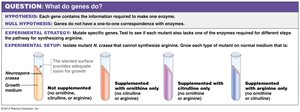
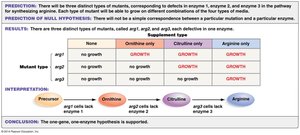
Early experiments by Beadle and Tatum established that each gene encodes a specific enzyme, a concept known as the one-gene, one-enzyme hypothesis. Their work with the bread mold Neurospora crassa involved creating mutants that were unable to synthesize certain amino acids, revealing the direct relationship between genes and metabolic pathways.
Knock-out genes: Mutating a single gene to observe the resulting loss of function.
Metabolic pathway analysis: By identifying which step in a pathway is blocked, the function of the corresponding gene can be inferred.

From Genes to Proteins: The Central Dogma
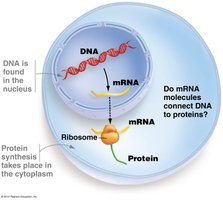
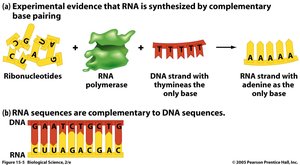
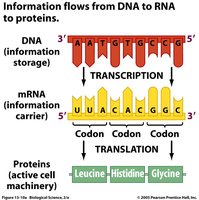
The Central Dogma of Molecular Biology describes the flow of genetic information: DNA → RNA → Protein. DNA stores genetic information, which is transcribed into messenger RNA (mRNA) and then translated into proteins by ribosomes.
Transcription: The process by which RNA polymerase synthesizes mRNA from a DNA template.
Translation: The process by which ribosomes read mRNA sequences to assemble amino acids into proteins.
mRNA: Acts as the intermediary, carrying genetic instructions from the nucleus to the cytoplasm.
The Genetic Code
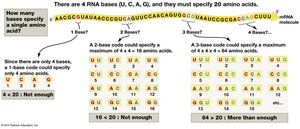
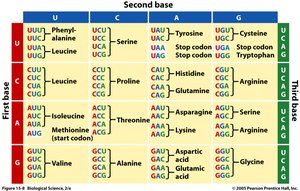
The genetic code is a set of rules by which the sequence of bases in DNA is translated into the sequence of amino acids in proteins. Each group of three RNA nucleotides (a codon) specifies a particular amino acid.
Triplet code: Three bases per codon, allowing for 64 possible codons.
Start codon: AUG (methionine) signals the beginning of translation.
Stop codons: UAA, UAG, UGA signal the end of translation.
Redundancy: Most amino acids are specified by more than one codon.
Universality: The genetic code is nearly universal among all organisms.
Unambiguous: Each codon specifies only one amino acid.
Non-overlapping: Codons are read one after another, without overlap.
Genotype and Phenotype
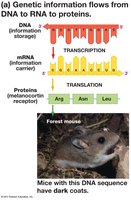
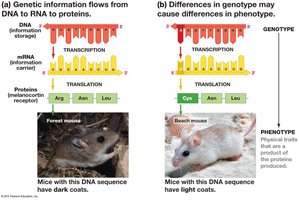
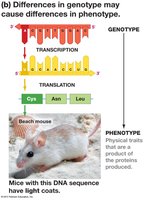
The genotype of an organism is determined by its DNA sequence, while the phenotype is the observable result of the proteins produced. Different alleles of a gene can lead to different proteins and thus different phenotypes.
Alleles: Variants of the same gene with different DNA sequences.
Example: Coat color in mice is determined by differences in the DNA sequence of a gene affecting pigment production.
Exceptions to the Central Dogma
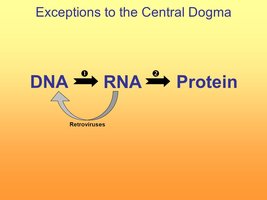
While the central dogma describes the typical flow of genetic information, there are exceptions:
Some genes code for functional RNA molecules that are not translated into proteins (e.g., rRNA, tRNA).
In some cases, information can flow from RNA back to DNA (e.g., retroviruses using reverse transcriptase).
Mutations: Changes in Genetic Information
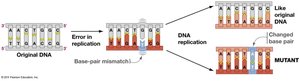
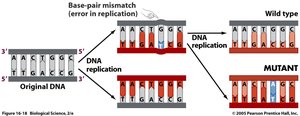
Mutations are permanent changes in the DNA sequence. They can create new alleles and potentially alter the structure and function of proteins, leading to new phenotypes.
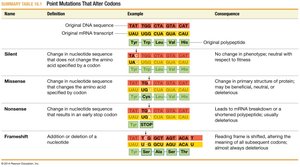
Point mutations: Changes in a single or a few base pairs.
Types of point mutations:
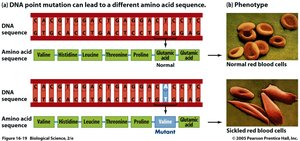
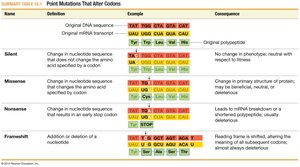
Missense mutations: Change the amino acid specified by a codon (e.g., sickle cell anemia).
Silent mutations: Do not change the amino acid sequence due to redundancy in the code.
Nonsense mutations: Change an amino acid codon to a stop codon, resulting in a truncated protein.
Frameshift mutations: Insertions or deletions that shift the reading frame, causing widespread changes in the protein sequence.
Impact of mutations:
Beneficial: Increase fitness.
Neutral: No effect on fitness.
Deleterious: Decrease fitness.
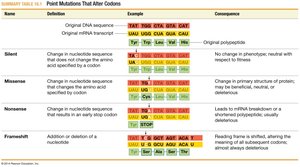
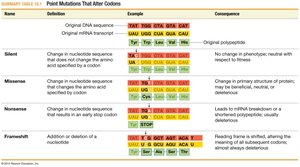
Summary Table: Types of Point Mutations
Type | Definition | Example | Consequence |
|---|---|---|---|
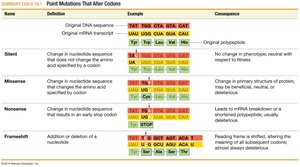
Silent | Change in nucleotide sequence that does not alter amino acid | UAC → UAU (both code for Tyr) | No change in phenotype |
Missense | Change in nucleotide sequence that changes one amino acid | GAA → GUA (Glu → Val) | Change in primary structure of protein |
Nonsense | Change in nucleotide sequence that results in a stop codon | UAC → UAA (Tyr → Stop) | Leads to mRNA breakdown or truncated protein |
Frameshift | Addition or deletion of a nucleotide | Insertion of A in AUG GCU → AAU GGC U... | Shifts reading frame, alters downstream amino acids |
Key Equations and Concepts
Transcription:
Translation:
Codon calculation: possible codons (for 4 RNA bases and 3 positions per codon)
Additional info: The study of gene function and mutation is foundational for understanding genetic diseases, biotechnology, and evolutionary biology.
