 Back
BackHow Genes Work: Molecular Basis, Genetic Code, and Mutations
Study Guide - Smart Notes
 Tailored notes based on your materials, expanded with key definitions, examples, and context.
How Genes Work
Introduction to Gene Expression
DNA is often described as the blueprint of life, containing the instructions for building and maintaining an organism. However, understanding how genes are expressed—how information in DNA is converted into functional molecules—was a major challenge for biologists. Gene expression refers to the process by which information encoded in DNA is used to produce functioning molecules, primarily proteins, within the cell.
What Do Genes Do?
Beadle and Tatum pioneered the study of gene function by creating defective genes and observing their effects on phenotype. Nonfunctioning alleles are called null or loss-of-function alleles. Their experiments with the bread mold Neurospora crassa revealed mutants unable to synthesize certain compounds, leading to the discovery that each gene contains information to make a specific enzyme.
The One-Gene, One-Enzyme Hypothesis
Hypothesis: Each gene encodes a single enzyme.
Experimental Test: Srb and Horowitz studied the arginine metabolic pathway, isolating mutants deficient in one of three enzymes required for arginine synthesis.
Conclusion: Most genes contain instructions for making proteins; the hypothesis evolved into the one-gene, one-polypeptide hypothesis.
Example: Mutants missing a specific enzyme could not survive without arginine supplementation.

The Genetic Code Hypothesis
Francis Crick proposed that the sequence of bases in DNA acts as a code, specifying the amino acid sequence of proteins. DNA is an information storage molecule, and different combinations of bases encode the 20 amino acids. However, information in DNA is not directly translated into proteins.
RNA as the Intermediary between Genes and Proteins
Jacob and Monod suggested that RNA links genes in the nucleus to protein synthesis in the cytoplasm. Messenger RNA (mRNA) carries information from DNA to the site of protein synthesis. The enzyme RNA polymerase synthesizes RNA using a DNA template, copying the code by matching complementary nucleotides.
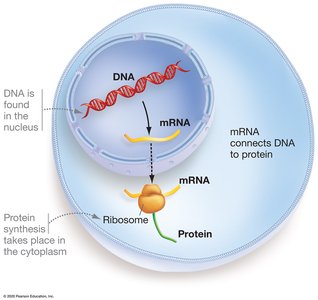
The Central Dogma of Molecular Biology
The central dogma summarizes the flow of information in cells: DNA codes for RNA, which codes for proteins. Genes are stretches of DNA that code for proteins, and the DNA sequence determines the RNA sequence, which in turn determines the amino acid sequence of proteins.
Transcription: Using a DNA template to make complementary RNA (copying information).
Translation: Using information in mRNA to synthesize proteins (interpreting nucleotide language to amino acids).
Linking Genotypes to Phenotypes
An organism's genotype is determined by the sequence of bases in its DNA, while its phenotype is the product of the proteins it produces. Alleles of the same gene differ in DNA sequence, resulting in proteins with different amino acid sequences and observable traits.

Modifications to the Central Dogma
Many genes code for RNAs that do not function as mRNA and are not translated into proteins; these RNAs perform important cellular functions.
Some viruses contain reverse transcriptase, which synthesizes DNA from an RNA template, allowing information flow from RNA to DNA.
The Genetic Code
Structure and Function of the Genetic Code
The genetic code specifies how a sequence of nucleotides codes for a sequence of amino acids. Gamow predicted that each "word" contains three bases—a triplet code—which is the minimum needed to specify 20 amino acids. Each group of three bases is called a codon.
Codon: A group of three bases that specifies a particular amino acid.
Reading Frame: The sequence of codons in a gene; disrupted by adding or subtracting one or two bases, but not by multiples of three.
Cracking the Genetic Code
Nirenberg and Leder determined which codon coded for each amino acid.
There is one start codon (AUG) for methionine, signaling where protein synthesis starts.
There are three stop codons (UGA, UAA, UAG) signaling the end of the protein-coding sequence.
The other 60 codons code for amino acids.

Analyzing the Code
Redundant: All but two amino acids are encoded by more than one codon.
Unambiguous: One codon never codes for more than one amino acid.
Non-overlapping: Codons are read one at a time.
Nearly universal: All codons specify the same amino acids in all organisms (with few exceptions).
Conservative: If several codons specify the same amino acid, the first two bases are usually identical.
The Value of Knowing the Code
Biologists can predict the amino acid sequence from a DNA sequence.
They can determine mRNA and DNA sequences that could code for a particular sequence of amino acids.
Due to redundancy, multiple DNA sequences can code for the same amino acid sequence.

Types and Consequences of Mutation
Definition and Types of Mutation
A mutation is any permanent change in an organism's DNA, modifying its information archive and genotype, and potentially creating new alleles. Mutations can be classified as point mutations (affecting one or a few bases) or chromosome-level mutations (larger scale changes).

Point Mutations
Missense mutations: Change an amino acid in the protein.
Silent mutations: Do not change the amino acid sequence due to redundancy in the code.
Frameshift mutations: Shift the reading frame, altering the meaning of all subsequent codons.
Nonsense mutations: Change a codon that specifies an amino acid into a stop codon.
Consequences of Point Mutations
Beneficial mutations: Increase fitness (survival and reproduction).
Neutral mutations: Do not affect fitness.
Deleterious mutations: Decrease fitness.
Most point mutations are neutral or deleterious.
Mutations outside coding regions can affect phenotype by altering gene expression.
Name | Definition | Example | Consequence |
|---|---|---|---|
Silent | Change in nucleotide sequence that does not change amino acid specified by a codon | TAT TGG CTA GTA CAT → TAT TGG CTT GTA CAT | No change in phenotype; neutral with respect to fitness |
Missense | Change in nucleotide sequence that changes the amino acid specified by a codon | TAT TGG CTA GTA CAT → TAT TGG CUA GTA CAT | Change in primary structure of protein; may be beneficial, neutral, or deleterious |
Nonsense | Change in nucleotide sequence that results in an early stop codon | TAT TGG CTA GTA CAT → TAT TGA CTA GTA CAT | Leads to mRNA breakdown or shortened polypeptide; usually deleterious |
Frameshift | Addition or deletion of a nucleotide | TAT TGG CTA GTA CAT → TAT TGG CTC TAG TAC AT | Reading frame is shifted, altering the meaning of all subsequent codons; almost always deleterious |

Chromosome Mutations
Chromosome mutations may change chromosome number (polyploidy or aneuploidy) or structure. Types include:
Inversion: Segment of chromosome breaks off, flips around, and rejoins.
Translocation: Section of chromosome breaks off and attaches to another chromosome.
Deletion: Segment of chromosome is lost.
Duplication: Segment of chromosome is present in multiple copies.

Consequences of Chromosome Mutations
Like point mutations, chromosome mutations can be beneficial, neutral, or deleterious.
Chromosomes of cancer cells often exhibit deleterious mutations, including aneuploidy, inversions, translocations, deletions, and duplications.
These mutations can be visualized on a karyotype, which is the complete set of chromosomes in a cell.

Key Equations and Concepts
Triplet Code Calculation
The number of possible codons in the triplet code:
Central Dogma Summary
Mutation Impact
Fitness impact:
----------------------------------------
