 Back
BackHow Genes Work: The Central Dogma and the Genetic Code
Study Guide - Smart Notes
 Tailored notes based on your materials, expanded with key definitions, examples, and context.
How Genes Work
Introduction to Genes and Their Function
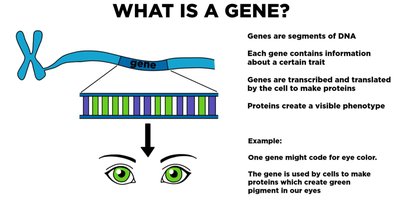
Genes are fundamental units of heredity that encode instructions for the synthesis of proteins, which determine the traits and functions of living organisms. Understanding how genes function is essential for grasping the molecular basis of life.
Gene: A segment of DNA that contains the information necessary to produce a functional product, typically a protein.
Central Dogma of Molecular Biology: Describes the flow of genetic information from DNA to RNA to protein.
Genotype: The genetic makeup of an organism.
Phenotype: The observable physical or biochemical characteristics of an organism.
The One-Gene, One-Enzyme Hypothesis
Development of the Hypothesis
The one-gene, one-enzyme hypothesis was proposed by George Beadle and Edward Tatum based on experiments with the bread mold Neurospora crassa. They demonstrated that specific genes encode specific enzymes, each controlling a step in a metabolic pathway.
Beadle and Tatum's Experiment: Mutants unable to synthesize certain amino acids were used to show that each gene is responsible for a single enzyme in a metabolic pathway.
Conclusion: Each gene encodes a single enzyme, supporting the one-gene, one-enzyme hypothesis.

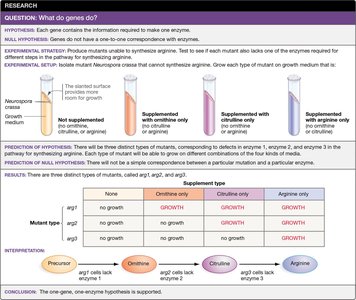
Example: In the arginine synthesis pathway, mutations in different genes block the pathway at different steps, each corresponding to a specific enzyme deficiency.
From One-Gene, One-Enzyme to One-Gene, One-Polypeptide
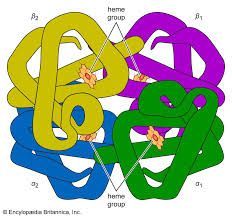
Further research revealed that not all proteins are enzymes and that some proteins are composed of multiple polypeptide chains, each encoded by a separate gene. This led to the refinement of the hypothesis to "one-gene, one-polypeptide."
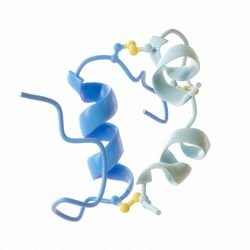
Polypeptide: A chain of amino acids; proteins may consist of one or more polypeptides.
Hemoglobin: An example of a protein with multiple polypeptide subunits, each encoded by a different gene.
The Central Dogma of Molecular Biology
Flow of Genetic Information
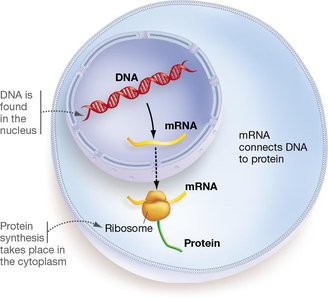
The central dogma describes the directional flow of genetic information: DNA is transcribed into RNA, which is then translated into protein. This process explains how genotype determines phenotype.
Transcription: The process by which a DNA sequence is copied into messenger RNA (mRNA).
Translation: The process by which the mRNA sequence is used to synthesize a protein.
Location: Transcription occurs in the nucleus (eukaryotes), and translation occurs in the cytoplasm at the ribosome.

Equation:
Types of RNA and Their Roles
RNA molecules play distinct roles in the process of gene expression:
mRNA (messenger RNA): Carries genetic information from DNA to the ribosome.
tRNA (transfer RNA): Brings amino acids to the ribosome during translation.
rRNA (ribosomal RNA): Forms the core of the ribosome's structure and catalyzes protein synthesis.
Genotype to Phenotype: The Link
Base Pairing and Transcription
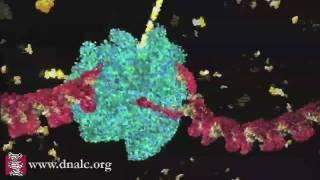
DNA replication and transcription rely on complementary base pairing. During transcription, the DNA template strand is used to synthesize a complementary mRNA strand.
Base Pairing Rules: Adenine (A) pairs with Thymine (T) in DNA, and with Uracil (U) in RNA; Cytosine (C) pairs with Guanine (G).
Example: For the DNA sequence 5’ TTATGCCTTAATCAGG 3’, the complementary DNA strand is 3’ AATACGGAATTAGTCC 5’, and the mRNA transcript is 5’ UUAUGCCUUAAUCAGG 3’.
Translation and the Genetic Code
The genetic code is a set of rules by which the information encoded in mRNA is translated into proteins. Each set of three nucleotides (codon) specifies a particular amino acid.
Triplet Code: Three nucleotide bases code for one amino acid.
Start Codon: AUG (codes for methionine) signals the start of translation.
Stop Codons: UAA, UAG, UGA signal the end of translation.
Application of the Genetic Code
Knowing the genetic code allows prediction of amino acid sequences from nucleotide sequences and vice versa. This is fundamental for genetic engineering and biotechnology.
Example: The mRNA sequence 5’ CAAUGUCUCAGUGACCU 3’ can be divided into codons and translated into a specific amino acid sequence.

Mutations and Their Effects
Types of Mutations
Mutations are changes in the DNA sequence that can affect gene function and phenotype. They can be classified as point mutations or chromosomal mutations.
Point Mutation: A change in a single nucleotide base (e.g., substitution, insertion, or deletion).
Frameshift Mutation: Insertion or deletion of a nucleotide that shifts the reading frame, altering all downstream codons.
Chromosomal Mutation: Large-scale changes affecting chromosome structure or number.
Effects of Mutations on Fitness
Mutations can have various effects on an organism's fitness:
Beneficial: Increase fitness by conferring an advantage.
Neutral: No effect on fitness.
Deleterious: Decrease fitness by causing harmful effects.
DNA Damage and Repair
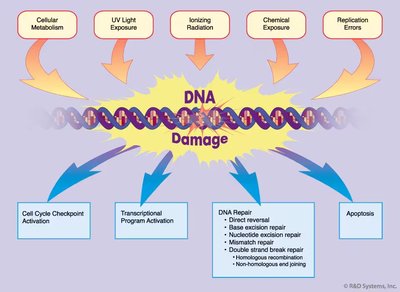
DNA can be damaged by environmental factors or errors during replication. Cells have mechanisms to repair DNA and maintain genetic integrity.
Sources of Damage: UV light, ionizing radiation, chemicals, replication errors.
Repair Mechanisms: Base excision repair, nucleotide excision repair, mismatch repair, double-strand break repair.
Summary Table: Types of Mutations
Type of Mutation | Description | Effect on Protein | Potential Impact |
|---|---|---|---|
Point Mutation | Change in a single nucleotide | May change one amino acid | Silent, missense, or nonsense |
Frameshift Mutation | Insertion or deletion of a nucleotide | Alters reading frame, changes all downstream amino acids | Usually deleterious |
Chromosomal Mutation | Large-scale changes (duplication, deletion, inversion, translocation) | May affect many genes | Varied effects |
Conclusion
Understanding how genes work, from the central dogma to the genetic code and the effects of mutations, is foundational to modern biology. These principles explain how genetic information is expressed and how changes in DNA can lead to variation in phenotype and evolution.
