 Back
How Genes Work: Transcription, RNA Processing, and Translation
Study Guide - Smart Notes
 Tailored notes based on your materials, expanded with key definitions, examples, and context.
Chapter 16: How Genes Work
Introduction to How Genes Work
Genes are fundamental units of heredity, encoding instructions for the synthesis of proteins and functional RNAs. The process by which genetic information is expressed involves the conversion of DNA sequences into functioning molecules within the cell, a concept central to molecular genetics.
DNA is the information storage molecule, often referred to as the "blueprint of life."
Gene expression is the process of converting information in DNA into functioning molecules, primarily proteins.
Research into gene expression led to the molecular genetics revolution.
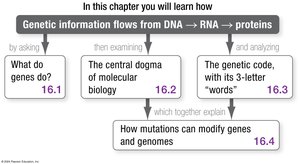
16.1 What Do Genes Do?
Early experiments by Beadle and Tatum demonstrated that genes direct the synthesis of specific enzymes, leading to the one-gene, one-enzyme hypothesis. This was later refined to the one-gene, one-polypeptide hypothesis, recognizing that proteins may consist of multiple polypeptides from different genes.
Null or loss-of-function alleles: Nonfunctioning versions of genes used to study gene function.
Mutants defective in single genes revealed the role of genes in metabolic pathways.

Example: Mutants in bread mold Neurospora crassa unable to synthesize arginine due to defects in specific enzymes.
The Genetic Code Hypothesis
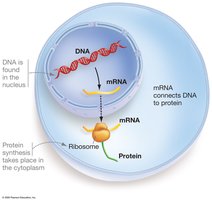
Francis Crick proposed that the sequence of bases in DNA acts as a code, specifying the sequence of amino acids in proteins. Messenger RNA (mRNA) serves as the intermediary, carrying information from DNA in the nucleus to the site of protein synthesis in the cytoplasm.
RNA polymerase synthesizes RNA using DNA as a template.
mRNA connects DNA to protein synthesis.
The Central Dogma of Biology
The central dogma summarizes the flow of genetic information: DNA codes for RNA, which codes for proteins. This process involves transcription (DNA to RNA) and translation (RNA to protein).
Transcription: Synthesis of RNA from a DNA template.
Translation: Synthesis of proteins from mRNA.
Linking Genotypes to Phenotypes
The genotype of an organism is determined by its DNA sequence, while its phenotype is the product of the proteins it produces. Alleles of the same gene can result in different protein products, affecting phenotype.
Genotype: Sequence of bases in DNA.
Phenotype: Physical traits produced by proteins.
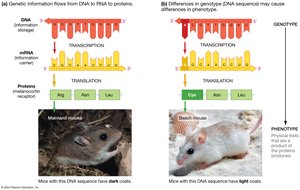
Example: Mice with different DNA sequences have different coat colors due to differences in protein products.
Modifications to the Central Dogma
Some genes code for RNAs that are not translated into proteins but perform important cellular functions. Additionally, certain viruses can reverse the flow of information, synthesizing DNA from an RNA template using reverse transcriptase.
Non-coding RNAs: RNAs with functions other than coding for proteins.
Reverse transcriptase: Enzyme in some viruses that synthesizes DNA from RNA.
16.3 The Genetic Code
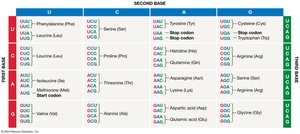
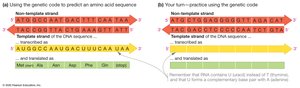
The genetic code specifies how sequences of nucleotides in DNA and RNA are translated into sequences of amino acids in proteins. The code is based on triplets of nucleotides called codons.
Triplet code: Each codon consists of three bases.
There are 64 possible codons, specifying 20 amino acids and stop signals.
Start codon: AUG (methionine) signals the start of protein synthesis.
Stop codons: UGA, UAA, UAG signal the end of protein synthesis.
Analyzing the Code
The genetic code has several important properties:
Redundant: Most amino acids are encoded by more than one codon.
Unambiguous: Each codon specifies only one amino acid.
Non-overlapping: Codons are read one at a time.
Nearly universal: The code is conserved across most organisms.
Conservative: Codons for the same amino acid often share the first two bases.
The Value of Knowing the Code
Understanding the genetic code allows biologists to predict amino acid sequences from DNA or mRNA sequences and vice versa. Due to redundancy, multiple DNA sequences can code for the same protein.
16.4 Types and Consequences of Mutation
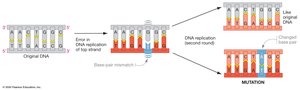
Mutations are permanent changes in DNA that can alter genotype and phenotype. They can be classified as point mutations (affecting one or a few bases) or chromosome-level mutations (affecting larger regions).
Point mutations: Change a single base pair.
Chromosome mutations: Affect chromosome number or structure.
Types of Point Mutations
Missense mutation: Changes an amino acid in the protein.
Silent mutation: Does not change the amino acid sequence.
Frameshift mutation: Alters the reading frame, affecting all subsequent codons.
Nonsense mutation: Changes a codon to a stop codon.
Mutations can be beneficial, neutral, or deleterious, affecting an organism's fitness.
Chromosome Mutations
Inversion: Segment of chromosome flips and rejoins.
Translocation: Segment attaches to another chromosome.
Deletion: Segment is lost.
Duplication: Segment is present in multiple copies.
Chromosome mutations can be visualized in a karyotype and are often seen in cancer cells.
Chapter 17: Transcription, RNA Processing, and Translation
Introduction to Transcription, RNA Processing, and Translation
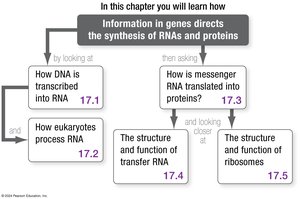
Proteins are essential for cellular function, and their synthesis is directed by genetic instructions encoded in DNA. The processes of transcription and translation convert genetic information into functional proteins.
17.1 An Overview of Transcription
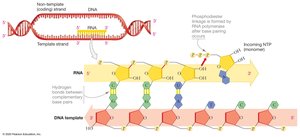
Transcription is the synthesis of RNA from a DNA template, carried out by RNA polymerases. Only one strand of DNA serves as the template, and the resulting RNA is complementary to this strand.
RNA polymerase: Enzyme that synthesizes RNA.
Template strand: DNA strand used for RNA synthesis.
Coding strand: DNA strand with the same sequence as the RNA (except U replaces T).
General Features of Transcription
RNA is synthesized de novo (no primer required).
RNA is single-stranded and unstable compared to DNA.
Occurs in the nucleus (eukaryotes).
Five types of RNA: mRNA, snRNA, tRNA, rRNA, miRNA.
Initiation: How Does Transcription Begin in Bacteria?
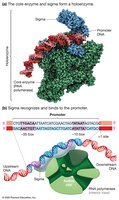
Transcription initiation in bacteria requires the sigma protein, which binds to RNA polymerase to form a holoenzyme. Sigma recognizes promoter sequences, determining the template strand and direction of transcription.
Promoters: DNA sequences where transcription begins.
-10 box: TATAAT sequence upstream of start site.
-35 box: TTGACA sequence further upstream.
Events Inside the Holoenzyme
Sigma binds to -35 and -10 boxes, orienting RNA polymerase.
RNA polymerase opens the DNA helix, creating a transcription bubble.
Polymerization begins as complementary NTPs pair with DNA bases.
Elongation and Termination in Bacteria
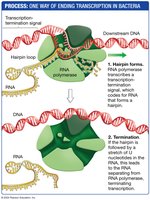
During elongation, RNA polymerase adds nucleotides to the 3′ end of the RNA. Termination occurs when a transcription-termination signal is transcribed, forming a hairpin structure that causes RNA polymerase to release the RNA transcript.
Transcription in Eukaryotes
Eukaryotic transcription differs from bacterial transcription in several ways:
Three types of RNA polymerases.
Larger, more diverse promoters (including TATA box).
General transcription factors replace sigma proteins.
Termination involves a poly(A) signal and RNA cleavage.
Transcription occurs in the nucleus; translation in the cytoplasm.
17.2 RNA Processing in Eukaryotes
In eukaryotes, the initial product of transcription is an immature primary transcript (pre-mRNA) that must undergo processing before translation.
RNA splicing: Removal of introns and joining of exons, catalyzed by snRNPs and spliceosomes.
Splicing allows production of different mRNAs and proteins from a single gene.
Example: More than 95% of human genes can be spliced in multiple ways.
Adding Caps and Tails to Transcripts
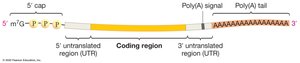
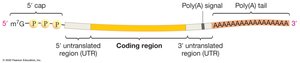
5′ cap: Modified guanine nucleotide added to the 5′ end, enabling ribosome binding and protecting from degradation.
Poly(A) tail: 100–250 adenine nucleotides added to the 3′ end, necessary for translation and stability.
5′ and 3′ UTRs Are Essential
Untranslated regions (UTRs) at both ends of mature mRNA are essential for stability and regulation of translation.
Additional info: Academic context was added to clarify the roles of RNA types, the significance of mutations, and the mechanisms of transcription and RNA processing.
