 Back
BackHow Populations Evolve: Mechanisms and Evidence of Evolution
Study Guide - Smart Notes
 Tailored notes based on your materials, expanded with key definitions, examples, and context.
How Populations Evolve
Introduction: Evolution and Its Importance
Evolution is the central unifying concept in biology, explaining the diversity of life and the adaptation of organisms to their environments. Understanding evolution is crucial for fields ranging from medicine to ecology.
Evolution is defined as the change in the genetic composition of populations over time.
Modern challenges, such as the evolution of drug-resistant pathogens and pesticide-resistant insects, highlight the ongoing relevance of evolutionary principles.
Evolutionary theory informs our understanding of everything from molecular biology to ecosystem dynamics.
Darwin’s Theory of Evolution
Darwin’s Voyage and the Origin of Species
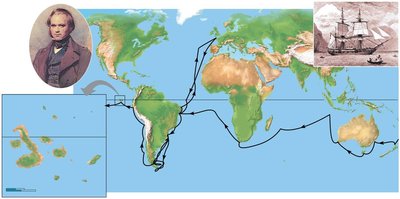
Charles Darwin’s observations during his voyage on the HMS Beagle were foundational to the development of evolutionary biology. His studies of the Galápagos Islands provided key insights into how species adapt to their environments.
Darwin’s theory, known as descent with modification, posits that all life is connected by common ancestry and that species change over time through adaptation.
Evolution by natural selection is considered a scientific theory—broad in scope, supported by extensive evidence, and capable of generating new hypotheses.
Evidence for Evolution: The Fossil Record
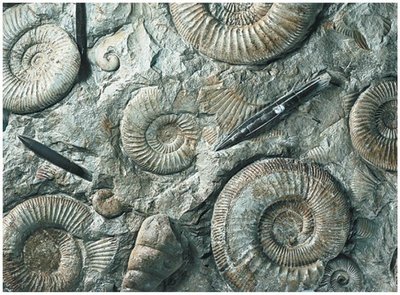
The study of fossils provides strong evidence for evolution, documenting the existence of species that are now extinct and revealing the sequence in which organisms have appeared over time.
Fossils are the preserved remains or imprints of organisms from the past.
The fossil record shows transitional forms, linking extinct species with modern ones and illuminating evolutionary pathways.
Transitional Fossils and Whale Evolution
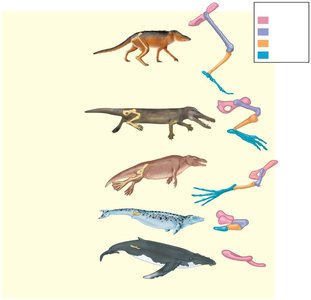
Transitional fossils provide direct evidence of evolutionary change. The evolution of whales from land-dwelling ancestors is a well-documented example.
Fossils such as Pakicetus and Rodhocetus show intermediate features between terrestrial mammals and modern whales.
Molecular evidence supports a close relationship between whales and hippos, indicating descent from a common ancestor.
Homology: Structural and Developmental Evidence
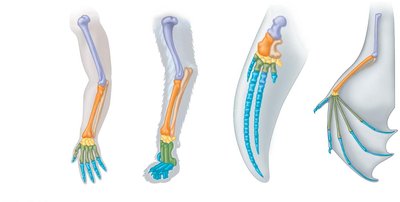
Homologies are similarities due to shared ancestry. They provide strong evidence for evolution and can be observed at anatomical, developmental, and molecular levels.
Homologous structures are anatomical features that are similar in different species due to common ancestry, even if they serve different functions.
Vestigial structures are remnants of features that served important functions in ancestors but are now reduced or unused.
Developmental homologies, such as pharyngeal pouches and post-anal tails in vertebrate embryos, reveal evolutionary relationships not always visible in adults.
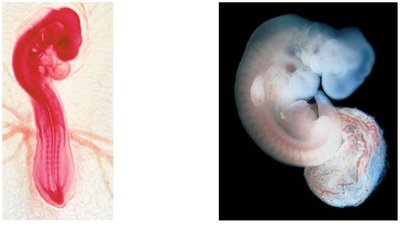
Evolutionary Trees
Biologists use evolutionary trees to represent patterns of descent and relationships among species. These trees are constructed using anatomical and molecular homologies.
Evolutionary trees illustrate how species are related through common ancestors.
Homologous traits help determine the branching patterns of these trees.
Mechanisms of Evolution
Natural Selection
Natural selection is the primary mechanism of evolution, explaining how populations adapt to their environments over generations.
Darwin’s observations of artificial selection (selective breeding) in domesticated species demonstrated how selection could drive significant change.
Natural selection acts on heritable variation within populations, favoring traits that enhance survival and reproduction.
Key points:
Populations, not individuals, evolve.
Only heritable traits are affected by natural selection.
Evolution is not goal-directed; it does not produce perfect organisms.
Genetic Variation: Mutation and Sexual Reproduction
Genetic variation is the raw material for evolution. It arises from mutations and the reshuffling of alleles during sexual reproduction.
Mutation is the ultimate source of new genetic variation.
In sexually reproducing organisms, most variation results from:
Crossing over during meiosis
Independent assortment of chromosomes
Random fertilization
Populations and Gene Pools
Evolution occurs at the population level. A population’s gene pool includes all alleles present in the group.
Microevolution is a change in allele frequencies within a population’s gene pool.
Individuals do not evolve; only populations do.
The Hardy-Weinberg Principle
The Hardy-Weinberg equilibrium provides a mathematical model for studying genetic variation in populations. It predicts that allele and genotype frequencies will remain constant from generation to generation in the absence of evolutionary forces.
Conditions for Hardy-Weinberg equilibrium:
Large population size
Random mating
No mutation
No gene flow
No natural selection
The Hardy-Weinberg equation: (where p and q are allele frequencies)
Genotype | Frequency |
|---|---|
WW | 0.64 |
Ww | 0.32 |
ww | 0.04 |
Mechanisms of Microevolution
Three main mechanisms can cause microevolution:
Natural selection: Differential survival and reproduction of individuals with advantageous traits.
Genetic drift: Random changes in allele frequencies, especially in small populations. Includes the bottleneck effect (drastic reduction in population size) and the founder effect (new population started by a few individuals).
Gene flow: Movement of alleles between populations through migration.
Adaptive Evolution and Relative Fitness
Natural selection is the only mechanism that consistently leads to adaptive evolution, increasing the frequency of traits that enhance survival and reproduction.
Relative fitness is the contribution an individual makes to the next generation’s gene pool compared to others.
Modes of Natural Selection
Natural selection can affect the distribution of phenotypes in three main ways:
Stabilizing selection: Favors intermediate phenotypes.
Directional selection: Favors one extreme phenotype.
Disruptive selection: Favors both extreme phenotypes over intermediates.
Type of Selection | Effect on Population |
|---|---|
Stabilizing | Reduces variation, favors average traits |
Directional | Shifts population toward one extreme |
Disruptive | Favors extremes, may lead to speciation |
Sexual Selection
Sexual selection is a form of natural selection where individuals with certain traits are more likely to obtain mates.
Intrasexual selection: Competition among individuals of the same sex (often males).
Intersexual selection (mate choice): Individuals of one sex (usually females) choose mates based on certain traits.
Evolution of Drug-Resistant Microorganisms
The evolution of antibiotic resistance in bacteria is a major public health concern. Overuse and misuse of antibiotics accelerate the selection for resistant strains.
Antibiotics do not create resistance; they select for bacteria that already possess resistance genes.
Preservation of Genetic Variation
Genetic variation is maintained in populations through several mechanisms:
Diploidy: Hides recessive alleles in heterozygotes.
Balancing selection: Maintains stable frequencies of multiple alleles (e.g., heterozygote advantage in sickle-cell anemia and malaria resistance).
Limits of Natural Selection
Natural selection cannot produce perfect organisms due to several constraints:
Selection can only act on existing variation.
Evolution is limited by historical constraints and existing structures.
Adaptations are often compromises between different functions.
Chance events and changing environments also play a role.
Summary Table: Key Concepts in Population Evolution
Concept | Definition | Example/Application |
|---|---|---|
Natural Selection | Process by which traits that enhance survival and reproduction increase in frequency | Pesticide resistance in insects |
Genetic Drift | Random changes in allele frequencies | Bottleneck effect after a natural disaster |
Gene Flow | Movement of alleles between populations | Migration of individuals between populations |
Mutation | Change in DNA sequence; source of new alleles | Point mutation creating a new allele |
Hardy-Weinberg Equilibrium | Allele and genotype frequencies remain constant in the absence of evolutionary forces | Used to estimate carrier frequency of genetic diseases |
Additional info: These notes synthesize and expand upon the provided lecture slides, integrating textbook-level explanations and examples for clarity and exam preparation.
