 Back
How Populations Evolve: Study Notes for General Biology: Chpt 13
Study Guide - Smart Notes
 Tailored notes based on your materials, expanded with key definitions, examples, and context.
How Populations Evolve
Introduction to Evolution
Evolution is the central concept explaining the diversity of life on Earth. It posits that living species are descendants of ancestral species, which were different from present-day organisms. The environment plays a crucial role in shaping evolutionary processes, and evolution continues to occur in modern times.
Evolution: The process by which species change over time through descent from common ancestors.
Diversity of Life: Over 1.8 million species have been identified, with millions more likely undiscovered.
Environmental Influence: Environmental changes drive adaptation and evolution.
Darwin’s Theory of Evolution
Charles Darwin revolutionized biology with his theory of evolution by natural selection, outlined in his book On the Origin of Species. Prior to Darwin, other hypotheses existed, such as Lamarck’s idea of inheritance of acquired characteristics.
Descent with Modification: Darwin’s phrase for evolution, meaning all life is connected by common ancestry and adaptations accumulate over time.
Natural Selection: The mechanism by which favorable traits become more common in a population due to environmental pressures.
Theory vs. Hypothesis: A theory is broader and supported by extensive evidence, while a hypothesis is a testable prediction.
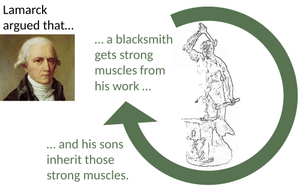
Additional info: Lamarck’s hypothesis suggested that traits acquired during an organism’s lifetime could be passed to offspring, such as a blacksmith’s strong muscles being inherited by his sons. This idea was later disproven by Darwin’s theory.
Evidence for Evolution
Fossil Evidence
Fossils are physical remains or imprints of organisms from the past. They provide a record of evolutionary changes and document extinct species.
Fossil Record: Reveals the historical sequence of organism evolution.
Transitional Fossils: Fossils that show intermediate forms between ancestral and modern species, supporting Darwin’s theory.
Example: Transitional fossils linking whales to cloven-hoofed mammals, such as Pakicetus and Rodhocetus.
Homologies
Homology refers to similarities in structure or molecular composition due to common ancestry. Homologous structures may serve different functions but share an underlying similarity.
Structural Homology: Similar anatomical features in related species (e.g., forelimbs of humans, cats, whales, and bats).
Molecular Homology: Similarities in DNA or protein sequences among species.
Vestigial Structures: Remnants of features that served important functions in ancestors (e.g., human appendix).
Additional info: Early developmental stages in different animal species often reveal homologies not visible in adults, such as similarities between chick and human embryos.
Evolutionary Trees
Biologists use evolutionary trees to represent patterns of descent. Homologous structures help determine the branching sequence of these trees, which can be based on anatomical or molecular data.
Evolutionary Tree: Diagram showing relationships among species based on shared homologies.
Example: Crocodiles are more closely related to birds than to lizards, as shown by evolutionary trees.
Mechanisms of Evolution
Natural Selection
Darwin proposed natural selection as the primary mechanism of evolution. Artificial selection, where humans breed organisms for desired traits, provided insight into how natural selection operates over longer timescales.
Population Evolution: Evolution occurs in populations, not individuals.
Heritable Traits: Only traits that can be inherited are affected by natural selection.
Non-goal Directed: Evolution does not aim for perfection; it is shaped by environmental pressures.
Observing Natural Selection
Scientists have observed natural selection in action, such as the evolution of pesticide resistance in insects. These adaptations demonstrate that natural selection edits existing traits based on current environmental conditions.
Editing Process: Natural selection modifies existing traits rather than creating new ones.
Contingency: The traits favored by natural selection depend on the local environment and time.
Example: Insect populations developing resistance to pesticides.
Additional info: Natural selection is a dynamic process, continually shaping populations in response to changing environments.
