 Back
Human Biology: Organ Systems, Body Cavities, and Anatomical Orientation
Study Guide - Smart Notes
 Tailored notes based on your materials, expanded with key definitions, examples, and context.
Organ Systems & Body Orientations
Introduction
This study guide covers the foundational concepts of human biology, focusing on the organization of the human body from cells to organ systems, the major body cavities, tissue membranes, and the anatomical terms used to describe body orientation and direction. Understanding these basics is essential for further study in biology, anatomy, and physiology.
Tissues of the Human Body
Major Tissue Types
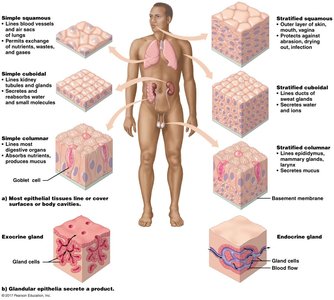
Tissues are groups of specialized cells that perform common functions. There are four major types of tissues in the human body:
Epithelial Tissue: Covers body surfaces, lines cavities, and forms glands. Functions include protection, absorption, secretion, and filtration.
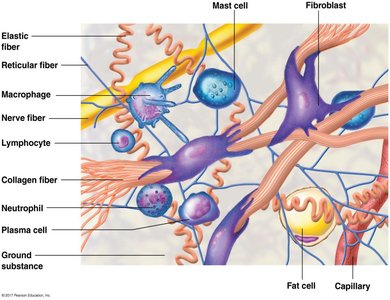
Connective Tissue: Supports, binds, and protects other tissues and organs. Includes fibrous tissues, cartilage, bone, blood, and adipose tissue.
Muscle Tissue: Responsible for movement. Types include skeletal, cardiac, and smooth muscle.
Nervous Tissue: Conducts electrical impulses and processes information.
Connective Tissue Details
Fibrous Connective Tissue: Contains reticular fibers (support), collagen fibers (strength), and elastic fibers (flexibility).
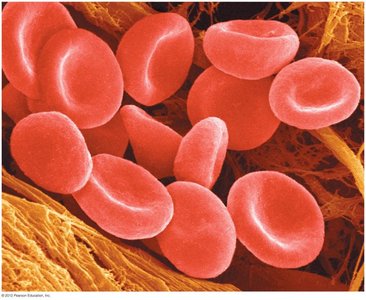
Specialized Connective Tissue: Includes cartilage, bone, blood, and adipose tissue. Each type has unique functions such as support, transport, and energy storage.
Organs and Organ Systems
Organs
An organ is a structure composed of two or more tissue types that work together to perform specific functions. For example, the heart contains cardiac muscle, smooth muscle, nervous, connective, and epithelial tissues, all contributing to its function of pumping blood.
Organ Systems
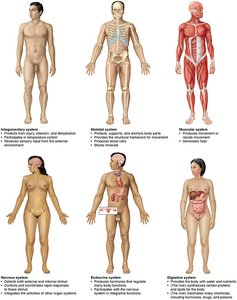
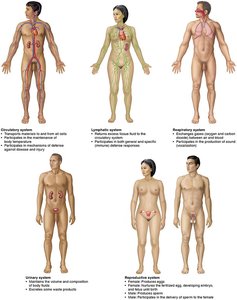
Organ systems are groups of organs that work together to perform major functions necessary for survival. There are eleven organ systems in the human body:
Organ System | Main Functions |
|---|---|
Integumentary | Protection, temperature regulation, sensation |
Skeletal | Support, movement, mineral storage, blood cell production |
Muscular | Movement, heat generation |
Circulatory | Transport of materials, temperature regulation, defense |
Lymphatic | Return of tissue fluid, immune defense |
Respiratory | Gas exchange, vocalization |
Nervous | Detection of stimuli, rapid response, integration |
Endocrine | Hormone production, regulation of body functions |
Digestive | Nutrient and water absorption, waste elimination |
Urinary | Fluid balance, waste excretion |
Reproductive | Production of gametes, nurturing offspring (female) |
Body Cavities
Major Body Cavities
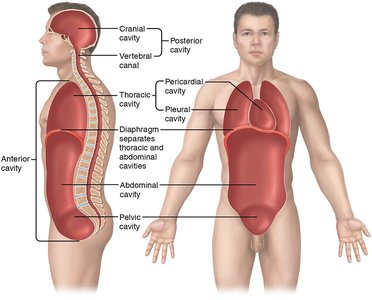
The human body contains several major cavities that house and protect internal organs:
Anterior (Ventral) Cavity: Includes the thoracic cavity (above the diaphragm, contains pleural and pericardial cavities) and the abdominal cavity (below the diaphragm).
Posterior (Dorsal) Cavity: Includes the cranial cavity (brain) and vertebral cavity (spinal cord).
Tissue Membranes
Types of Membranes
Tissue membranes are layers of connective tissue and epithelial cells that line body cavities and surfaces:
Serous Membrane: Lines and lubricates internal body cavities, reducing friction between organs.
Mucous Membrane: Lines passages open to the exterior (airways, digestive tract, reproductive passages); contains goblet cells that produce mucus.
Synovial Membrane: Lines and lubricates joint cavities, secreting synovial fluid.
Cutaneous Membrane: The skin; protects the body and will be discussed in detail in future lessons.
Anatomical Terms and Body Orientation
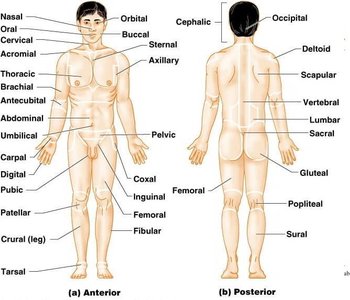
Body Regions and Landmarks
Specific terms are used to describe locations and regions of the body. These terms help avoid confusion when identifying structures or describing injuries.
Orientation and Directional Terms
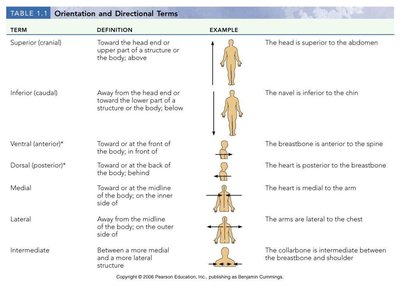
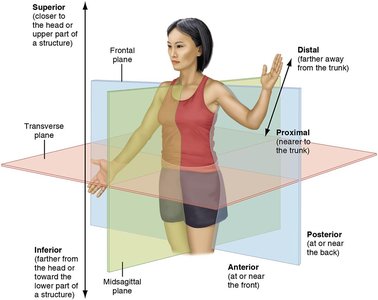
Directional terms are used to describe the positions of structures relative to each other:
Superior (cranial): Toward the head or upper part of a structure
Inferior (caudal): Away from the head or toward the lower part
Anterior (ventral): Toward the front of the body
Posterior (dorsal): Toward the back of the body
Medial: Toward the midline of the body
Lateral: Away from the midline
Intermediate: Between a more medial and a more lateral structure
Proximal: Closer to the origin of a body part or point of attachment
Distal: Farther from the origin or point of attachment
Superficial (external): Toward or at the body surface
Deep (internal): Away from the body surface
Term | Definition | Example |
|---|---|---|
Superior (cranial) | Toward the head or upper part of a structure | The head is superior to the abdomen |
Inferior (caudal) | Away from the head or toward the lower part | The navel is inferior to the chin |
Ventral (anterior) | Toward or at the front of the body | The breastbone is anterior to the spine |
Dorsal (posterior) | Toward or at the back of the body | The heart is posterior to the breastbone |
Medial | Toward the midline of the body | The heart is medial to the arm |
Lateral | Away from the midline of the body | The arms are lateral to the chest |
Intermediate | Between a more medial and a more lateral structure | The collarbone is intermediate between the breastbone and shoulder |
Body Planes
Body planes are imaginary flat surfaces that divide the body into sections for anatomical study:
Frontal (coronal) plane: Divides the body into anterior and posterior parts
Transverse (horizontal) plane: Divides the body into superior and inferior parts
Midsagittal (median) plane: Divides the body into equal right and left halves
Summary Table: Major Concepts
Concept | Key Points |
|---|---|
Tissues | Epithelial, connective, muscle, nervous |
Organs | Composed of multiple tissue types, perform specific functions |
Organ Systems | 11 systems, each with specialized roles |
Body Cavities | Anterior (ventral) and posterior (dorsal) cavities |
Membranes | Serous, mucous, synovial, cutaneous |
Anatomical Terms | Standardized language for orientation and direction |
Body Planes | Frontal, transverse, midsagittal |
Additional info: Understanding these foundational concepts is essential for all further study in human biology, anatomy, and physiology. Mastery of anatomical terminology and body organization allows for clear communication and accurate identification of structures and functions in health and disease.
