 Back
3.3:Human Evolution
Study Guide - Smart Notes
 Tailored notes based on your materials, expanded with key definitions, examples, and context.
Human Evolution: Overview
Spirituality vs. Evolution
The theory of evolution and personal spirituality are often perceived as conflicting, especially among students and professionals in biology. This section explores the juxtaposition of spiritual beliefs with evolutionary science, highlighting that many individuals reconcile these perspectives in various ways.
Conflict and Coexistence: Some view their spiritual beliefs as incompatible with evolution, while others find ways for both to coexist, either comfortably or uncomfortably.
Prominent Thinkers: Both religious and scientific leaders have discussed this conflict, but many Christians accept evolutionary principles, and some evolutionary biologists hold spiritual beliefs.
Goal: The primary aim is to understand how our species originated, focusing on the scientific evidence for human evolution.
Origins and Migrations of Hominid Ancestors
Taxonomic Context: Phylum Chordata, Class Mammalia, Order Primates, Family Hominidae
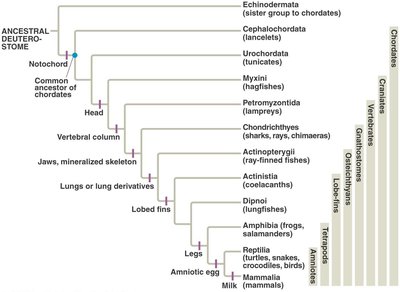
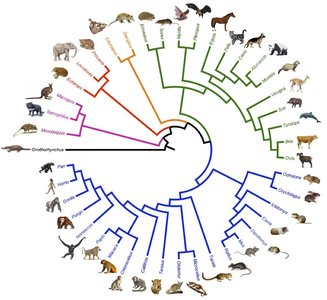
Humans are classified within the animal kingdom, specifically in the phylum Chordata, class Mammalia, order Primates, and family Hominidae. Understanding these classifications helps place human evolution in the broader context of animal evolution.
Chordata: Animals with a notochord, dorsal nerve cord, and pharyngeal slits.
Mammalia: Warm-blooded vertebrates with hair and mammary glands.
Primates: Mammals with flexible limbs, grasping hands, and large brains.
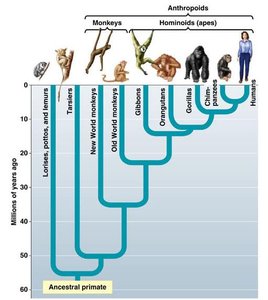
Hominidae: Great apes and humans, sharing a common ancestor with chimpanzees about 6–7 million years ago.
Hominid Phylogeny and Traits
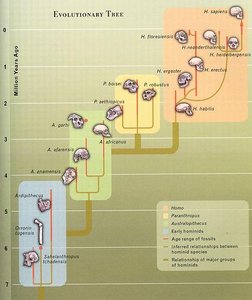
Hominids are human-like primates. The evolutionary relationships among hominid species are complex, resembling a bush rather than a tree, due to multiple speciation events and unresolved ancestry.
Common Ancestor: Humans and chimpanzees share a common ancestor from 6–7 million years ago.
Hominid Traits: Traits include bipedalism, larger brain size, and tool use.
Phylogeny: Major disagreements exist over which hominids are direct ancestors versus cousins.
Hominid Origins and Migration
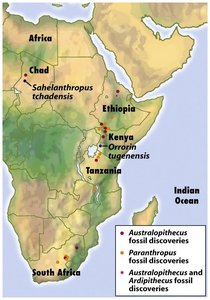
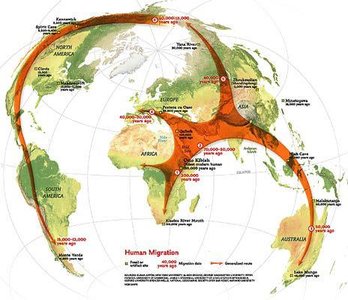
Most of the oldest hominid fossils have been found in East Africa. Migration out of Africa occurred relatively recently, with species such as Homo erectus, Homo neanderthalensis, and Homo sapiens spreading to other continents.
Fossil Locations: East Africa is the primary site for early hominid fossils.
Migration Patterns: Recent migrations (tens of thousands of years ago) led to global dispersal.
Adaptive Trends in Hominid Evolution
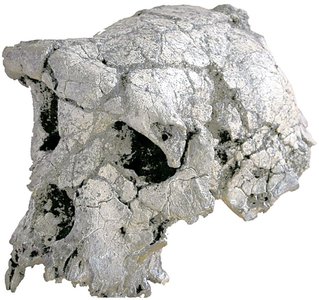
Sahelanthropus tchadensis
The oldest hominid fossils, found in Chad, are 6–7 million years old and may represent the earliest divergence after the human-chimpanzee split. Some researchers debate whether these fossils belong to the human or chimp lineage.
Significance: Extends the timeline of hominid evolution.
Location: Chad, Africa.
Ardipithecus sp. (“Ardi”)
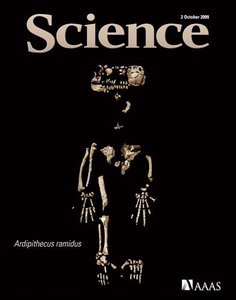
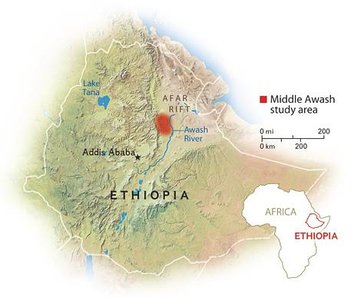
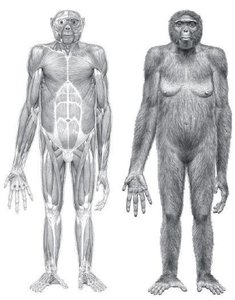
Ardi is considered the oldest known hominid relative ancestral to the Homo lineage. The skeleton, found in Ethiopia, is about 4.4 million years old and provides key insights into early hominid traits.
Bipedalism: Pelvic structure indicates upright walking, but Ardi had grasping feet.
Hand Structure: Not a knuckle-walker, unlike chimpanzees.
Brain Size: Similar to modern chimpanzees.
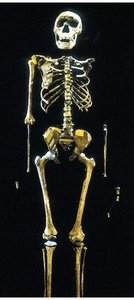
Australopithecus afarensis (“Lucy”)
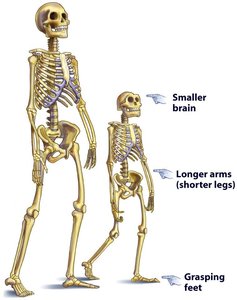
Lucy was previously considered the oldest ancestor of the Homo lineage. The skeleton, found in Ethiopia, is about 3.5 million years old and shows adaptations for bipedalism.
Bipedalism: Pelvic structure supports upright walking.
Physical Traits: Long arms, short legs, grasping feet.
Brain Size: 450 cc, similar to chimpanzees.
Homo ergaster (“Turkana Boy”)
Homo ergaster is ancestral to Homo erectus and Homo sapiens. The best-preserved remains were found in Kenya and belong to a 1.6 million year-old boy.
Modern Traits: Modern face, limbs, and adult height.
Tool Technology: Evidence for advanced tools.
Brain Size: 700–800 cc, over half the volume of Homo sapiens.
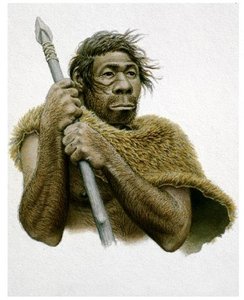
Homo neanderthalensis
Neanderthals likely descended from Homo ergaster but are not ancestral to Homo sapiens. They lived 200,000 to 27,000 years ago and were the first extinct hominid fossils discovered.
Physical Traits: Short, stocky, powerfully built, heavy brow ridge, receding chin.
Culture: Evidence for tool use and burial practices.
Brain Size: Slightly larger than Homo sapiens.
Modern Homo sapiens
Our species arose 100,000 to 200,000 years ago in Africa, migrating globally and coexisting with other hominids such as Homo erectus and Homo neanderthalensis.
Migration: Spread to Indonesia by 46,000 years ago and Europe by 40,000 years ago.
Replacement: Homo sapiens may have replaced Neanderthals.
Homo floresiensis (“Hobbit People”)
Discovered in 2004 on the Indonesian island of Flores, Homo floresiensis lived as recently as 18,000 years ago. Adults were only 3 feet tall, with a brain size similar to Lucy and Ardi, yet they used fire and sophisticated tools.
Unique Traits: Small stature, small brain, advanced tool use.
Questions: How did they avoid extinction? Did they evolve from Homo erectus?
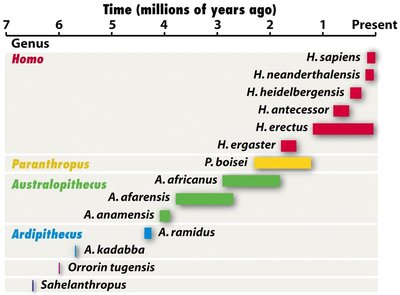
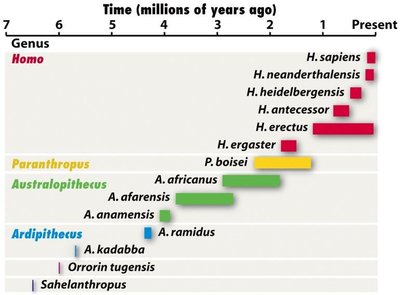
Summary Table: Hominid Evolution Timeline
The following table summarizes the timeline and key genera in hominid evolution:
Time (millions of years ago) | Genus | Key Species |
|---|---|---|
7 | Sahelanthropus | S. tchadensis |
6 | Orrorin | O. tugenensis |
5 | Ardipithecus | A. kadabba, A. ramidus |
4 | Australopithecus | A. anamensis, A. afarensis, A. africanus |
3 | Paranthropus | P. boisei |
2 | Homo | H. ergaster, H. erectus, H. neanderthalensis, H. sapiens |
Key Concepts and Definitions
Bipedalism: Walking upright on two legs, a defining trait of hominids.
Speciation: The process by which new species arise from existing ones.
Phylogeny: The evolutionary history and relationships among species.
Adaptive Trends: Changes in traits such as brain size, tool use, and locomotion that contributed to the success of hominids.
Equations and Academic Context
While human evolution is primarily studied through fossil evidence and comparative anatomy, genetic analysis also plays a role. Sequence variation in Homo sapiens genomes reveals population ancestries and migration patterns.
Genetic Distance Equation: Used to estimate divergence times between species. Where D is genetic distance, \mu is mutation rate, and t is time since divergence.
Additional info: Academic context was added to clarify definitions and provide a summary table for evolutionary timeline.
----------------------------------------
