 Back
Human Reproductive System: Structure, Function, and Hormonal Regulation
Study Guide - Smart Notes
 Tailored notes based on your materials, expanded with key definitions, examples, and context.
Human Reproductive System
Overview
The human reproductive system is responsible for producing, storing, and delivering gametes, as well as supporting the development of offspring. It consists of specialized organs and is regulated by a complex interplay of hormones.
Female Reproductive System
Anatomy and Functions
Ovary: Produces eggs (ova) and hormones such as estrogen and progesterone. Each ovary typically releases one egg per month, alternating sides.
Oviducts (Fallopian Tubes): Tubes lined with cilia that transport eggs from the ovaries to the uterus; the usual site of fertilization.
Uterus (Womb): A muscular, highly vascular organ where implantation and embryonic/fetal development occur.
Endometrium: The vascular lining of the uterus, which thickens in preparation for implantation and is shed during menstruation if fertilization does not occur.
Cervix: Cartilaginous disk separating the uterus from the vagina.
Vagina: Muscular tube serving as the birth canal and the exit for menstrual flow.
Urethra: Tube for urine excretion, not shared with the reproductive tract in females.
Labia: External tissue surrounding the vaginal opening.

Ovulation and the Menstrual Cycle
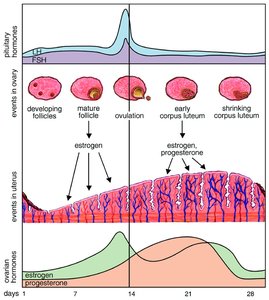
Ovulation: The release of an egg from the ovary, typically around Day 14 of the menstrual cycle.
Corpus Luteum: The remnant of the follicle after ovulation, which secretes estrogen and progesterone to maintain the uterine lining.
Menstruation: Shedding of the endometrial lining if implantation does not occur, marking Day 1 of the menstrual cycle.
Hormonal Regulation
Estrogen: Produced by the ovaries; stimulates growth of the uterine lining.
Progesterone: Produced by the ovaries; maintains the uterine lining.
Gonadotropin-releasing hormone (GnRH): Produced by the hypothalamus; stimulates the pituitary to release FSH and LH.
Follicle-stimulating hormone (FSH): Produced by the pituitary; stimulates follicle and egg maturation.
Luteinizing hormone (LH): Produced by the pituitary; triggers ovulation and corpus luteum formation.
Fertilization, Implantation, and Pregnancy
Fertilization: Occurs in the oviduct; fusion of sperm and egg nuclei forms a diploid zygote.
Implantation: The embryo embeds in the endometrium for nourishment and development.
Gestation: The period of embryonic and fetal development within the uterus.
Placenta: A vascular organ that facilitates exchange of nutrients, gases, and wastes between mother and fetus without mixing their blood.
Human chorionic gonadotropin (HCG): Hormone produced by the placenta to maintain the corpus luteum and uterine lining in early pregnancy.
Oxytocin: Hormone from the hypothalamus that induces uterine contractions during labor and milk release after birth.


Male Reproductive System
Anatomy and Functions
Testes: Organs where sperm are produced via meiosis in seminiferous tubules.
Scrotum: Sac that holds the testes outside the body to maintain optimal temperature for sperm production.
Seminiferous Tubules: Highly coiled structures within the testes where spermatogenesis occurs.
Epididymis: Structure atop the testes where sperm mature and are stored.
Vas Deferens: Duct that transports sperm from the epididymis to the urethra.
Urethra: Tube that carries semen (sperm plus seminal fluid) out of the body.
Prostate Gland & Seminal Vesicles: Produce seminal fluid containing water, fructose, and proteins to nourish and protect sperm.
Semen: The combination of sperm and seminal fluid expelled during ejaculation.

Hormonal Regulation
Gonadotropin-releasing hormone (GnRH): Stimulates the pituitary to release FSH and LH.
Follicle-stimulating hormone (FSH): Stimulates sperm production in the testes.
Luteinizing hormone (LH): Stimulates androgen (testosterone) production in the testes.
Testosterone: Main male sex hormone; maintains male reproductive tissues and secondary sexual characteristics.
Summary Table: Key Structures and Functions
Structure | Location | Function |
|---|---|---|
Ovary | Female | Egg and hormone production |
Oviduct (Fallopian tube) | Female | Egg transport; site of fertilization |
Uterus | Female | Embryo/fetus development |
Testes | Male | Sperm and testosterone production |
Seminiferous tubules | Male | Spermatogenesis |
Prostate/Seminal vesicles | Male | Seminal fluid production |
Placenta | Female (pregnancy) | Maternal-fetal exchange |
Key Hormones and Their Roles
Hormone | Source | Main Function |
|---|---|---|
GnRH | Hypothalamus | Stimulates FSH and LH release |
FSH | Pituitary | Egg/sperm maturation |
LH | Pituitary | Ovulation/testosterone production |
Estrogen | Ovary/Placenta | Uterine lining growth, secondary sex characteristics |
Progesterone | Ovary/Placenta | Maintains uterine lining |
Testosterone | Testes | Male reproductive health, secondary sex characteristics |
HCG | Placenta | Maintains corpus luteum in early pregnancy |
Oxytocin | Hypothalamus | Uterine contractions, milk release |
Additional info:
The menstrual cycle is typically 28 days, but can vary among individuals.
Fertilization restores the diploid chromosome number in humans (46 chromosomes).
The placenta acts as an endocrine organ, producing hormones necessary for pregnancy maintenance.
