 Back
BackIdentifying Biological Molecules: DNA, RNA, and Proteins
Study Guide - Smart Notes
 Tailored notes based on your materials, expanded with key definitions, examples, and context.
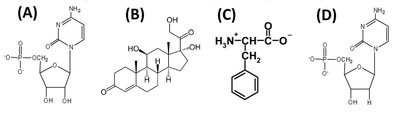
Q3. Identify which molecule would be found in DNA, which in RNA, and which in a protein. Also, name the type of molecule for each.
Background
Topic: Structure of Biological Macromolecules
This question tests your ability to recognize the structural differences between nucleotides (found in DNA and RNA) and amino acids (found in proteins). Understanding these differences is essential for studying gene expression and molecular biology.
Key Terms and Concepts:
Nucleotide: The building block of nucleic acids (DNA and RNA). Each nucleotide consists of a sugar, a phosphate group, and a nitrogenous base.
Deoxyribonucleotide: A nucleotide found in DNA, containing deoxyribose sugar.
Ribonucleotide: A nucleotide found in RNA, containing ribose sugar.
Amino Acid: The building block of proteins, containing an amino group, a carboxyl group, and a unique side chain (R group).
Step-by-Step Guidance
Examine the structure labeled (A). Look for the presence of a ribose sugar (with an -OH group on the 2' carbon) to identify a ribonucleotide, which is found in RNA.
Examine the structure labeled (D). Check for a deoxyribose sugar (with an -H on the 2' carbon instead of -OH) to identify a deoxyribonucleotide, which is found in DNA.
Examine the structure labeled (C). Look for the presence of an amino group (), a carboxyl group (), and a unique side chain (R group) to identify an amino acid, which is found in proteins.
Structure (B) is a steroid molecule and is not typically found as a monomer in DNA, RNA, or proteins.
Try solving on your own before revealing the answer!
Final Answer:
The molecule found in DNA is (D), a deoxyribonucleotide. The molecule found in RNA is (A), a ribonucleotide. The molecule found in a protein is (C), an amino acid.
We identify these based on the sugar present in the nucleotide (ribose for RNA, deoxyribose for DNA) and the presence of amino and carboxyl groups for amino acids.
