 Back
Immune and Defense Systems: Concept Challenge Study Guide
Study Guide - Smart Notes
 Tailored notes based on your materials, expanded with key definitions, examples, and context.
Q1. What are the main differences between innate and adaptive immunity?
Background
Topic: Immune System Overview
This question tests your understanding of the two major branches of the immune system: innate (nonspecific) and adaptive (specific) immunity. You should be able to compare their characteristics, speed, and mechanisms.
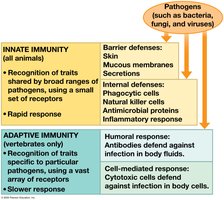
Key Terms and Concepts:
Innate Immunity: The first line of defense, present in all animals, provides rapid but nonspecific responses to pathogens.
Adaptive Immunity: Found only in vertebrates, involves slower but highly specific responses using a vast array of receptors.
Barrier Defenses: Physical and chemical barriers like skin and mucous membranes.
Humoral Response: Antibodies defend against infection in body fluids.
Cell-mediated Response: Cytotoxic cells defend against infection in body cells.
Step-by-Step Guidance
Identify which components of the immune system act as the first line of defense and describe their general characteristics (e.g., speed, specificity).
List the types of cells and molecules involved in innate immunity and their roles (e.g., phagocytic cells, natural killer cells, antimicrobial proteins).
Describe how adaptive immunity differs in terms of response time and specificity, and name the main cell types involved (e.g., B cells, T cells).
Explain how the humoral and cell-mediated responses function within adaptive immunity.
Try solving on your own before revealing the answer!
Final Answer:
Innate immunity provides a rapid, nonspecific response using barriers and general immune cells, while adaptive immunity is slower but highly specific, involving B and T cells that target particular pathogens. Adaptive immunity also has memory, allowing for a stronger response upon re-exposure to the same pathogen.
Q2. How do physical and chemical barriers contribute to innate immunity?
Background
Topic: Innate Immune Defenses
This question focuses on the role of the body's physical and chemical barriers in preventing pathogen entry as part of the innate immune system.
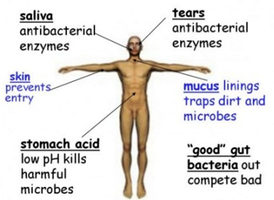
Key Terms and Concepts:
Physical Barriers: Structures like skin and mucous membranes that block pathogen entry.
Chemical Barriers: Substances such as stomach acid, enzymes in saliva and tears, and antimicrobial peptides that destroy or inhibit pathogens.
Microbiota: Beneficial bacteria that outcompete harmful microbes.
Step-by-Step Guidance
List the main physical barriers and describe how each prevents pathogen entry (e.g., skin, mucous membranes).
Identify chemical barriers and explain their mechanisms (e.g., low pH in the stomach, lysozyme in tears and saliva).
Discuss the role of beneficial microbes in protecting against infection.
Try solving on your own before revealing the answer!
Final Answer:
Physical barriers like skin and mucous membranes block pathogen entry, while chemical barriers such as stomach acid and enzymes destroy or inhibit microbes. Beneficial bacteria also help by outcompeting harmful organisms.
Q3. How do immune cells recognize pathogens as part of the innate and adaptive immune responses?
Background
Topic: Pathogen Recognition
This question examines how immune cells distinguish between self and non-self, and how recognition differs between innate and adaptive immunity.
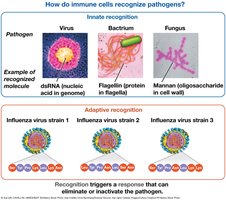
Key Terms and Concepts:
Pattern Recognition Receptors (PRRs): Used by innate immune cells to detect common pathogen-associated molecular patterns (PAMPs).
Antigen Receptors: Used by adaptive immune cells (B and T cells) to recognize specific antigens.
Pathogen-Associated Molecular Patterns (PAMPs): Molecules commonly found on pathogens but not host cells.
Step-by-Step Guidance
Describe how innate immune cells use PRRs to recognize broad classes of pathogens (e.g., flagellin, dsRNA).
Explain how adaptive immune cells recognize specific antigens using highly variable receptors.
Discuss the outcome of pathogen recognition in both systems (e.g., activation of immune responses).
Try solving on your own before revealing the answer!
Final Answer:
Innate immune cells recognize common molecular patterns on pathogens, while adaptive immune cells use specific receptors to identify unique antigens. Recognition leads to immune activation and pathogen elimination.
