 Back
Immunogenetics: Structure, Function, and Diversity of Antigen Receptors and HLA (PP 5)
Study Guide - Smart Notes
 Tailored notes based on your materials, expanded with key definitions, examples, and context.
Immunogenetics: Overview
Introduction
Immunogenetics is the study of genetic mechanisms underlying immune system function, focusing on antigen receptors (BCR and TCR), antibody diversity, and the Human Leukocyte Antigen (HLA) complex. These concepts are central to understanding immune responses, transplantation, and immunological memory.
B Cell and T Cell Antigen Receptors
B Cell Receptor (BCR) and T Cell Receptor (TCR) Structure
BCRs and TCRs are specialized proteins on lymphocytes that recognize antigens. Their structure determines specificity and function.
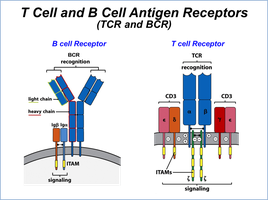
BCR: Composed of two heavy and two light chains, with variable and constant regions.
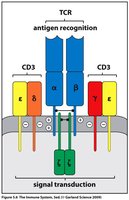
TCR: Composed of alpha and beta chains, associated with CD3 complex for signaling.
Antibody Structure
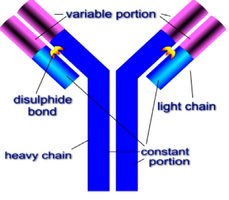
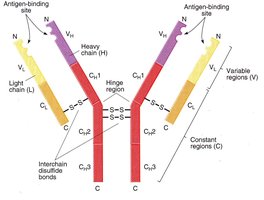
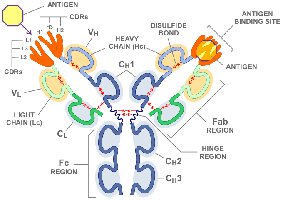
Antibodies (immunoglobulins) are Y-shaped molecules with variable regions for antigen binding and constant regions for effector functions.
Variable region: Determines antigen specificity.
Constant region: Defines antibody class and function.
Disulfide bonds: Stabilize the structure.
Classes of Antibodies (Immunoglobulins)
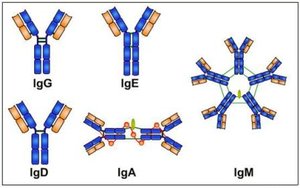
Antibodies are classified into five main isotypes, each with distinct functions.
IgG: Most abundant, crosses placenta, opsonization.
IgM: First produced, pentameric, activates complement.
IgA: Mucosal immunity, dimeric.
IgE: Allergic responses, parasite defense.
IgD: B cell receptor function.
T Cell Receptor (TCR) Complex
TCR Structure and Function
The TCR complex recognizes antigens presented by MHC molecules.
CD3: Signaling component, universal T cell marker.
Antigen recognition: TCR binds peptide-MHC complexes.
Co-receptors: CD4 (helper T cells) and CD8 (cytotoxic T cells) determine function.
Affinity: TCRs have lower affinity than BCRs due to lack of somatic hypermutation.
TCR Regions
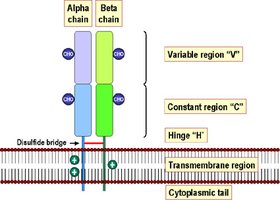
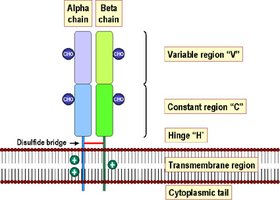
Variable region: Recognizes antigen, unique to each T cell.
Constant region: Same in all TCRs.
Generation of TCR Diversity
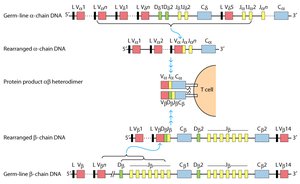
TCR diversity is generated by gene rearrangement, creating millions of unique receptors.
Gene segments: V (variable), D (diversity), J (joining).
Combinatorial diversity: Multiple gene segments recombine.
Estimated combinations: possible TCRs.
B Cell Receptor Diversity and Antibody Development
Antibody Generation and Diversity
Each antibody recognizes a unique antigen, requiring immense diversity to cover all possible pathogens.
Heavy chain: 51 V, 27 D, 6 J segments.
Light chain: V and J segments.
Total combinations: possible antibodies.
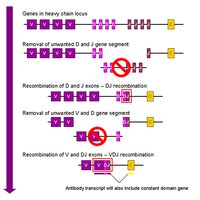
Gene Rearrangement in B Cells
VL, JL, CL genes: Variable, joining, and constant regions for light chains.
Random selection: DNA segments are randomly chosen and recombined.
B Cell and T Helper Cell Interaction
Antigen Presentation and B Cell Activation
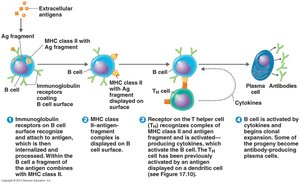
B cells present antigens to T helper cells, which activate B cells via cytokines (e.g., IL-4), leading to antibody production.
Antigen uptake: B cell internalizes and presents antigen.
T helper cell activation: Recognizes antigen-MHC complex.
B cell activation: Cytokines stimulate antibody production.
Effects of T Helper Cells
Clonal expansion: B cells proliferate.
Isotype switching: B cells change antibody class.
Affinity maturation: Higher affinity antibodies produced.
Memory cell formation: Long-lived cells for rapid response.
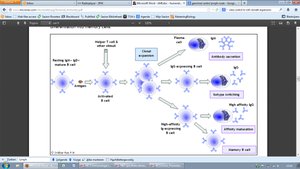
Antibody Response and Isotype Switching
Primary and Secondary Responses
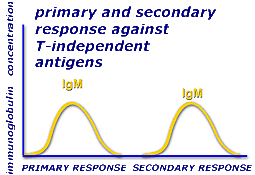
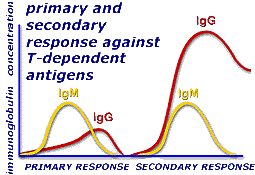
Primary response: IgM produced first, slow and low titer.
Secondary response: IgG and other isotypes produced, rapid and high titer.
Isotype Switching
B cells switch from IgM to other isotypes (IgG, IgA, IgE) to adapt to different immune functions. 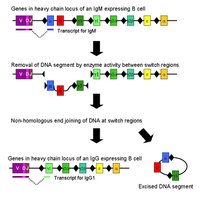
Affinity Maturation
Somatic hypermutation in the complementarity determining regions (CDRs) increases antibody affinity.
High mutation rate: CDRs undergo frequent point mutations.
Selection: B cells with higher affinity survive.
Immunological Memory
Memory Cells
Long-lived cells: Survive in circulation or bone marrow.
Rapid response: Produce antibodies quickly upon re-exposure.
Primary vs. Secondary Infection
T-independent: No memory cells, same response each time.
T-dependent: Memory cells present, faster and stronger response.
Types of Acquired Immunity
Classification
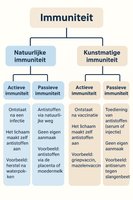
Acquired immunity can be natural or artificial, and active or passive.
Natural active: Infection-induced immunity.
Natural passive: Maternal antibody transfer.
Artificial active: Vaccination.
Artificial passive: Immunoglobulin administration.
Human Leukocyte Antigen (HLA) and Transplantation
MHC/HLA Genes
The Major Histocompatibility Complex (MHC), also known as HLA in humans, encodes cell surface antigens for self/non-self recognition.
Polymorphic genes: Hundreds of alleles per gene.
Distinguishes self from non-self: Essential for immune response and transplantation.
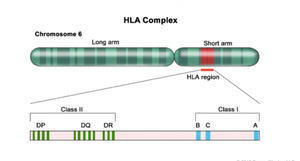
MHC Class I and II
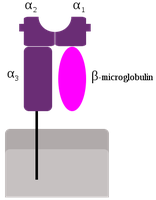
MHC-I: Presents antigens to CD8+ T cells; consists of one alpha chain and beta-microglobulin. Main variants: HLA-A, HLA-B, HLA-C.
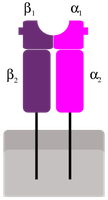
MHC-II: Presents antigens to CD4+ T cells; consists of alpha and beta chains. Main variants: DP, DQ, DR.
HLA Inheritance and Expression
Two alleles per person: One from each parent.
Co-dominant expression: All alleles are expressed.
HLA and Disease Susceptibility
Certain HLA types are associated with increased risk for specific diseases.
Transplantation and Graft Rejection
Incompatible HLA: Leads to graft rejection via cytotoxicity, phagocytosis, and complement activation.
Graft-versus-Host Disease: Donor immune cells attack recipient tissues.
Types of Transplants
Autograft: From self.
Isograft: From genetically identical individual.
Allograft: From another person (HLA matching required).
Xenograft: From another species.
Stem Cells in Transplantation
Autograft with stem cells: Reduces rejection risk.
Therapeutic cloning: Uses stem cells to replace organs.
Types: Embryonic, hematopoietic, and connective tissue stem cells.
Table: Types of Transplants and Immunological Response
Transplant Type | Source | Immune Response |
|---|---|---|
Autograft | Self | No immune response |
Isograft | Identical twin | No immune response |
Allograft | Another person | Immune response, HLA matching required |
Xenograft | Other species | Strong immune response, rejection likely |
Summary
Immunogenetics integrates molecular genetics and immunology to explain how antigen receptors and HLA molecules determine immune specificity, diversity, and transplantation outcomes. Understanding these mechanisms is essential for clinical applications such as vaccine development, disease susceptibility, and organ transplantation.
