 Back
Inheritance, Chromosomes, and Genetic Variation: Study Notes for General Biology
Study Guide - Smart Notes
 Tailored notes based on your materials, expanded with key definitions, examples, and context.
Inheritance of Genes
Basic Principles of Inheritance
The transmission of traits from one generation to the next is known as inheritance or heredity. Offspring inherit genes from their parents by receiving chromosomes, but sons and daughters are not identical copies of either parent or their siblings. This inherited similarity is accompanied by variation, which is the foundation of genetics—the scientific study of heredity and variation.
Genes are units of heredity, composed of DNA segments.
Genes are passed to the next generation via gametes (sperm and eggs).
Most DNA is packaged into chromosomes.
Humans have 46 chromosomes in somatic cells (all cells except gametes and their precursors).
A gene’s specific position on a chromosome is called its locus.
Comparison of Asexual and Sexual Reproduction
Modes of Reproduction
Organisms reproduce either asexually or sexually, each method affecting genetic diversity differently.
Asexual reproduction: A single individual passes all its genes to offspring without gamete fusion, producing genetically identical clones.
Sexual reproduction: Two parents contribute genes, resulting in offspring with unique gene combinations.
Clones: Genetically identical individuals from one parent.
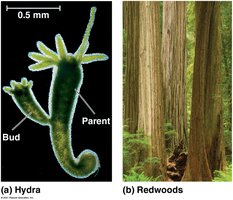
Example: Hydra reproduce by budding (asexual), while redwoods can clone themselves from roots.
Life Cycles and Alternation of Meiosis and Fertilization
Sexual Life Cycles
A life cycle is the sequence of stages in an organism’s reproductive history. In sexually reproducing organisms, meiosis and fertilization alternate to maintain chromosome number across generations.
Meiosis produces haploid gametes.
Fertilization restores diploid chromosome number.
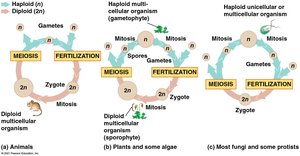
Example: Animals, plants, and fungi have distinct life cycle patterns involving meiosis and fertilization.
Chromosomes and Karyotypes
Structure and Classification
Chromosomes are the carriers of genetic information. A karyotype is an ordered display of chromosome pairs from a cell, useful for identifying chromosomal abnormalities.
Each chromosome is replicated after DNA synthesis, forming two identical sister chromatids.
Homologous chromosomes (homologs) are pairs with the same length, centromere position, and staining pattern, carrying genes for the same traits.
Each homologous pair includes one chromosome from each parent.
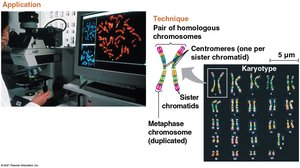
Example: Karyotyping is used in medical genetics to diagnose chromosomal disorders.
Sex Chromosomes and Autosomes
Humans have 23 pairs of chromosomes: 22 pairs of autosomes and 1 pair of sex chromosomes (XX for females, XY for males).
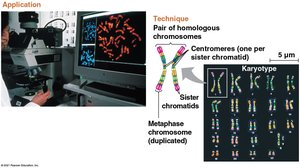
Example: The presence of X and Y chromosomes determines biological sex.
Karyotype Analysis
Karyotypes can reveal chromosomal abnormalities such as trisomies.
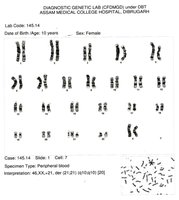
Feature | Number |
|---|---|
Pairs of chromosomes | 23 |
Autosomes | 22 pairs |
Sex chromosomes | 1 pair |
Sex of patient | Female (XX) |
Trisomy | Chromosome 21 (Down syndrome) |
Chromosome Sets in Human Cells
Diploid and Haploid Cells
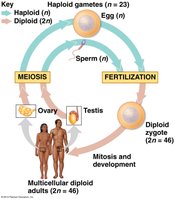
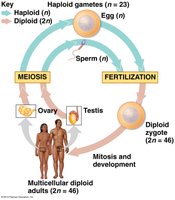
Human somatic cells are diploid (2n = 46), containing two sets of chromosomes—one from each parent. Gametes are haploid (n = 23), containing a single set.
Diploid cells: All body cells except gametes.
Haploid cells: Gametes (sperm and egg).
Ovum contains X chromosome; sperm contains X or Y.
Human Life Cycle: Chromosome Behavior
Fertilization and Development
Fertilization is the union of haploid gametes, forming a diploid zygote. The zygote undergoes mitosis to produce somatic cells and develop into an adult.
Meiosis and Chromosome Number Maintenance
Gametes are produced by meiosis in the ovaries and testes. Meiosis ensures gametes have half the chromosome number, maintaining stability across generations.
Meiosis: Process and Stages
Overview of Meiosis
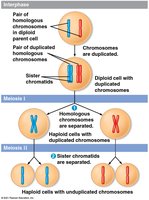
Meiosis reduces chromosome sets from diploid to haploid through two consecutive divisions: meiosis I and meiosis II. Four genetically distinct haploid cells are produced.
Meiosis is preceded by chromosome replication.
Meiosis I and II each have four phases: Prophase, Metaphase, Anaphase, Telophase.
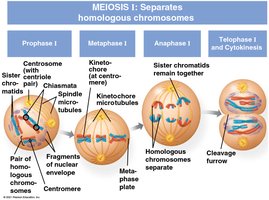
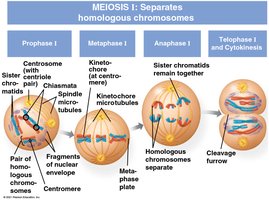
Meiosis I: Separation of Homologous Chromosomes
Meiosis I separates homologous chromosomes, reducing chromosome number by half.
Prophase I: Homologs pair to form tetrads; crossing over occurs.
Metaphase I: Homologous pairs align at the metaphase plate.
Anaphase I: Homologs separate to opposite poles.
Telophase I and Cytokinesis: Two haploid cells form.
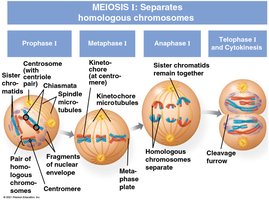
Prophase I: Crossing Over
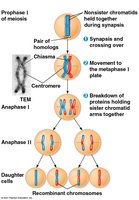
During prophase I, homologous chromosomes pair and exchange DNA segments at chiasmata, creating genetic diversity.
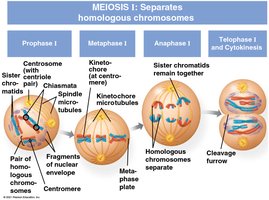
Chiasmata and Synapsis
Chiasmata are X-shaped regions where crossing over occurs. Synapsis involves the repair of DNA breaks, joining DNA from nonsister chromatids.
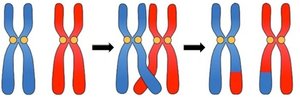
Metaphase I
Homologous pairs align at the metaphase plate, with microtubules attaching to kinetochores.
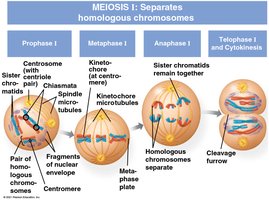
Anaphase I
Homologous chromosomes separate, guided by the spindle apparatus. Sister chromatids remain attached.
Telophase I and Cytokinesis
Each cell has a haploid set of duplicated chromosomes. Cytokinesis forms two haploid daughter cells.
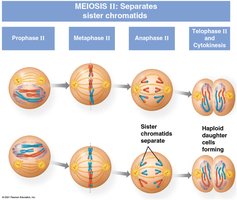
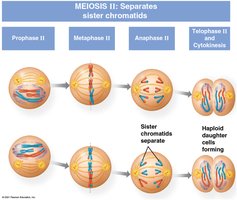
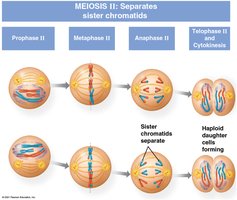
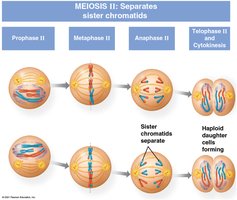
Meiosis II: Separation of Sister Chromatids
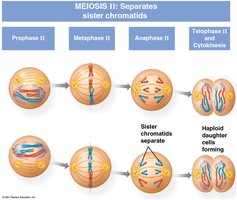
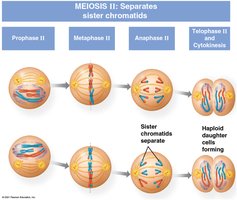
Meiosis II resembles mitosis, separating sister chromatids to produce four haploid cells.
Prophase II: Spindle apparatus forms; chromosomes move toward metaphase plate.
Metaphase II: Chromatids align at metaphase plate; kinetochores attach to microtubules.
Anaphase II: Sister chromatids separate.
Telophase II and Cytokinesis: Chromosomes decondense; four haploid cells form.
Comparison of Mitosis and Meiosis
Key Differences
Mitosis produces two genetically identical diploid cells, conserving chromosome number. Meiosis produces four genetically distinct haploid cells, reducing chromosome number.
Mitosis: 2n → 2n
Meiosis: 2n → n
Unique Events in Meiosis I
Synapsis and crossing over (Prophase I)
Alignment of homologous pairs (Metaphase I)
Separation of homologs (Anaphase I)
Genetic Variation and Its Origins
Mutations and Alleles
Mutations are changes in DNA, creating new alleles and serving as the original source of genetic diversity. Sexual reproduction reshuffles alleles, increasing variation.
Mechanisms of Genetic Variation
Three mechanisms contribute to genetic variation among offspring:
Independent assortment of chromosomes
Crossing over
Random fertilization
Independent Assortment
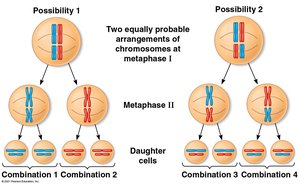
Homologous pairs orient randomly at metaphase I, sorting maternal and paternal chromosomes independently. The number of possible combinations is , where n is the haploid number. For humans, yields over 8 million combinations.
Crossing Over
Crossing over produces recombinant chromosomes, combining DNA from both parents. In humans, 1–3 crossover events occur per chromosome.
Random Fertilization
Any sperm can fuse with any ovum, resulting in a zygote with about 70 trillion possible diploid combinations from the same two parents.
Example: Genetic variation is essential for evolution and adaptation in populations.
