 Back
Innate Immunity and the Lymphatic System: Structure, Function, and Inflammatory Response (aantekeningen)
Study Guide - Smart Notes
 Tailored notes based on your materials, expanded with key definitions, examples, and context.
Innate (Nonspecific) Immunity
Three Lines of Defense
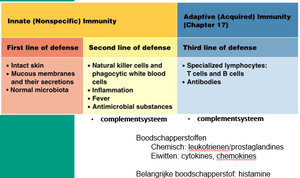
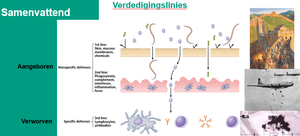
The immune system protects the body from pathogens through three main lines of defense. The first two lines are part of the innate (nonspecific) immunity, while the third line is adaptive (acquired) immunity.
First Line of Defense: Physical and chemical barriers such as intact skin, mucous membranes, and normal microbiota prevent pathogen entry.
Second Line of Defense: Cellular and molecular mechanisms including natural killer cells, phagocytic white blood cells, inflammation, fever, and antimicrobial substances act rapidly and nonspecifically against invaders.
Third Line of Defense: Specialized lymphocytes (T cells and B cells) and antibodies provide specific, adaptive immunity with immunological memory.
First Line of Defense: Physical and Chemical Barriers
The first line of defense consists of barriers that block pathogens from entering the body.
Intact Skin: Acts as a physical barrier; its dryness and saltiness inhibit microbial growth.
Mucous Membranes: Trap pathogens and are continuously renewed; tight junctions between cells prevent penetration.
Normal Flora: Occupy space, consume nutrients, and secrete growth-inhibiting substances.
Antimicrobial Proteins: Found in saliva, tears, mucus, sweat, and breast milk; prevent infections.
Mechanical Removal: Urine and air flow help flush out pathogens.
Second Line of Defense: Cellular and Molecular Response
The second line of defense involves rapid, nonspecific responses by immune cells and molecules.
Granulocytes: Include neutrophils (strongly phagocytic, accumulate early in inflammation), basophils (release histamine in allergies), and eosinophils (combat parasites, mildly phagocytic).
Macrophages: Large phagocytic cells involved in tissue repair; called monocytes when in blood.
Phagocytosis: Specialized uptake of particles >0.5 μm by macrophages, neutrophils, and eosinophils.
Production of Antimicrobial Substances: Includes reactive oxygen species (e.g., H2O2, O2-).
Inflammation: Local response to infection or injury, characterized by redness, heat, swelling, pain, and loss of function.
Pattern Recognition and Inflammatory Response
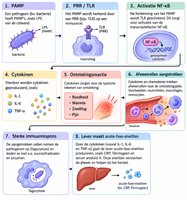
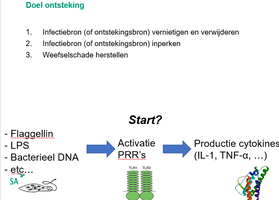
Cells of the innate immune system recognize pathogens and damaged cells using pattern recognition receptors (PRRs), which detect pathogen-associated molecular patterns (PAMPs) and damage-associated molecular patterns (DAMPs).
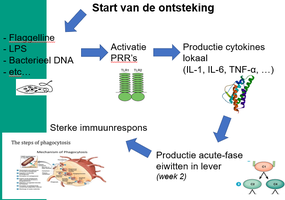
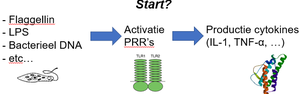
PAMPs: Molecules from microbes (e.g., flagellin, LPS, bacterial DNA) that alert the immune system.
DAMPs: Molecules released from damaged or dying cells, triggering inflammation.
Toll-Like Receptors (TLRs): Specialized PRRs that activate transcription factors (e.g., NF-κB), leading to cytokine production.
Cytokines: Signaling proteins (e.g., IL-1, TNF-α) that mediate local and systemic inflammatory responses.
Acute Phase Response and Strong Immune Activation
Upon activation, immune cells produce cytokines locally, which stimulate the liver to synthesize acute-phase proteins (e.g., C-reactive protein, mannose-binding lectin, fibrinogen, kinins). These proteins enhance inflammation, promote phagocytosis, and aid in tissue repair.
Acute Phase Proteins: Increase during inflammation; involved in complement activation, blood clotting, and vasodilation.
Complement System: A group of proteins that lyse pathogens, enhance phagocytosis, and trigger inflammation.
Lymphatic System
Structure and Function
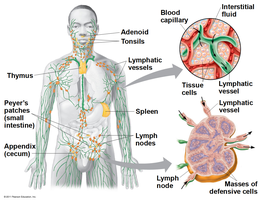
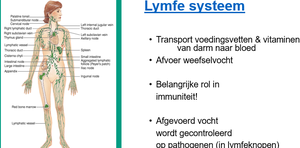
The lymphatic system is a network of vessels and organs that play a crucial role in immunity, fluid balance, and nutrient transport.
Transport: Moves dietary fats and vitamins from the intestine to the blood.
Fluid Removal: Drains excess tissue fluid and returns it to the bloodstream.
Immune Surveillance: Lymph nodes filter lymph and monitor for pathogens.
Primary, Secondary, and Tertiary Lymphoid Organs
Lymphoid organs are classified based on their function in immune cell development and response.
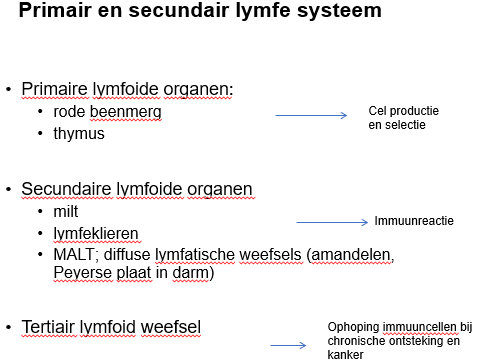
Primary Lymphoid Organs: Bone marrow (produces and selects cells) and thymus (T cell maturation).
Secondary Lymphoid Organs: Spleen, lymph nodes, and MALT (mucosa-associated lymphatic tissue, e.g., tonsils, Peyer's patches) where immune responses occur.
Tertiary Lymphoid Tissue: Accumulates immune cells during chronic inflammation or cancer.
Organ Type | Examples | Main Function |
|---|---|---|
Primary | Bone marrow, thymus | Cell production and selection |
Secondary | Spleen, lymph nodes, MALT | Immune response |
Tertiary | Inflamed tissues | Immune cell accumulation |
Summary: Lines of Defense
The innate immune system provides immediate, nonspecific protection through physical barriers and cellular responses, while the adaptive immune system offers specific, long-lasting immunity. The lymphatic system supports both by filtering pathogens and facilitating immune cell interactions.
Inflammatory Response: Purpose and Mechanism
Goals of Inflammation
Inflammation is a protective response to infection or injury, aiming to eliminate the source, limit spread, and repair tissue damage.
Destroy and remove the infection or inflammation source
Contain the infection or inflammation
Restore tissue integrity
Key Steps in Inflammatory Response
Recognition: PRRs detect PAMPs/DAMPs, activating immune cells.
Cytokine Production: Local release of IL-1, IL-6, TNF-α, and other mediators.
Acute Phase Protein Synthesis: Liver produces proteins that amplify the response.
Phagocytosis: Macrophages and neutrophils engulf pathogens.
Summary Table: Inflammatory Mediators
Type | Examples | Function |
|---|---|---|
Chemical | Leukotrienes, prostaglandins | Vasodilation, pain, fever |
Protein | Cytokines, chemokines | Cell signaling, immune cell recruitment |
Key Messenger | Histamine | Increases vascular permeability |
Additional info: The notes above expand on the original content by providing definitions, examples, and structured explanations suitable for General Biology students. The included images directly reinforce the described concepts, such as the lines of defense, PRR activation, and lymphatic system anatomy.
