 Back
BackInnate Immunity: Recognition and Response in Animals
Study Guide - Smart Notes
 Tailored notes based on your materials, expanded with key definitions, examples, and context.
Innate Immunity: Recognition and Response in Animals
Overview of Innate Immunity
Innate immunity is the first line of defense in animals, providing immediate, non-specific protection against a broad range of pathogens. It relies on the recognition of traits common to groups of pathogens and is present in all animals. This system includes physical barriers, cellular responses, and molecular mechanisms that act rapidly upon infection.
Pathogen: Any disease-causing agent, such as bacteria, fungi, or viruses.
Immune system: The collection of cells, tissues, and molecules that protect the body from infection.
Molecular recognition: The process by which immune cells identify nonself molecules, particles, and cells.
Innate Immunity in Invertebrates
Barrier Defenses
Invertebrates, such as insects, possess effective barrier defenses that prevent pathogen entry. The exoskeleton, primarily composed of chitin, acts as a physical barrier, while chitin lining the intestine and enzymes like lysozyme provide chemical protection against ingested pathogens.
Chitin: A polysaccharide forming the exoskeleton and intestinal lining in insects.
Lysozyme: An enzyme that breaks down bacterial cell walls, acting as a chemical barrier.
Internal Defenses: Cellular and Molecular Mechanisms
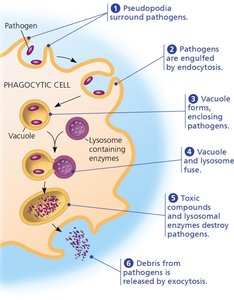
If pathogens breach barrier defenses, invertebrates rely on internal immune responses. Hemocytes, the major immune cells, recognize pathogen-associated molecules and initiate defense mechanisms such as phagocytosis and the release of antimicrobial peptides.
Hemocytes: Immune cells in insects responsible for phagocytosis and secretion of defense molecules.
Phagocytosis: The process by which cells engulf and digest pathogens.
Antimicrobial peptides: Molecules that disrupt pathogen membranes, leading to their inactivation or death.
Specificity of Innate Responses
Insect innate immunity can be specific for certain classes of pathogens. For example, the Toll receptor is activated by fungal cell wall components, leading to the production of peptides that specifically target fungi. Similar receptor proteins are found in mammals.
Antiviral Defense in Insects
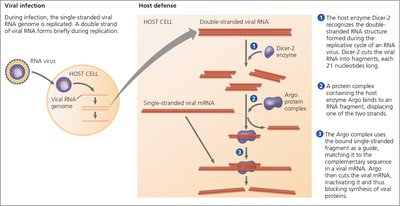
Insects defend against RNA viruses by recognizing double-stranded RNA (dsRNA) produced during viral replication. The enzyme Dicer-2 cleaves dsRNA into fragments, which are then used by the Argo protein complex to target and destroy viral mRNAs, preventing viral protein synthesis.
Dicer-2: Enzyme that cleaves viral dsRNA into small fragments.
Argo complex: Uses RNA fragments to guide the destruction of viral mRNAs.
Innate Immunity in Vertebrates
Barrier Defenses
Vertebrates, including mammals, possess barrier defenses such as skin and mucous membranes. These barriers are reinforced by secretions (e.g., mucus, saliva, tears) containing antimicrobial enzymes like lysozyme and by acidic environments (e.g., stomach acid) that inhibit pathogen growth.
Mucous membranes: Line body tracts and secrete mucus to trap pathogens.
Lysozyme: Present in tears, saliva, and mucus, destroys bacterial cell walls.
Acidic pH: Stomach acid and skin secretions create hostile environments for pathogens.
Cellular Innate Defenses
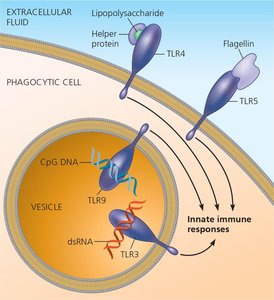
Phagocytic cells such as neutrophils and macrophages play a central role in vertebrate innate immunity. These cells use pattern recognition receptors, including Toll-like receptors (TLRs), to detect pathogen-associated molecular patterns and initiate immune responses.
Neutrophils: Circulate in the blood and are recruited to infection sites to engulf pathogens.
Macrophages: Large phagocytic cells that reside in tissues and organs, engulfing and destroying pathogens.
Dendritic cells: Stimulate adaptive immunity by presenting antigens to lymphocytes.
Eosinophils: Defend against multicellular parasites by releasing destructive enzymes.
Natural killer cells: Detect and induce death in virus-infected or cancerous cells.
Mast cells: Release histamine, contributing to inflammation and allergic responses.
Toll-like receptors (TLRs): Recognize specific pathogen molecules and activate innate immune responses.
Local Inflammatory Response
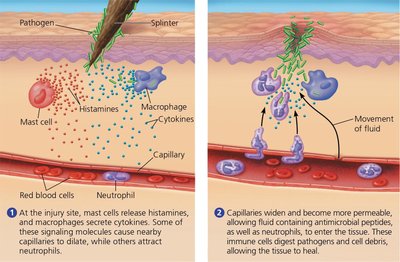
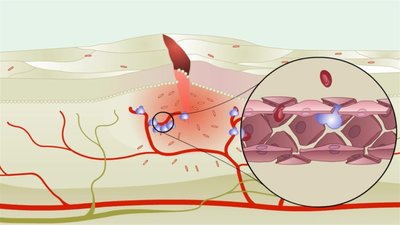
The inflammatory response is triggered by injury or infection. Mast cells release histamine, causing blood vessels to dilate and become more permeable. This allows immune cells and antimicrobial peptides to enter the tissue, resulting in redness, heat, and swelling. Cytokines released by macrophages recruit additional immune cells to the site.
Histamine: Increases blood vessel permeability and dilation.
Cytokines: Signaling molecules that attract immune cells to sites of infection or injury.
Pus: Accumulation of white blood cells, dead pathogens, and tissue debris at the infection site.
The Lymphatic System and Immune Activation
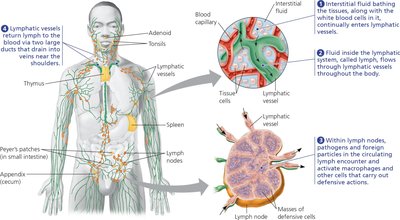
The lymphatic system transports lymph, a fluid containing immune cells, throughout the body. Lymph nodes filter lymph, trapping pathogens and presenting them to immune cells, which can then initiate adaptive immune responses.
Lymph: Fluid containing immune cells, pathogens, and debris.
Lymph nodes: Sites where immune cells interact and adaptive immunity is activated.
Systemic and Chronic Inflammation
Severe infections can trigger a systemic inflammatory response, including fever, which may enhance immune function and tissue repair. Chronic inflammation, however, can be harmful and is associated with diseases such as Crohn’s disease and ulcerative colitis.
Fever: Elevated body temperature in response to infection, potentially enhancing immune activity.
Chronic inflammation: Persistent inflammation that can damage tissues and disrupt normal function.
Antimicrobial Peptides and Proteins
Pathogen recognition in mammals triggers the production of antimicrobial peptides and proteins, including interferons and complement proteins. Interferons inhibit viral replication, while the complement system consists of plasma proteins that enhance immune responses and pathogen destruction.
Interferons: Proteins that interfere with viral replication and activate immune cells.
Complement system: A group of plasma proteins that enhance phagocytosis and pathogen lysis.
Evasion of Innate Immunity by Pathogens
Some pathogens have evolved mechanisms to evade innate immunity. For example, bacterial capsules can prevent recognition and phagocytosis, while certain bacteria and viruses can survive within host cells or suppress host immune responses.
Bacterial capsule: Outer layer that inhibits immune recognition and phagocytosis.
Intracellular survival: Some pathogens, like Mycobacterium tuberculosis, survive and replicate within host cells.
Immune suppression: Viral proteins may inhibit host protein synthesis or block defensive protein production.
Summary Table: Key Components of Innate Immunity
Component | Function | Example |
|---|---|---|
Barrier Defenses | Prevent pathogen entry | Skin, mucous membranes, chitin |
Phagocytic Cells | Engulf and destroy pathogens | Neutrophils, macrophages, hemocytes |
Antimicrobial Peptides | Disrupt pathogen membranes | Defensins, lysozyme |
Pattern Recognition Receptors | Detect pathogen-associated molecules | Toll-like receptors (TLRs) |
Inflammatory Response | Recruit immune cells, increase blood flow | Histamine, cytokines |
Complement System | Enhance phagocytosis, lyse pathogens | Complement proteins |
Interferons | Inhibit viral replication | Type I and II interferons |
Key Equations and Concepts
Phagocytosis: No specific equation, but involves the engulfment of pathogens by immune cells, formation of a phagosome, fusion with a lysosome, and digestion of the pathogen.
Pattern Recognition: TLRs bind to pathogen-associated molecular patterns (PAMPs), initiating signal transduction pathways that activate immune responses.
Example Application
Example: When a splinter introduces bacteria under the skin, mast cells release histamine, causing local blood vessels to dilate. Neutrophils and macrophages are recruited to the site, where they engulf and destroy the bacteria, resulting in the formation of pus and eventual healing of the tissue.
Additional info: Adaptive immunity, which is not covered in detail here, provides a more specific and long-lasting response to pathogens and is unique to vertebrates.
