 Back
Chapters 7-8
Study Guide - Smart Notes
 Tailored notes based on your materials, expanded with key definitions, examples, and context.
Chapter 7: Inside the Cell
Overview of Cellular Components
Cells are the fundamental units of life, and all cells share certain basic features. Understanding the structure and function of these components is essential for grasping how cells operate and interact with their environment.
Proteins: Perform most of the cell’s functions, including catalysis, structure, and signaling.
Nucleic Acids: Store, transmit, and process genetic information (DNA and RNA).
Carbohydrates: Provide chemical energy, structural support, and cellular identity.
Plasma Membrane: A selectively permeable barrier that separates the cell from its environment.
Prokaryotic Cells
Prokaryotic cells, such as those found in Bacteria and Archaea, are structurally simpler than eukaryotic cells. They lack membrane-bound organelles but contain all the necessary components for life.
Single Chromosome: Contains the genetic material.
Ribosomes: Sites of protein synthesis.
Phospholipid Components: Form the plasma membrane.
Cytoplasm: All contents inside the plasma membrane.
Cell Wall: Provides structural support (present in most bacteria).
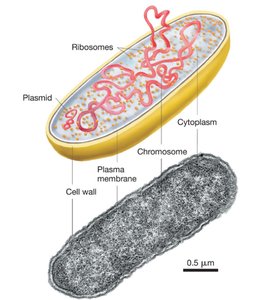
Additional info: Prokaryotes may also contain plasmids (small, circular DNA molecules) and long, thin protein filaments for structural support and movement.
Eukaryotic Cells
Eukaryotic cells are more complex and can be unicellular or multicellular. They contain membrane-bound organelles that compartmentalize cellular functions.
Organelles: Specialized structures (e.g., nucleus, mitochondria, endoplasmic reticulum) not found in prokaryotes.
Cytoplasm vs. Cytosol: Cytoplasm includes all cell contents except the nucleus; cytosol is the fluid portion.
Compartmentalization: Separates incompatible reactions and increases efficiency.
Additional info: Some eukaryotes (plants, fungi, algae) have cell walls; most animal cells rely on the extracellular matrix for structural support.
Key Organelles and Structures
Nucleus: Contains genetic material, is membrane-bound, and has nuclear pores for regulated transport.
Ribosomes: Manufacture proteins; composed of proteins and RNA, not considered organelles.
Endoplasmic Reticulum (ER): Network of membranes continuous with the nuclear envelope.
Rough ER: Studded with ribosomes; synthesizes proteins for secretion or membrane insertion.
Smooth ER: Lacks ribosomes; synthesizes lipids and contains detoxifying enzymes.
Golgi Apparatus: Processes and sorts proteins from the ER; composed of stacked cisternae (cis side faces nucleus, trans side faces plasma membrane). Proteins are often glycosylated here.
Lysosomes: (Animal cells only) Contain acid hydrolases for breaking down macromolecules; maintain acidic pH via proton pumps.
Mitochondria: Powerhouse of the cell; site of ATP production, contains its own DNA, has double membrane structure.
Extracellular Matrix: Network outside animal cells providing structural support and anchorage.
Endomembrane System
The endomembrane system includes the ER, Golgi apparatus, and lysosomes. It is responsible for the synthesis, processing, and transport of proteins and lipids within the cell.
Proteins are synthesized in the ER, processed in the Golgi, and shipped to their final destinations (e.g., lysosomes, plasma membrane).
Vesicles (membrane-bound sacs) transport materials between organelles.
Nuclear Transport
Proteins destined for the nucleus contain a nuclear localization signal (NLS), a specific amino acid sequence that directs their import through nuclear pore complexes. Transport is highly regulated and essential for cellular function.
Nuclear envelope separates nucleus from cytosol.
Nuclear pore complexes allow selective transport of proteins and RNA.
Protein Targeting and the Signal Hypothesis
Proteins are directed to specific cellular locations by signal sequences. The signal recognition particle (SRP) binds to the ER signal sequence, pausing translation and targeting the ribosome to the ER membrane for co-translational import.
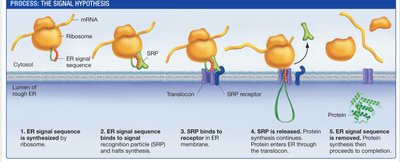
Proteins with no signal sequence remain in the cytosol.
Proteins destined for secretion or organelles have specific signal sequences.
Mannose-6-phosphate tags direct proteins to lysosomes.
Endocytosis and Recycling
Cells can internalize external materials via endocytosis. Receptor-mediated endocytosis uses specific receptors to bring in macromolecules, which are then delivered to lysosomes for processing and recycling.
Endocytosis: General uptake of materials via vesicles.
Receptor-mediated endocytosis: Specific uptake using membrane receptors.
Cytoskeleton
The cytoskeleton provides structural support, facilitates movement, and organizes cellular components. It consists of three main types of protein filaments:
Actin Filaments (Microfilaments): Involved in cell shape and movement.
Intermediate Filaments: Provide mechanical strength.
Microtubules: Involved in intracellular transport and cell division.
Chapter 8: Energy and Enzymes: Introduction to Metabolism
Metabolism and Energy
Metabolism encompasses all chemical reactions in a cell, including the synthesis and breakdown of molecules. Enzymes catalyze these reactions, making cellular processes efficient and regulated.
Kinetic Energy: Energy of motion (e.g., thermal energy).
Potential Energy: Stored energy due to position or structure (e.g., chemical bonds).
Potential Energy in Chemical Bonds
Covalent bonds can store varying amounts of potential energy. Breaking high-energy bonds releases more energy than breaking low-energy bonds.
Energetic Coupling
Energetic coupling links exergonic (energy-releasing) and endergonic (energy-requiring) reactions, allowing cells to drive unfavorable processes using energy from favorable ones.
Occurs via transfer of electrons (redox reactions) or phosphate groups.
Redox Reactions
Reduction-oxidation (redox) reactions involve the transfer of electrons between molecules. These reactions are fundamental to cellular energy transformations.
Oxidation: Loss of electrons.
Reduction: Gain of electrons.
Always occur together.
Key electron carriers:
FAD (Flavin Adenine Dinucleotide): Accepts two electrons and two protons to become FADH2.
NAD+ (Nicotinamide Adenine Dinucleotide): Accepts two electrons and one proton to become NADH.
ATP and Phosphorylation
ATP (adenosine triphosphate) is the primary energy currency of the cell. Hydrolysis of ATP releases energy by breaking a high-energy phosphate bond:
Phosphorylation is the transfer of a phosphate group to another molecule, increasing its potential energy and reactivity.
How Enzymes Work
Enzymes are biological catalysts that lower the activation energy required for chemical reactions, increasing reaction rates without being consumed.
Activation Energy: The energy required to initiate a reaction by straining bonds.
Transition State: High-energy intermediate state during a reaction.
Enzymes stabilize the transition state, making reactions more favorable and efficient.
