 Back
BackInside the Cell: Structure and Function of Prokaryotic and Eukaryotic Cells
Study Guide - Smart Notes
 Tailored notes based on your materials, expanded with key definitions, examples, and context.
Inside the Cell
Overview of Prokaryotic Cells
Prokaryotic cells are among the simplest forms of life, lacking a membrane-bound nucleus and most organelles. They include bacteria and archaea, and their cellular organization is distinct from that of eukaryotes.
Chromosome: The most prominent structure inside a prokaryotic cell is its chromosome, typically a single, circular DNA molecule associated with proteins.
Plasmids: Many prokaryotic cells contain small, circular, supercoiled DNA molecules called plasmids, which often carry genes that confer advantageous traits, such as antibiotic resistance.
Cytoplasm: The interior of the cell, where metabolic reactions occur and ribosomes are found.
Ribosomes: Structures responsible for protein synthesis, scattered throughout the cytoplasm.
Plasma Membrane: A phospholipid bilayer that encloses the cell, controlling the movement of substances in and out.
Cell Wall: Most prokaryotes possess a tough, fibrous cell wall that surrounds the plasma membrane, providing shape and rigidity. In bacteria, the primary structural component is the polysaccharide peptidoglycan.
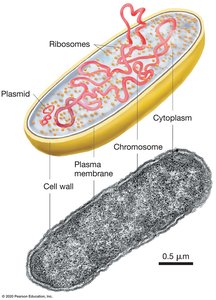
The Chromosome and DNA Organization in Prokaryotes
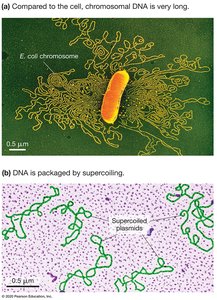
Prokaryotic chromosomes are organized within a region called the nucleoid. The DNA is highly compacted and supercoiled to fit within the small cell volume.
Nucleoid: The area in the cytoplasm where the chromosome is located, not separated by a membrane.
Supercoiling: The process by which DNA is twisted to reduce its volume, allowing the long DNA molecule to fit inside the cell.
Plasmids: These may also be supercoiled and are independent of the main chromosome.
The Cell Wall: A Protective Exoskeleton
The cell wall is a defining feature of most prokaryotes, providing structural support and protection.
Composition: In bacteria, the cell wall is primarily made of peptidoglycan, a complex polysaccharide.
Function: Maintains cell shape, prevents osmotic lysis, and contributes to the cell's rigidity.
External Structures for Movement and Attachment
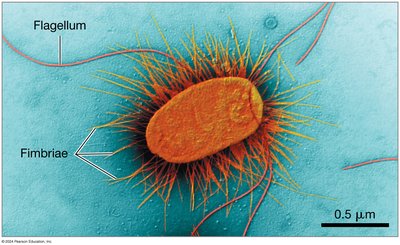
Many prokaryotes possess external appendages that facilitate movement and attachment to surfaces or other cells.
Flagella: Long, whip-like filaments that rotate to propel the cell through liquid environments.
Fimbriae: Short, needle-like projections that enable the cell to adhere to surfaces or other cells, playing a key role in colonization and infection.
Eukaryotic Cell Structures and Their Functions
General Features of Eukaryotic Cells
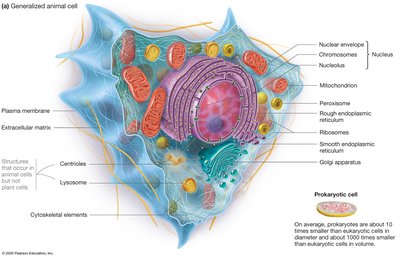
Eukaryotic cells are structurally more complex than prokaryotic cells and include protists, fungi, plants, and animals. They may be unicellular or multicellular and are generally larger than prokaryotic cells.
Size: Eukaryotic cells are typically 10 times larger in diameter and about 1000 times greater in volume than prokaryotic cells.
Organelles: Eukaryotic cells contain membrane-bound organelles, including a nucleus, mitochondria, endoplasmic reticulum, Golgi apparatus, and others.
Cytosol: The fluid portion of the cell, where many metabolic reactions occur.
The Benefits of Organelles and Compartmentalization
Organelles divide the cell's interior into specialized compartments, each with distinct functions. This compartmentalization provides several advantages:
Separation of Incompatible Reactions: Organelles allow different chemical reactions to occur in isolation, preventing interference.
Increased Efficiency: By concentrating substrates and enzymes, organelles enhance the speed and regulation of metabolic processes.
Example: Lysosomes contain digestive enzymes that break down macromolecules, while mitochondria are specialized for ATP production.
Additional info: The presence of organelles is a key evolutionary innovation that enabled the complexity and diversity of eukaryotic life forms.
