 Back
BackInside the Cell: Structure and Function of Prokaryotic and Eukaryotic Cells
Study Guide - Smart Notes
 Tailored notes based on your materials, expanded with key definitions, examples, and context.
Inside the Cell
Overview of Prokaryotic Cells
Prokaryotic cells, which include bacteria and archaea, are characterized by their simple structure and lack of membrane-bound organelles. Despite their simplicity, they possess specialized features that allow them to survive and thrive in diverse environments.
Chromosome Organization: The most prominent structure in a prokaryotic cell is the chromosome, typically a single, circular DNA molecule associated with proteins. This region is called the nucleoid.
Plasmids: Many prokaryotes contain small, circular, supercoiled DNA molecules called plasmids, which often carry genes beneficial for survival.
Cell Wall: Most prokaryotes have a cell wall composed of a tough, fibrous layer that surrounds the plasma membrane, providing shape and rigidity. In bacteria, the primary component is the polysaccharide peptidoglycan.
External Structures: Prokaryotes may have external appendages such as flagella (long filaments for movement) and fimbriae (needle-like projections for attachment to surfaces or other cells).
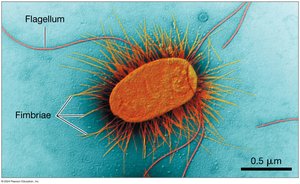
Example: The bacterium Escherichia coli uses flagella for motility and fimbriae to adhere to host tissues.
Eukaryotic Cell Structures and Their Functions
Eukaryotic cells are more complex than prokaryotic cells and include protists, fungi, plants, and animals. They may be unicellular or multicellular and are generally larger than prokaryotic cells.
Organelles: Eukaryotic cells contain membrane-bound compartments called organelles that compartmentalize cellular functions, increasing efficiency and allowing separation of incompatible reactions.
Cytosol: The fluid portion of the cell, where many metabolic reactions occur.
Advantages of Compartmentalization:
Separation of incompatible chemical reactions
Increased efficiency of chemical reactions
Eukaryotic Cell Structure: A Parts List
The Nucleus
The nucleus is a large, highly organized, membrane-bound compartment that stores and transmits genetic information.
Surrounded by a double-membrane nuclear envelope with pore-like openings
Inside surface linked to the nuclear lamina (a lattice of fibrous proteins)
Contains the nucleolus, where ribosomal RNA is synthesized and ribosome subunits are assembled
Ribosomes
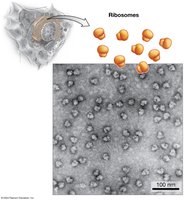
Ribosomes are complex molecular machines responsible for protein synthesis. They are not membrane-bound and can be found free in the cytosol or attached to the endoplasmic reticulum.
Free ribosomes synthesize proteins for use in the cytosol or import into organelles
Ribosomes on the endoplasmic reticulum synthesize proteins destined for secretion or membrane insertion
Endoplasmic Reticulum (ER)
The endoplasmic reticulum (ER) is an extensive membrane-enclosed factory continuous with the nuclear envelope. It has two distinct regions:
Rough ER (RER): Studded with ribosomes; synthesizes proteins for secretion, membrane insertion, or organelle targeting. Proteins are folded and processed in the RER lumen.
Smooth ER (SER): Lacks ribosomes; contains enzymes for lipid synthesis and detoxification. Also serves as a reservoir for ions.
Golgi Apparatus
The Golgi apparatus is a series of stacked, flat, membranous sacs (cisternae) that processes, sorts, and ships proteins from the RER. It has a distinct polarity:
Cis face: Closest to the nucleus; receives products from the RER
Trans face: Oriented toward the plasma membrane; ships products to their final destinations
Materials are transported via membranous vesicles
Lysosomes
Lysosomes are recycling centers found only in animal cells. They contain about 40 different enzymes, called acid hydrolases, specialized for hydrolyzing macromolecules. These enzymes function best at pH 5.0, maintained by proton pumps in the lysosomal membrane.
Lysosomes, Golgi apparatus, and ER together form the endomebrane system, which produces, processes, and transports proteins, carbohydrates, and lipids.
Vacuoles
Vacuoles are prominent organelles in plant, fungal, and some protist cells. They serve as storage centers for water, ions, proteins, pigments, and sometimes noxious compounds for defense.
Peroxisomes
Peroxisomes are globular organelles found in all eukaryotic cells. They are centers for reduction–oxidation (redox) reactions, often producing hydrogen peroxide, which is detoxified by the enzyme catalase.
Mitochondria
Mitochondria are the power-generating stations of the cell, supplying ATP through cellular respiration.
Have two membranes: an outer membrane and a highly folded inner membrane (cristae)
Contain their own DNA (mtDNA) and ribosomes; can grow and divide independently
Chloroplasts
Chloroplasts are found in plant and algal cells and are the site of photosynthesis.
Have three membranes; the innermost contains thylakoids arranged in stacks called grana
Stroma surrounds the thylakoids and contains enzymes for glucose production
Contain their own DNA and ribosomes; support the endosymbiosis theory (origin from free-living bacteria)
Cytoskeleton
The cytoskeleton is an extensive system of protein fibers that provides shape, structural stability, and organization to the cell. It also facilitates intracellular transport and cellular movement.
The Eukaryotic Cell Wall
Fungi, algae, and plants have a stiff outer cell wall, located outside the plasma membrane, providing structural support and protection. Animal cells lack a cell wall but are supported by the extracellular matrix (ECM), a mixture of secreted proteins and polysaccharides.
Cytoskeletal Filaments and Cellular Movement
The cytoskeleton is composed of different types of protein filaments, each with specialized functions:
Actin filaments: Involved in cell shape, movement, and muscle contraction
Microtubules: Serve as tracks for vesicle transport and are essential for chromosome movement during cell division
Intermediate filaments: Provide mechanical strength
Motor Proteins and Vesicle Transport
Motor proteins such as kinesin move vesicles along microtubule tracks, a process that requires ATP hydrolysis.
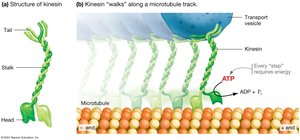
Kinesin has a tail, stalk, and head; the head binds to microtubules and hydrolyzes ATP to "walk" along the track.
This movement is essential for transporting materials within the cell.
Cilia and Flagella
Most eukaryotic cilia and flagella have a characteristic "9 + 2" arrangement of microtubules, called the axoneme (nine doublets surrounding two central microtubules). The axoneme originates from the basal body, which is structurally similar to the centriole and aids in axoneme growth.
Summary Table: Eukaryotic Cell Components
Organelle | Main Function | Key Features |
|---|---|---|
Nucleus | Information storage and processing | Double membrane, nucleolus |
Ribosomes | Protein synthesis | Free or bound to ER, not membrane-bound |
Rough ER | Protein synthesis and processing | Studded with ribosomes |
Smooth ER | Lipid synthesis and detoxification | Lacks ribosomes |
Golgi apparatus | Protein processing, sorting, shipping | Stacked cisternae, cis/trans faces |
Lysosomes | Digestion and recycling | Acid hydrolases, low pH |
Vacuoles | Storage, digestion, recycling | Large in plants/fungi |
Peroxisomes | Redox reactions, detoxification | Contains catalase |
Mitochondria | ATP production | Double membrane, own DNA |
Chloroplasts | Photosynthesis | Three membranes, own DNA |
Cytoskeleton | Structural support, movement | Actin, microtubules, intermediate filaments |
Cell wall/ECM | Support and protection | Cellulose (plants), chitin (fungi), ECM (animals) |
Additional info: The above table summarizes the main eukaryotic cell components, their functions, and distinguishing features for quick review.
